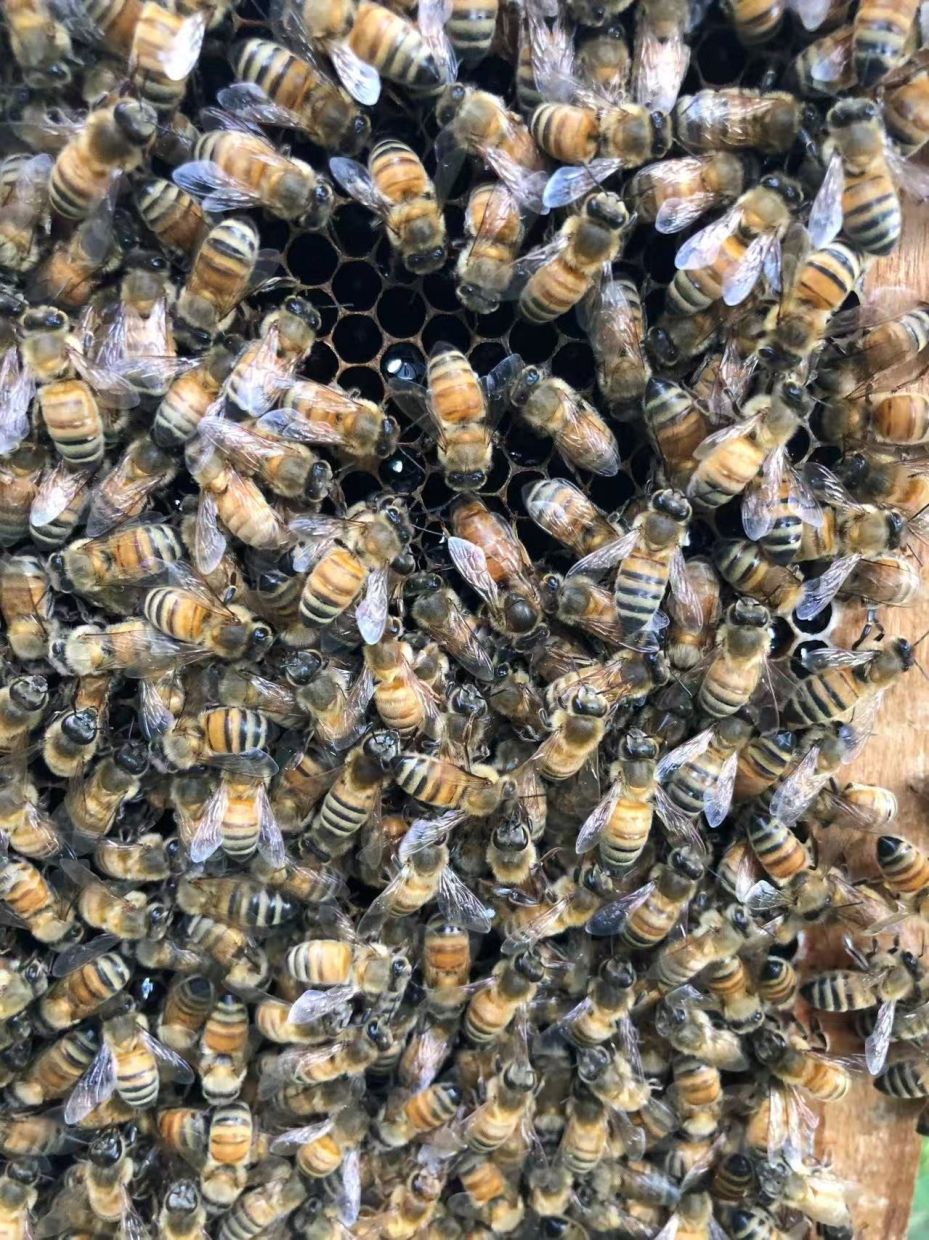
A fundamental discovery about honeybee reproduction is upending decades of scientific orthodoxy. Researchers led by Kai Wang at the Institute of Apicultural Research under the Chinese Academy of Agricultural Sciences have found that the architectural design of a queen's nursery chamber is as vital as the special diet she receives. Their findings, published in Nature, suggest that a honeybee colony functions as a sophisticated collective intelligence, not merely as a sum of individual biological responses. This insight carries implications for beekeepers across Southeast Asia and beyond, where honeybee health directly affects agricultural productivity and food security.
For generations, the prevailing explanation for how a female honeybee becomes a queen rather than a worker has been straightforward: royal jelly. This nutrient-rich secretion produced by worker bees was seen as the singular determining factor. All honeybees, after all, develop from identical fertilised eggs. The future queen receives abundant royal jelly while her sisters, destined to become workers, receive a plainer diet. This notion seemed to account for the profound physical and behavioural differences that emerge. Yet Wang's team has demonstrated that this understanding is incomplete, missing a crucial dimension of how colonies orchestrate the development of their reproductive heart.
The architecture of the queen cell itself emerges as an active rather than passive component in this biological drama. Worker bees construct three distinct chamber types within the hive: ordinary hexagonal cells for food storage and worker rearing, and a third category resembling downward-hanging peanut shells. Beekeepers have long recognised these distinctive structures as signals of impending swarming or queen replacement events, but largely dismissed them as simple containers. The new research repositions these chambers as precisely engineered biological devices—what Wang describes as a "smart incubator." The distinction matters profoundly because it reframes the honeybee colony as an engineering enterprise, where multiple biological systems coordinate to achieve specific developmental outcomes.
The physical properties of royal wax differ markedly from standard honeycomb material. The wax used in queen chambers is notably softer and melts at a higher temperature than worker-cell wax, properties that appear functionally significant rather than incidental. The researchers propose that softer walls permit the developing larva more physical space to expand, a consideration that may sound minor but carries consequences for proper growth. Additionally, this specialised wax releases a distinct chemical signature—what Wang poetically terms a "perfume"—that permeates the larval environment. These chemical and tactile cues apparently function as hormonal triggers, communicating developmental instructions that shape the larva's trajectory toward queenship. When larvae were experimentally exposed to standard worker-cell wax despite receiving abundant royal jelly, development suffered dramatically, with substantially elevated mortality rates. This evidence strongly suggests that the sensory experience of the chamber itself—its smell and texture—proves essential for survival and transformation.
The worker bees constructing these royal chambers undertake a physiological ordeal that underscores the collective sacrifice embedded in queen production. During construction, these young females generate unusually elevated temperatures within their thoraxes, heating the tissues to over 39 degrees Celsius—a fever-like state that enables them to manipulate and shape the high-melting-point wax. Wang describes them as "tiny living furnaces," a metaphor that captures the metabolic intensity required. Simultaneously, gene expression patterns in these builder-bees shift distinctly, facilitating the biological process of wax secretion and processing. Yet these specialised workers remain fundamentally ordinary bees undertaking temporary roles rather than members of a permanently differentiated caste. Their extraordinary contributions persist only for the duration of this emergency task, after which they resume routine hive duties—sharing food with nestmates, inspecting cells, and maintaining colony welfare. This flexibility reveals honeybee societies as dynamically responsive to internal needs rather than rigidly determined by genetics.
The implications for understanding social insect biology extend well beyond honeybees themselves. Wang suggests that similar architectural engineering may underlie development in termite colonies and wasp nests, where the physical structure of communal spaces might actively guide developmental pathways in ways previously attributed solely to chemical or nutritional factors. Stingless bees, abundant across tropical regions including Malaysia and Indonesia, construct intricate wax nests whose hidden functions may parallel those discovered in western honeybees. This possibility opens new research directions for understanding how eusocial insects—those displaying reproductive specialisation and collective care—maintain their extraordinary organisational complexity. The finding that structure itself carries developmental significance challenges reductionist approaches that isolate single causal factors, instead suggesting that biology operates through integrated systems where multiple modalities reinforce each other.
Practical applications emerge directly from these theoretical advances. Boris Baer, professor of pollinator health at the University of California, Riverside and co-leader of the study, emphasises that modern beekeeping depends critically on queen production. Healthy, vigorous queens are essential for maintaining strong colonies capable of surviving environmental stresses and disease pressures. As beekeepers in the United States, Europe, and increasingly in developing economies report alarming colony losses, understanding the natural mechanisms that produce high-quality queens becomes strategically important. By decoding the precise molecular switches that activate royal development—the specific chemical compounds or physical cues that instruct a larva's genetics to embrace queenship—researchers may eventually enable beekeepers to replicate these conditions artificially or enhance them through selective breeding. Such advances could support more resilient honeybee populations precisely when agricultural systems most urgently require reliable pollination.
For Malaysia and the broader Southeast Asian region, this research carries direct relevance. Managed honeybees pollinate more than 80 major agricultural crops globally, sustaining production of fruits, vegetables, oilseeds, and protein sources that underpin food security and rural livelihoods. Malaysian agriculture depends substantially on both native stingless bees and introduced honeybee species, yet beekeeping remains vulnerable to disease, environmental degradation, and queen failures. A deeper understanding of natural queen development processes may eventually enable Malaysian beekeepers to maintain healthier colonies with greater self-sufficiency, reducing dependency on imported queens and queens from uncertain sources. This could strengthen the economic viability of beekeeping as a livelihood option, particularly for smallholders and rural communities.
The philosophical significance of this discovery resonates equally with its scientific merit. Wang's characterisation of the honeybee colony as a "superorganism"—a collective entity that transcends the sum of its individual members—gains empirical grounding through this research. The notion that worker bees collectively shape an ordinary larva into their future mother, through coordinated provision of both chemical nutrition and precisely engineered physical environment, illustrates how social insects achieve their remarkable accomplishments. As Wang concludes with striking simplicity: "Eating well is important, but living in the perfect home is what truly changes your destiny." This observation, drawn from the microscopic world of insects, carries metaphorical weight for human societies contemplating their own collective choices. The honeybee colony demonstrates that individual potential unfolds not in isolation but within contexts shaped by communal effort. The next phase of research will pursue the molecular specifics—identifying the exact chemical compounds or tactile stimuli that communicate queenship to the developing larva's genes. This granular investigation may ultimately reveal whether artificial replication becomes possible, or whether the collective intelligence of the hive remains irreducibly complex.