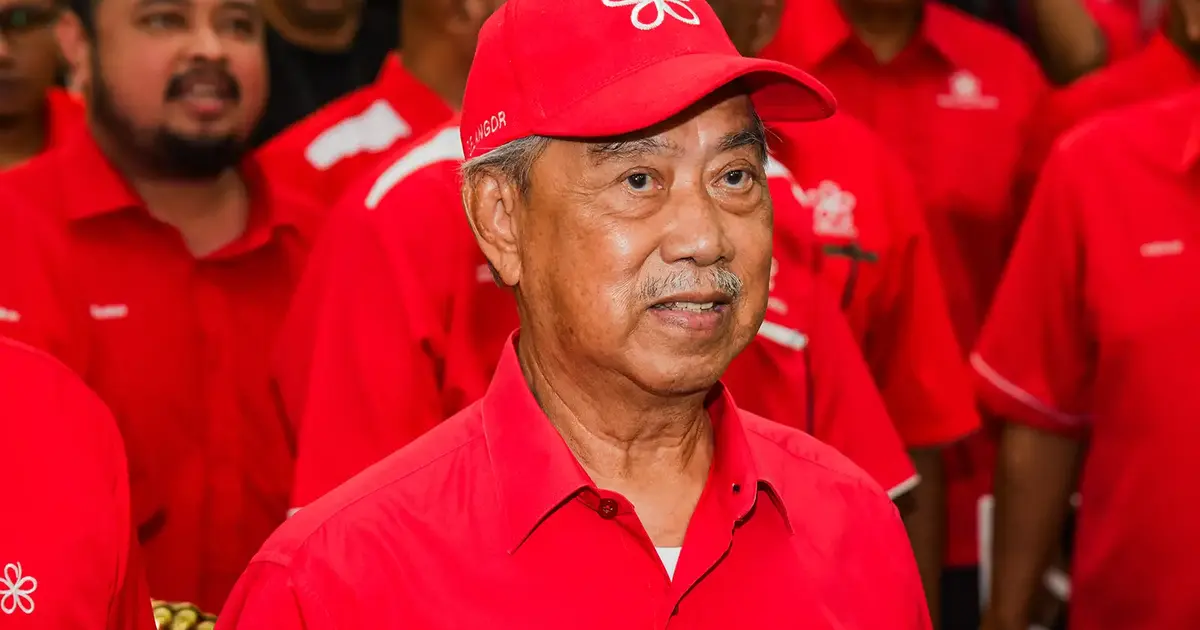
Bersatu president Muhyiddin Yassin has expressed confidence that his party possesses the capacity to draw meaningful support from non-Malay communities without depending on partnership with PAS, signalling a strategic recalibration in the party's political positioning ahead of potential electoral contests. The statement reflects Bersatu's evolving calculations as it navigates the fractured landscape of Malaysian coalition politics, where maintaining multiethnic appeal has become increasingly crucial to electoral viability.
Muhyiddin's assertion directly addresses a longstanding vulnerability that has constrained Bersatu's appeal among Chinese and Indian voters throughout its existence as an independent political entity. By pinpointing the disconnect between voter sentiment and PAS's particular brand of Islamic-oriented politics, the Bersatu leader has articulated what opposition strategists and political analysts have long observed: that non-Malay electorates harbour reservations about political frameworks they perceive as ethno-religious in emphasis rather than multiracial in substance.
The timing of Muhyiddin's comments carries particular significance given the evolving state of Malay-Muslim politics in Malaysia. The relationship between Bersatu and PAS has historically complicated the former's message to moderate and non-Malay constituencies, creating an association that proved difficult to shed despite Bersatu's positioning as distinct from its more conservative coalition partner. This perception problem intensified whenever the two parties collaborated on policy initiatives or campaigned jointly, inadvertently reinforcing impressions that Bersatu operated within ideological parameters defined by PAS rather than charting an independent centrist course.
From a strategic standpoint, Bersatu's pursuit of broader non-Malay support reflects recognition that electoral mathematics in contemporary Malaysia increasingly reward parties capable of transcending narrow communal constituencies. The 2022 general election and subsequent state contests demonstrated that voters across all communities were increasingly willing to punish parties perceived as narrow in appeal or exclusionary in governance philosophy. A party framework that succeeds in broadening its tent while maintaining Malay-Muslim confidence represents the electoral sweet spot that competing coalitions now actively pursue.
Historically, Bersatu has struggled to establish itself as a credible vehicle for non-Malay political representation despite periodic outreach efforts and policy commitments to multiracial governance. This weakness stemmed partly from structural factors—the party emerged from Malay political circumstances and leadership drawn predominantly from Malay backgrounds—but was substantially compounded by the perceived influence of PAS within allied political structures. Many non-Malay voters made electoral choices based not on individual party credentials but on coalition-level assessments that weighted PAS's public positioning heavily in their calculations.
Muhyiddin's confidence statement also implicitly acknowledges that Bersatu possesses policy platforms and governance narratives potentially attractive to non-Malay communities if unencumbered by association with more conservative political forces. The party has articulated positions on economic development, meritocracy, and secular institutional governance that theoretically resonate with moderate voters across ethnic lines. However, these messages have historically been drowned out or reinterpreted through the lens of coalition partnerships that emphasised Islamic governance frameworks and communal political prioritisation.
For Malaysian political observers, this development signals potential fragmentation within Malay-Muslim political alignments that have remained relatively stable in recent years. If Bersatu genuinely pursues non-Malay voter outreach as an independent strategic priority rather than a supplementary coalition requirement, the party may reshape expectations about how major political blocs organise themselves. This could create space for new coalition configurations that prioritise moderate, developmentalist politics over identity-based polarisation—a shift that would reverberate across Malaysia's entire political ecosystem.
The practical implications for non-Malay communities merit careful consideration. Bersatu's ability to authentically expand its support base depends not merely on distancing from PAS rhetorically but on demonstrating sustained commitment to policies and institutional practices that serve non-Malay interests. Whether the party can translate Muhyiddin's public assertions into concrete political outcomes remains an open question that will likely be tested in upcoming electoral cycles. Voters across all communities have developed considerable scepticism toward merely symbolic gestures of inclusivity that evaporate once electoral objectives are achieved.
Regionally, developments within Malaysian political coalitions influence broader Southeast Asian dynamics around majority-Muslim nations navigating pluralist governance frameworks. Malaysia's trajectory—whether toward consolidating identity-based political sorting or developing more inclusive cross-communal political vehicles—carries implications for how other societies in the region structure multiracial democracy. Bersatu's strategic repositioning thus reflects not merely internal Malaysian calculations but engages with substantive regional questions about the viability of moderate, developmentalist political models.
As Malaysian politics enters its next chapter, the credibility of Muhyiddin's confidence about Bersatu's independent appeal to non-Malay voters will be definitively tested through electoral performance rather than rhetorical claims. The statement itself signals that Malaysian political calculations are shifting, with parties reconsidering alliance structures and constituency strategies in response to evolving voter preferences that reward genuine multiracial politics over narrow communal coalitions. Whether Bersatu can successfully execute this repositioning while maintaining Malay-Muslim support remains among the more consequential questions for Malaysian political development.

