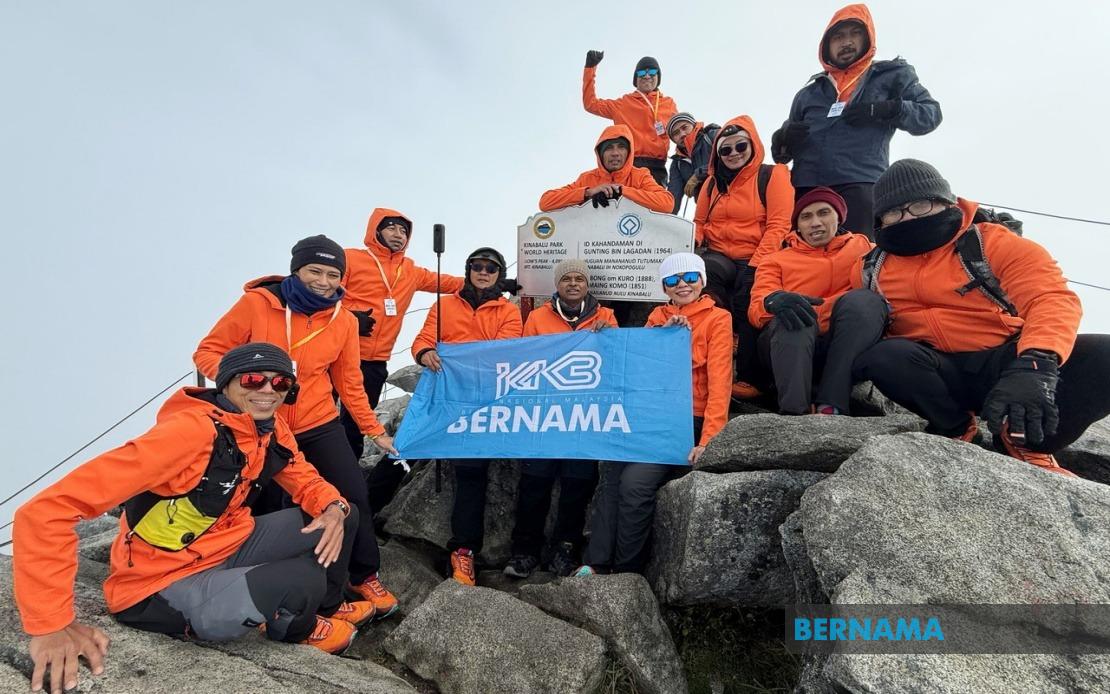
Malaysia's national news agency achieved a significant organisational milestone on July 1 when 23 Bernama staff members summited Mount Kinabalu, Southeast Asia's highest peak, as a centrepiece event marking the National Journalists' Day (HAWANA) 2026 celebration. The expedition, which included reporters, photographers, sub-editors, television crew members, and administrative personnel, underscores the growing emphasis within Malaysian media organisations on building institutional cohesion through challenging team endeavours.
Edior-in-Chief Arul Rajoo Durar Raj spearheaded the expedition, which intentionally pursued dual recognition from the Malaysia Book of Records. The agency aims to establish itself as the largest contingent from a single media organisation to reach Mount Kinabalu's summit, whilst simultaneously targeting recognition as the first news organisation to produce multilingual reporting—specifically in four languages—directly from the mountain's 4,095.2-metre peak. This dual-pronged record-seeking approach demonstrates how contemporary news organisations are leveraging landmark events to gain institutional visibility beyond their conventional journalistic output.
The physical achievement itself proved noteworthy given the prevailing conditions. The climbing party departed Timpohon Gate at 10 am on June 30, with climbers resting overnight at Panalaban before resuming their final push at 2.30 am. The summit was reached at approximately 7.20 am on July 1, with the team navigating challenging weather including rainfall, dense mist, and powerful winds throughout the ascent. Such meteorological obstacles are routine challenges on Mount Kinabalu, where rapid weather deterioration can force retreats or create dangerous conditions, making the successful summit completion a genuine accomplishment rather than a ceremonial gesture.
For Arul Rajoo personally, the achievement carried additional significance. He became the first Bernama Editor-in-Chief to successfully summit Mount Kinabalu, a distinction that reflects both the demanding nature of the climb and the historical evolution of the organisation's leadership. This personal milestone adds a human dimension to the institutional narrative, highlighting how senior figures within Malaysian media institutions are increasingly willing to participate directly in physically demanding activities rather than remaining office-bound.
The expedition was organised through the Bernama Staff Club (KKB), marking the first instance that the agency has mobilised such a large-scale mountaineering venture. Beyond the record-chasing objectives, organisers framed the climb as serving multiple institutional purposes: reinvigorating HAWANA celebrations, fostering workplace cohesion, building physical and mental resilience among staff, and promoting healthier lifestyles within the newsroom. These aims reflect broader global trends in which media organisations increasingly recognise the correlation between employee wellness initiatives and workplace productivity.
Logistical and financial support came from an extensive network of commercial partners, revealing how Malaysian event organisers increasingly rely on corporate sponsorship to underwrite ambitious projects. International sportswear brand BMAI, regional airline Batik Air, and beverage manufacturer 100PLUS provided primary backing, whilst secondary support came from EHH Food Industry Sdn Bhd, Saloma Bistro, Malaysia Airports, Malaysia Insight, UFL, Sabah Parks, and Marathon Baker. This diversified sponsorship portfolio suggests that corporate entities view association with news-media initiatives and wellness activities as valuable brand-positioning opportunities.
Mount Kinabalu itself carries substantial cultural and environmental significance within Malaysian identity and Southeast Asian geography. Rising from within Kinabalu Park—a 754-square-kilometre protected area—the mountain holds designation as a UNESCO World Heritage Site and forms the centrepiece of the Kinabalu UNESCO Global Geopark (KUGGp). This layered protection reflects international recognition of the peak's geological importance and biodiversity value, meaning that any large-scale human activity on the mountain occurs within a carefully managed conservation framework. The mountain's status adds symbolic weight to Bernama's expedition, positioning the news agency's achievement within broader conversations about Malaysian environmental stewardship and sustainable tourism.
The HAWANA 2026 celebration itself provides important context for understanding why Bernama selected such a physically demanding activity as the centrepiece of its commemoration. HAWANA—the national journalists' day—traditionally emphasises the profession's role in society, journalistic ethics, and press freedom. By combining this observance with a physically arduous collective endeavour, Bernama positioned journalism not merely as an intellectual pursuit but as a profession requiring resilience, teamwork, and physical fortitude. This framing may resonate particularly within Malaysian media circles, where institutional pride and professional identity remain important concerns.
The expedition's emphasis on producing news content in four languages from the mountain's summit distinguishes this initiative from conventional mountaineering achievements by other organisations. By integrating journalistic output into the climbing experience itself, Bernama transformed what might otherwise be simply a staff wellness activity into a demonstration of the agency's multilingual capabilities and commitment to serving diverse Malaysian and Southeast Asian audiences. The specific focus on four-language reporting underscores Malaysia's linguistic diversity and reflects the complex media landscape in which Bernama operates.
This endeavour invites reflection on contemporary trends within Malaysian media institutions. Large-scale organisational initiatives combining institutional celebration, employee wellness, environmental engagement, and record-seeking represent a notable departure from traditional journalism-focused activities. The success of Bernama's Mount Kinabalu expedition may well inspire similar initiatives among other Malaysian media organisations, potentially establishing a new category of institutional activities that merge journalistic purpose with team building and personal challenge. Such developments suggest that Malaysian news organisations increasingly perceive their role as extending beyond newsroom output to encompass broader institutional and social responsibilities.

