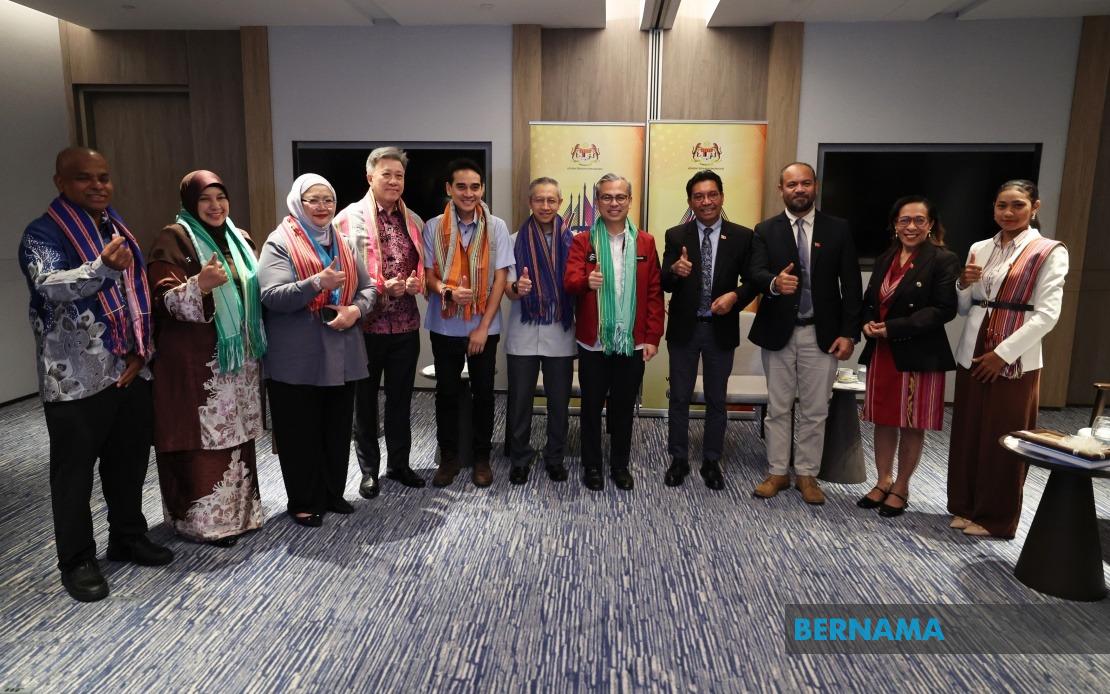
The Malaysian National News Agency Bernama and Timor-Leste's Agência Noticiosa de Timor-Leste (TATOLI) have formalized a strategic partnership through a memorandum of understanding, marking a significant step toward strengthening media ties across Southeast Asia. The agreement was officially sealed during the National Journalists' Day (HAWANA) 2026 celebrations in Butterworth, with Communication Minister Datuk Fahmi Fadzil and Timor-Leste's Secretary of State for Social Communication Expedito Loro Dias Ximenes overseeing the exchange, while Prime Minister Datuk Seri Anwar Ibrahim witnessed the historic moment.
The collaboration encompasses multiple dimensions of journalistic cooperation that extend beyond simple news distribution. Bernama Chief Executive Officer Datin Paduka Nur-ul Afida Kamaludin outlined how the partnership will facilitate comprehensive sharing of news content, photographs, and multimedia materials, complemented by structured training programs and professional journalism courses for TATOLI staff. This multifaceted approach reflects recognition that sustainable media cooperation requires investment in human capital alongside content exchange, positioning both agencies to strengthen their operational capabilities and editorial standards.
Timor-Leste's accession to ASEAN as the 11th member state in October 2025 catalyzed this initiative, creating an opportune moment for regional media institutions to deepen their integration. The timing demonstrates how geopolitical developments within ASEAN create concrete pathways for institutional collaboration, enabling newer members to rapidly establish working relationships with established regional players. For Malaysia, the partnership reinforces its soft power position within the bloc by positioning Bernama as a training hub and knowledge-sharing partner for fellow ASEAN news agencies.
One of the partnership's most tangible benefits involves the multilingual dissemination strategy already taking shape. Bernama news will be broadcast through TATOLI's platforms in four languages—Tetum, Portuguese, Bahasa Indonesia, and English—making Malaysian reporting accessible to Timorese audiences in their preferred language of consumption. This linguistic accessibility proves particularly significant for Timor-Leste, where Portuguese remains an official language reflecting the nation's colonial heritage, and Indonesian serves as a widely understood regional lingua franca. The arrangement thus bridges cultural and linguistic divides that typically fragment information flows across the archipelago.
Bernama's current multilingual capabilities already span six languages including Bahasa Melayu, English, Tamil, Mandarin, Arabic, and Spanish, representing decades of investment in regional and global outreach. However, the TATOLI partnership has prompted Bernama to consider adding Portuguese to its language portfolio, a decision that signals how bilateral media agreements can drive operational innovation. Such expansion would enable Malaysian news to penetrate Lusophone markets across Africa and beyond, leveraging Timor-Leste's unique position as a bridge between Southeast Asia and Portuguese-speaking communities worldwide. This linguistic diversification strategy reflects a broader evolution in how national news agencies maintain relevance in an increasingly multipolar information ecosystem.
The training component addresses a critical gap in Timor-Leste's media development. Cohorts of TATOLI reporters are scheduled to undergo professional development at Bernama before year's end, gaining exposure to advanced techniques across multiple platforms. Bernama's institutional expertise spans digital media production, television broadcasting, radio journalism, photography, and online news platforms, with specialized teaching staff available to mentor international colleagues. This knowledge transfer proves particularly valuable for TATOLI, which was only established in 2016 and operates with fewer than two decades of institutional memory compared to Bernama's fifty-seven-year track record.
Bernama's Journalism Excellence Centre and dedicated School of Journalism provide the institutional infrastructure supporting this training mission. The agency's two decades of conducting specialized training programs demonstrate sustained capacity in professional development delivery, ensuring that TATOLI participants receive instruction grounded in proven pedagogical approaches rather than ad hoc mentoring. Such structured training generates long-term benefits by building TATOLI's internal capacity to eventually train its own journalists, creating a multiplier effect across Timor-Leste's broader media ecosystem.
TATOLI President Noémio Mateus Soares Falcão emphasized how the partnership addresses contemporary challenges confronting all regional news agencies. In an era of rapid digital information circulation across social media platforms, maintaining journalistic integrity and verifying facts becomes increasingly difficult yet more essential than ever. Falcão articulated TATOLI's commitment to promoting press freedom, adhering to journalistic ethics, and ensuring public access to accurate information—values that both agencies recognize as foundational to healthy democratic societies. This shared normative foundation provides the ethical grounding for practical cooperation, ensuring both partners work toward common professional standards rather than divergent editorial agendas.
The broader context reveals how established institutions like Bernama can leverage their experience to strengthen peer agencies across ASEAN. Rather than competing for audience attention or political influence, the two news agencies instead pursue complementary roles: Bernama amplifies Malaysian perspectives through TATOLI's distribution channels while TATOLI gains professional capacity and technical knowledge from a more seasoned counterpart. This mutually beneficial arrangement demonstrates how ASEAN's principle of non-interference and respect for sovereignty can coexist with practical institutional cooperation.
The HAWANA 2026 celebration itself attracted additional regional participation, with representatives from Cambodia and Laos attending alongside media practitioners from across Southeast Asia. This broader assembly suggests that ASEAN-wide media coordination represents an emerging priority across the bloc, with multiple governments recognizing that stronger institutional links among national news agencies serve collective regional interests. Cambodia's presence through its Undersecretary of State at the Ministry of Information and Laos' involvement through the Ministry of Technology and Communications indicate how media cooperation fits within larger regional governance frameworks.
For Malaysian readers and businesses, this partnership carries several implications. Enhanced visibility of Malaysian news through TATOLI platforms could promote Malaysia's diplomatic interests and commercial opportunities in Timor-Leste, while Bernama's expanded language offerings position Malaysian journalism for greater influence in emerging markets. The initiative also showcases Malaysia's institutional strength in media management, potentially attracting partnerships from other regional governments seeking similar capacity-building arrangements. As ASEAN becomes increasingly important geopolitically, controlling and shaping the narrative about regional developments through coordinated media cooperation becomes strategically valuable.
Looking forward, the TATOLI-Bernama model may establish a template for other ASEAN media partnerships. The agreement demonstrates that bilateral cooperation between national news agencies need not involve direct editorial control or political bias, instead focusing on practical skill-sharing and content distribution that benefits all parties while maintaining professional independence. As newer ASEAN members develop their media institutions, established agencies like Bernama can position themselves as preferred training partners and technology providers, further cementing Malaysia's influence within regional governance structures while contributing meaningfully to press freedom and journalistic standards across Southeast Asia.