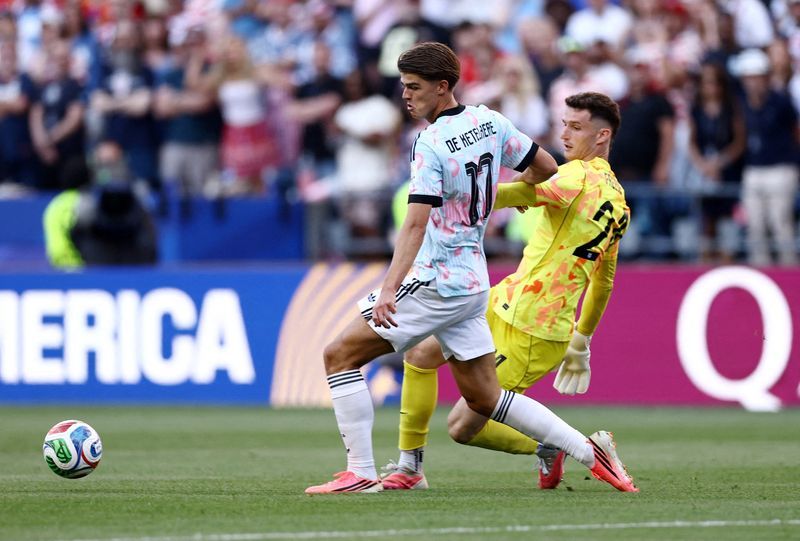
Belgium's resurgence at the World Cup has come through an unconventional and risky decision by coach Rudi Garcia to sideline his most celebrated players in the Round of 16 encounter against co-hosts the United States, a move that yielded immediate and convincing results with a 4-1 victory in Atlanta. The Belgian side, which had stuttered through the group stage and nearly exited at the hands of Senegal, suddenly found a cohesion and attacking verve that had eluded them throughout the tournament, leaving observers and doubters alike reassessing their championship credentials ahead of a quarter-final showdown with Spain.
The road to this turning point had been precarious for the European powerhouse. Belgium limped through their opening matches with two draws before recovering with a comprehensive 5-1 defeat of New Zealand, a result that secured their progression to the knockout stages but masked deeper concerns about their playing style and team balance. More alarmingly, their Round of 16 encounter with Senegal saw them staring at elimination, having conceded two goals with merely five minutes remaining before a late penalty in extra time granted them an unlikely reprieve and passage to the next round.
Faced with mounting pressure and tactical questions, Garcia made the bold decision to substantially reshape his starting eleven for the American showdown. Kevin De Bruyne, whose creative brilliance has long defined Belgium's midfield and whose leadership has been central to their identity for years, was consigned to the bench and ultimately did not appear in the match. Romelu Lukaku, the nation's centre-forward and goal-scoring pillar, was similarly dropped, as was Jeremy Doku, the dynamic attacking midfielder. In their place, Garcia introduced Nicolas Raskin and Amadou Onana to buttress the midfield, brought Dodi Lukebakio into the attack, and repositioned Charles De Ketelaere into a central forward role that would prove transformative.
Garcia's rationale for these selections centred on observable factors during training and a precise understanding of how he wished his team to execute tactically against the Americans. Speaking before the match, the Belgian coach acknowledged that he had maintained uncertainty about his lineup until mere hours before kickoff, yet he carried absolute clarity regarding his strategic intent. When Belgium opened the scoring, the original plan to introduce De Bruyne as a substitute option became redundant, and Garcia chose to trust the system he had established rather than revert to familiar patterns of dependence on his most celebrated midfielder.
De Ketelaere's new positioning proved immediately productive, with the attacking midfielder scoring twice in the first half to establish Belgian dominance and set the foundation for their most impressive tournament performance to date. The restructured setup allowed Belgium to control the pace and rhythm of the encounter from its inception, with captain Youri Tielemans operating in an advanced role that enabled the midfield to consistently win contested balls and reclaim possession at a tempo that overwhelmed the American resistance. The tactical adjustment also permitted Belgium to exploit the width of the pitch, exposing the defensive fragility and organisational brittleness of a United States side that appeared overmatched and lacking any coherent means to counter the Belgian approach.
The American team, despite enjoying home advantage in Atlanta, appeared listless and without tactical solutions, struggling to contain Belgium's fluid movement and pressing intensity. The host nation's defence, characterised as brittle and immobile, had no answer to the waves of Belgian attacks funnelled through multiple channels, particularly down the flanks where space was persistently found and exploited. What unfolded was a comprehensive footballing lesson in which the Belgians demonstrated superior organisation, movement and execution, vindicating Garcia's controversial selection gamble in the most emphatic manner possible.
Notably, the loss of Amadou Onana to a knee injury sustained in the first half could have derailed Belgium's ascendant trajectory, yet the team adapted seamlessly to this setback. Garcia's decision to deploy Hans Vanaken, the 33-year-old midfielder, in Onana's defensive position proved prescient and productive. Vanaken's physical presence and positional intelligence allowed Belgium to maintain their structural integrity whilst actually enhancing their attacking potential, with the veteran midfielder even adding his name to the scoreline—a moment Garcia remarked upon with particular satisfaction, recognising the symbolic value of an experienced player who had not always received consistent national team recognition scoring on football's grandest stage.
Belgium's unexpected tactical revolution addresses a deeper narrative concerning the evolution of modern football and the tension between established hierarchies and tactical flexibility. For years, Belgian football had constructed its competitive approach around De Bruyne's exceptional technical capacity and playmaking range, building elaborate systems designed to maximise his influence. Garcia's willingness to dispense with this orthodoxy suggests an emerging recognition that rigidity in team construction can become a liability, particularly in knockout football where opponents study and prepare specific countermeasures. By demonstrating that alternative configurations could produce superior results, Garcia has offered a blueprint that challenges conventional assumptions about the indispensability of marquee players.
The implications of this performance extend throughout the remaining tournament. Belgium had entered the Round of 16 widely perceived as vulnerable and potentially overmatched, their status as traditional contenders undermined by uneven group-stage performances and a fortunate progression. The emphatic dismissal of the Americans fundamentally reshapes perceptions of their competitive standing and has elevated their trajectory from survival to serious championship consideration. Their quarter-final appointment with Spain, a technically refined side that has impressed throughout the tournament, now represents a genuine meeting of serious contenders rather than a mismatch favouring the Iberian team.
Garcia's tactical adjustments also carry psychological significance for a Belgian squad that had grown accustomed to adversity and near-catastrophe. The confidence generated by a dominant, comprehensive victory over a traditionally strong opponent provides intangible advantages as the tournament intensifies and margins of success narrow. Additionally, the successful deployment of previously peripheral players like De Ketelaere in his new role opens strategic options for future matches, as Garcia can now rotate and adjust his approach with confidence born from evidence rather than speculation.
The broader question animating Belgium's tournament trajectory concerns sustainability and whether Garcia's tactical innovation represents a durable framework or a matchday aberration. Spain will present fundamentally different challenges than the athletically dynamic but tactically disorganised Americans, with greater technical proficiency and defensive organisation likely requiring Belgian refinement rather than replication. Nonetheless, the Round of 16 victory has conclusively demonstrated that Belgium possesses tactical flexibility and can compete at the highest level through unconventional means, transforming their World Cup narrative from one of managed decline to one of potential renaissance.

