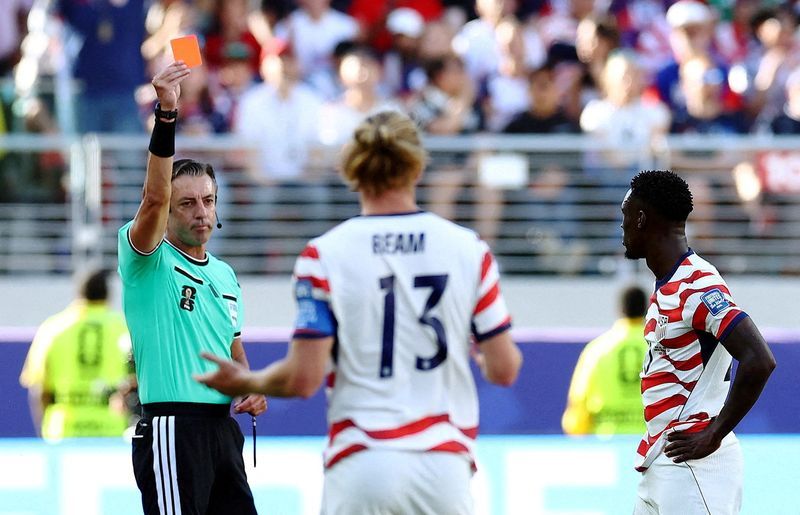
An extraordinary diplomatic row has engulfed world football after FIFA reversed a disciplinary suspension on a key American striker following direct pressure from US President Donald Trump on FIFA President Gianni Infantino. The decision to clear striker Folarin Balogun for competition has prompted sharp criticism from Belgium's government and public ahead of Monday's last-16 World Cup encounter in Seattle, raising unprecedented questions about the integrity of FIFA's disciplinary framework and the appropriate limits of political influence on international sport.
The red-card suspension, which would have sidelined Balogun from the crucial knockout stage, was initially upheld under FIFA's standard procedures. However, Trump's personal intervention with Infantino fundamentally altered the course of the disciplinary process, prompting FIFA to reconsider and ultimately reverse its earlier determination. This extraordinary reversal marks a dramatic departure from established protocols governing player discipline at World Cup tournaments and has exposed fault lines within FIFA's governance structure regarding how political figures can shape outcomes in competitive sport.
Belgian responses have been swift and pointed. Citizens interviewed in Brussels voiced deep frustration at what they perceive as a systemic violation of sporting principles. One Brussels resident articulated the broader concern: questioning how referees' decisions—the foundational element of any match—could be nullified through administrative intervention. The logical inconsistency troubled many Belgians: if a referee issued a red card for serious misconduct during play, what mechanism suddenly renders that judgment invalid? The decision appeared to undermine not merely individual discipline but the entire architecture upon which fair competition rests.
Belgium's Deputy Prime Minister Maxime Prevot escalated the issue into official government territory, issuing a formal statement characterizing the situation as fundamentally incompatible with sporting governance. Prevot's language—describing the decision as "flouting the most basic rules of football and sport"—reflected governmental concern that FIFA's credibility had suffered material damage. The statement represented more than diplomatic disappointment; it signalled that Belgium viewed the matter as touching upon principles of fair play that extend beyond a single tournament outcome.
The intensity of public sentiment in Belgium reflects deeper anxieties about power imbalances within international sport. Citizens recognized that smaller nations competing against major powers traditionally possess fewer channels through which to exert pressure on governing bodies. Trump's successful direct appeal to FIFA's leadership appeared to exemplify this disparity, prompting concerns among Belgians about whether competitive outcomes might increasingly depend upon political connections rather than athletic performance. One resident suggested the team channel such frustration into heightened motivation, though the underlying resentment remained evident.
The US Embassy in Brussels moved quickly to manage diplomatic damage, with Ambassador Bill White issuing an Instagram denial that Trump had engaged in improper interference. White's statement claimed Trump merely expressed gratitude to FIFA after the decision had been reached, positioning the president's involvement as post-hoc appreciation rather than causative intervention. This framing attempted to separate Trump's actions from the disciplinary reversal, though the timeline and sequence of events suggested otherwise to skeptical observers.
For Southeast Asian football analysts and observers, this episode carries particular significance as it illuminates how traditional power structures manifest within international sporting governance. Smaller nations throughout the region often navigate complex relationships with larger powers across multiple domains, and FIFA's apparent susceptibility to political pressure from major actors demonstrates vulnerabilities that extend far beyond this specific case. The precedent—that a sitting president could successfully lobby for reconsideration of competitive discipline—potentially reshapes expectations around FIFA's autonomy and impartiality.
The suspension of Balogun's ban represents not merely a technical disciplinary matter but a watershed moment in how international sport accommodates political influence. FIFA's founding principles emphasize independence from governmental interference, yet this incident suggests those principles may bend under sufficient political weight. For Malaysian and other regional observers monitoring FIFA's trajectory, the question becomes whether this intervention signals a new era wherein major powers openly pursue competitive advantage through political channels, fundamentally altering the operational environment within which all nations compete.
The World Cup represents sport's premier competitive stage, where smaller nations historically capture global attention through athletic excellence precisely because formal rules ostensibly apply equally regardless of political weight. Belgium's protest articulates this foundational concern: that FIFA's decision threatens to introduce arbitrary political considerations into what should remain a purely sporting domain. As the Belgium-US match approaches, the disciplinary reversal overshadows the sporting contest itself, with many Belgians viewing the pitch as the venue where their nation might restore integrity that administrative corridors have compromised.

