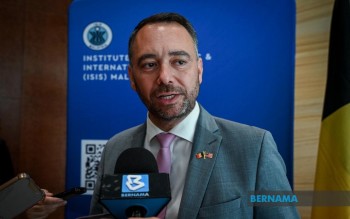
Belgium's Deputy Prime Minister and Foreign Affairs Minister Maxime Prévot has identified offshore energy as a flagship area for expanded bilateral cooperation with Malaysia, positioning renewable power generation as a cornerstone of deepening ties between the two nations. Speaking during his inaugural visit to Malaysia since taking office in February 2025, Prévot outlined a vision where Belgium's considerable expertise in offshore wind development could directly benefit Malaysia's pursuit of cleaner energy infrastructure. The proposal emerged during discussions at the 39th Asia-Pacific Roundtable in Kuala Lumpur, a gathering that brought together regional and international policymakers focused on strategic partnerships and development trajectories across the Indo-Pacific.
Belgium's credentials in offshore energy are substantial despite the country's modest geographical footprint. Despite controlling only 60 kilometres of coastline, the Belgian coast has been transformed into a hub for renewable electricity generation. Currently, offshore wind installations deliver two gigawatts of power to the national grid, a figure that underscores the efficiency and scalability of such projects even in spatially constrained environments. The government has announced ambitious expansion plans, targeting capacity of between six and seven gigawatts within the coming years—a level of generation equivalent to the output of five to seven conventional nuclear power plants. This trajectory demonstrates Belgium's serious commitment to decarbonisation and energy independence, objectives that resonate strongly with Malaysia's own renewable energy targets.
Prospects for cooperation extend well beyond the offshore wind sector alone. Prévot identified semiconductors, logistics infrastructure, clinical trials facilitation, biotechnology research and development, and pharmaceutical manufacturing as complementary domains where Belgium and Malaysia could forge productive partnerships. This broader framing suggests that energy collaboration would form part of a more comprehensive economic relationship encompassing high-value manufacturing and life sciences sectors. For Malaysian policymakers, the Belgian approach offers a template for diversifying bilateral engagement beyond traditional trade relationships into knowledge-intensive and technology-driven domains.
The European Union's financial backing significantly amplifies the attractiveness of these collaborative proposals. During his ministerial address at the forum, Prévot announced that the EU and its constituent member states intend to mobilise €10 billion under the Global Gateway Strategy specifically to support the ASEAN Power Grid and facilitate the region's broader energy transition. At current exchange rates, this commitment translates to approximately RM46.5 billion in available financing. The scale of this pledge underscores Europe's conviction that Southeast Asia's energy future matters strategically and that sustainable infrastructure development in the region serves mutual long-term interests. The Global Gateway Initiative represents a deliberate European strategy to compete with alternative sources of development finance while anchoring Southeast Asian economies within frameworks emphasizing environmental sustainability and transparent governance.
Prévot framed this financial commitment as reflecting genuine European conviction that sustainable development must be locally beneficial and anchored in the priorities of recipient nations. The emphasis on long-term, locally embedded development contrasts with some alternative financing models and suggests a European approach prioritizing capacity-building and technology transfer alongside capital provision. By supporting interconnected power systems across ASEAN, the EU aims to strengthen regional energy resilience while enabling individual member states to optimize their renewable energy portfolios. For Malaysia specifically, participation in an expanded ASEAN Power Grid could allow the country to export surplus renewable generation to neighbouring markets while importing power during periods of lower domestic renewable availability.
The strategic logic binding energy transition to broader regional resilience reflects recognition that decarbonisation and geopolitical stability are interdependent objectives. Prévot emphasized that by aligning strategies, Europe and ASEAN could simultaneously pursue sustainable economic growth while buttressing regional resilience against external shocks and internal vulnerabilities. Accelerating the clean energy transition across Southeast Asia reduces the region's exposure to volatile fossil fuel markets and creates self-sufficiency in a critical input for industrial competitiveness. The proposition appeals particularly to Malaysia, which aspires to position itself as a regional manufacturing hub and technology centre, objectives undermined by energy insecurity or reliance on imported hydrocarbons subject to supply disruptions.
Existing bilateral economic relations provide a foundation upon which expanded energy cooperation could build. Total bilateral trade reached RM9.74 billion during 2025, with Malaysia exporting goods valued at RM6.85 billion while importing RM2.89 billion from Belgium. This trade surplus suggests Malaysian comparative advantage in resource-intensive and labour-dependent production, while Belgian exports likely concentrate in high-technology goods, specialty chemicals, and advanced machinery. As of 2025, Belgian investors had secured approval for 67 projects in Malaysia involving combined investments exceeding RM5.1 billion and projected job creation of 4,605 positions. This existing commercial footprint demonstrates Belgian business confidence in Malaysian market fundamentals and regulatory stability, factors that could facilitate expansion into renewable energy infrastructure development.
The timing of Prévot's visit carries significance beyond the immediate bilateral agenda. His first journey to Malaysia since assuming the foreign affairs portfolio in February 2025 signals that the new Belgian government accords priority to Southeast Asian engagement. The decision to participate in the Asia-Pacific Roundtable and to advance substantive proposals on energy cooperation reflects European recognition that the continent's future prosperity depends substantially on seamless integration with dynamic Asian economies. For Malaysia, the visit represents validation of its strategic importance and an opportunity to position itself at the intersection of European and Asian networks of capital, technology, and expertise.
The offshore energy proposal merits particular attention within Malaysia's energy planning context. The country possesses substantial offshore wind resources, particularly in waters off Peninsular Malaysia's west coast and within Borneo regions. These resources remain substantially underdeveloped despite their commercial potential. Belgian expertise in project development, supply chain management, grid integration, and operational optimization could accelerate Malaysia's transition from fossil fuel dependence to renewable generation. The technical and financial support embedded within European frameworks could also address financing constraints that have historically slowed renewable energy deployment across Southeast Asia. For Malaysian energy planners, Belgium's demonstrated success in scaling offshore wind despite geographical limitations offers a replicable model worthy of serious study and adaptation to local conditions.

