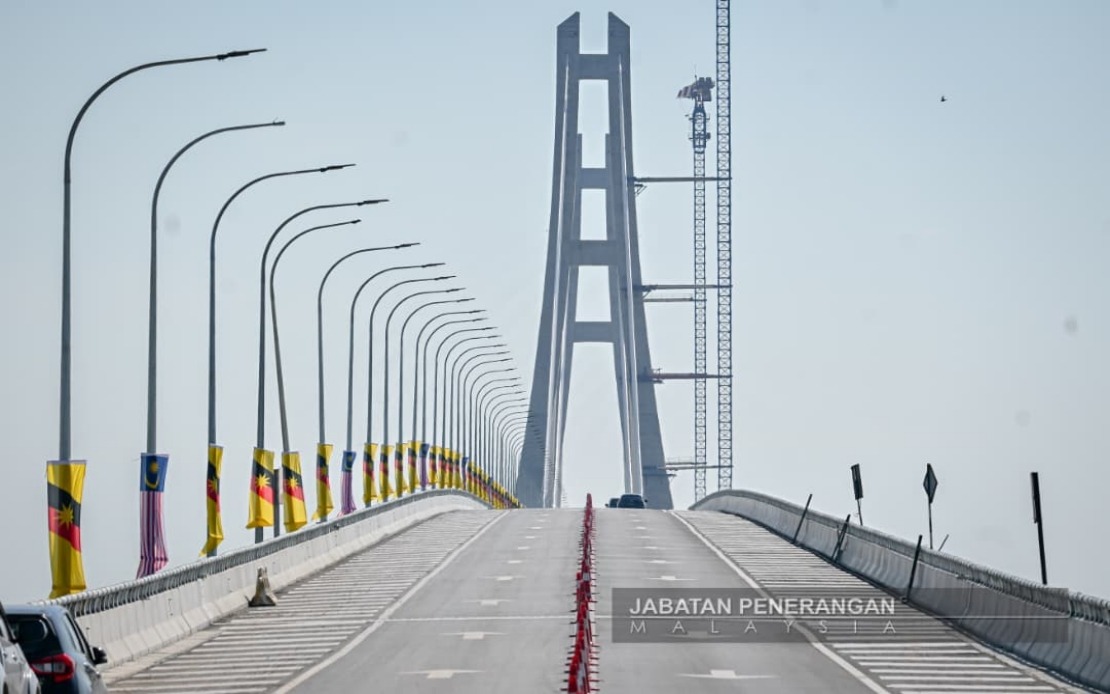
Sarawak's ambitious infrastructure transformation has reached a critical juncture with the official opening of the Batang Lupar 1 Bridge, a project that Premier Tan Sri Abang Johari Tun Openg hailed as a watershed moment for the state's economic future. The 4.844-kilometre structure, constructed at a cost of RM848.75 million, represents far more than a simple river crossing—it symbolises the state government's commitment to systematically dismantling geographic barriers that have long constrained development in the coastal hinterland.
The bridge's completion addresses a need articulated repeatedly by residents and local elected representatives over many years. Communities in Sebuyau, Betong, Sri Aman and Samarahan have historically relied on ferry services to cross the Batang Lupar River, a dependency fraught with practical complications and occasional tragedy. The unpredictable weather patterns at the river mouth frequently disrupted ferry operations, with crossing times stretching to an hour or more during adverse conditions. For agricultural producers seeking to move goods to markets in Kuching or beyond, these delays translated directly into economic losses and competitive disadvantages. The bridge eliminates this friction entirely, enabling seamless road connectivity where ferries once operated as an inefficient chokepoint.
The strategic positioning of Batang Lupar 1 within the broader Sarawak Second Trunk Road (STRR) framework reveals the sophistication of the state's planning. Rather than treating this as an isolated engineering achievement, authorities have integrated the bridge into a comprehensive coastal road network investment valued at RM3.21 billion. This larger ecosystem of connectivity improvements aims to completely reconfigure transportation patterns across Sarawak's coastal corridor. Deputy Premier Datuk Amar Douglas Uggah Embas, who oversees infrastructure and port development, emphasised that the bridge forms a critical node in this expansive vision, scheduled for completion by 2030.
The quantifiable benefits already materialising through this single bridge are remarkable. The STRR network will collapse the road distance between Kuching and Sibu from 396 kilometres to 252 kilometres, a reduction of 144 kilometres representing roughly a 36 percent shortening of the route. For logistics operators, manufacturers, and traders, this translates into dramatically lower fuel costs, reduced vehicle wear and tear, and faster delivery times. Produce transported from interior regions can now reach markets with minimal spoilage, fundamentally altering the economic calculus for agricultural enterprises throughout the corridor.
Beyond logistics and trade, the bridge's completion opens unprecedented development possibilities in districts that have historically operated in relative isolation. Sebuyau, Betong, Sri Aman and Samarahan now occupy integrated positions within a coherent regional economy centred on Kuching. Investors considering manufacturing operations, agro-processing facilities, or tourism ventures in these areas can now model their business cases around reliable, rapid connectivity rather than the unpredictability that characterised ferry-dependent transportation. The bridge effectively rewrites the competitive equation for these localities.
The engineering accomplishment itself warrants attention. The Malaysia Book of Records officially recognised Batang Lupar 1 as the longest bridge spanning a river in Malaysia, a distinction underscoring both the technical ambition and successful execution of the project. Spanning the Batang Lupar, which flows through some of Sarawak's most geographically challenging terrain, the bridge required sophisticated engineering solutions to accommodate environmental factors and construction complexity. This achievement positions Sarawak as a centre of Malaysian infrastructure innovation, demonstrating the state's capability to execute sophisticated engineering projects.
The bridge's economic implications extend across multiple sectors. Agricultural productivity stands to increase substantially as farmers gain reliable market access and can coordinate their supply chains with retailers and processors across the broader region. Tourism operators gain the ability to develop integrated itineraries encompassing multiple districts without reliance on unpredictable ferry schedules. Manufacturers seeking riverside locations benefit from guaranteed connectivity to input suppliers and export markets. The investment efficiency of the RM848.75 million expenditure becomes apparent when multiplied across these diverse economic activities.
For Malaysian policymakers observing from outside Sarawak, the Batang Lupar 1 Bridge illustrates critical principles about infrastructure investment and regional development. The project succeeded because it identified a genuine bottleneck constraining economic activity and deployed targeted investment to eliminate that constraint. The integration of this single bridge into a larger STRR framework demonstrates how isolated infrastructure projects can multiply their impact through strategic sequencing and coordination with complementary investments. These lessons hold relevance for other Malaysian states grappling with uneven regional development.
The bridge also signals Sarawak's distinct approach to managing its geographic sprawl and economic potential. Unlike peninsular states where population density facilitates conventional road networks, Sarawak must employ strategic mega-projects to overcome vast distances and river barriers. The Batang Lupar 1 Bridge exemplifies this approach—a high-investment, high-impact solution tailored to the state's unique geography. As the STRR network progresses toward its 2030 completion date, similar bridges and road corridors will progressively unlock additional regions, compounding the economic transformation already underway.
The symbolic importance of retiring the Sebuyau-Triso ferry service should not be underestimated. Ferry dependence represented, for residents and investors, a tangible manifestation of geographic isolation. The bridge's presence signals concrete progress toward modern infrastructure standards and regional integration. This psychological shift, wherein communities transition from accepting geographic constraints to expecting modern connectivity, often precedes and facilitates subsequent development.
Looking ahead, the Batang Lupar 1 Bridge establishes a foundation upon which subsequent Sarawak development initiatives will build. The road capacity now exists for expanded commerce, tourism, and industrial activity throughout the coastal corridor. Government agencies and private enterprises can now plan investments with confidence in the underlying infrastructure. The bridge transforms from a mere engineering structure into the essential backbone enabling Sarawak's next phase of economic expansion, justifying the substantial capital invested and validating the long-term vision Abang Johari and his administration have articulated for the state's future.

