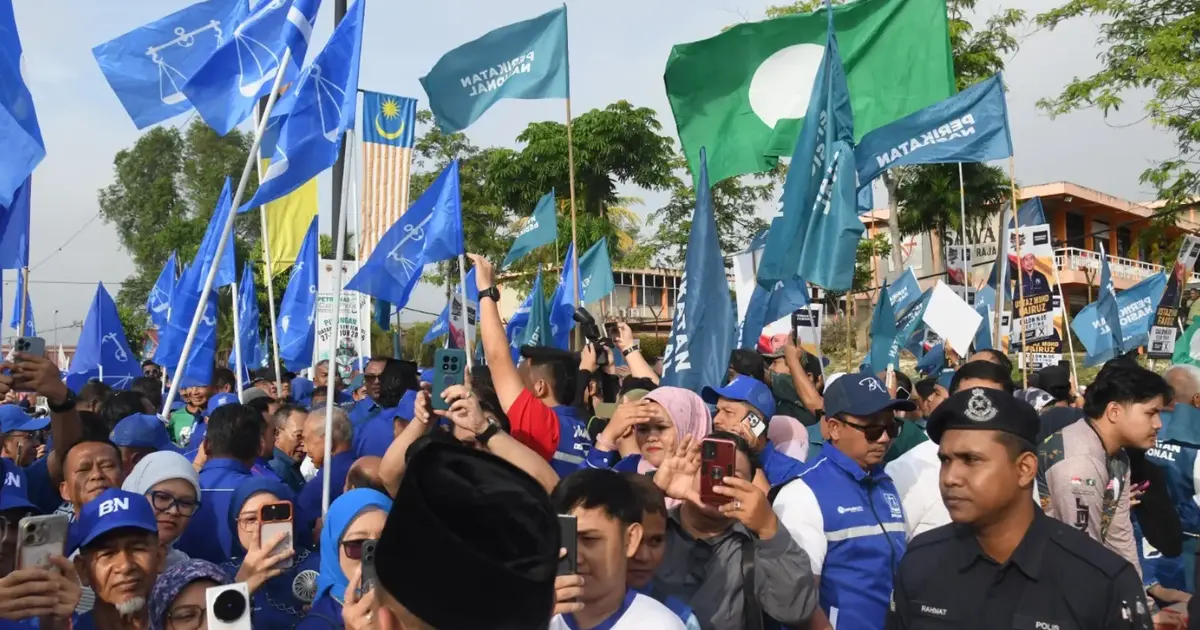
The coalition politics shaping Malaysia's most economically significant state face a critical reassessment, with political analysts questioning whether Barisan Nasional possesses the structural capabilities to become a meaningful ally for Perikatan Nasional's ambitions in Selangor. Azmi Hassan, a seasoned observer of Malaysian electoral dynamics, contends that BN's organisational framework differs fundamentally from the role Bersatu performed during the previous state election cycle, suggesting that any alliance reconfiguration would operate under entirely different constraints and advantages.
The observation highlights a deeper complexity within opposition politics that extends beyond simple coalition mathematics. When Bersatu participated alongside Perikatan Nasional in the previous Selangor election, the party brought specific qualities that transcended mere seat allocation. Bersatu's relatively recent emergence as a political force, its grassroots network concentrated in particular demographic segments, and its strategic positioning as a Bumiputera-focused entity created synergies within the broader PN coalition that proved instrumental in the party's ability to challenge the ruling authorities.
Barisan Nasional's traditional structure, by contrast, operates from a fundamentally different historical foundation. The coalition brings decades of institutional machinery, established networks, and entrenched relationships with the federal bureaucracy. However, Azmi Hassan's analysis suggests these conventional strengths may not translate effectively into the specific battle for electoral supremacy in Selangor, where grassroots mobilization, community engagement patterns, and localized issue-based politics determine electoral outcomes more decisively than hierarchical party structures.
The Selangor context presents unique electoral characteristics that have shifted markedly over successive election cycles. The state's rapid urbanization, its diverse demographic composition spanning affluent suburban constituencies alongside working-class urban centres, and the presence of substantial swing voter populations create an environment where traditional coalition strategies frequently misfire. Political parties must navigate multiple, sometimes contradictory voter priorities simultaneously—a challenge that requires nuanced, localized response mechanisms rather than top-down directives.
Bersatu's effectiveness in the previous cycle stemmed partly from its positioning as a vehicle for specific voter anxieties and aspirations. The party's narrative resonated with particular segments of the Selangor electorate in ways that complemented PN's broader platform. Furthermore, Bersatu's relative newness meant the party had not accumulated the accumulated grievances and historical rivalries that encumber more established political entities. This blank-slate quality proved strategically advantageous when attempting to reshape electoral coalitions and attract voters disillusioned with conventional political arrangements.
Barisan Nasional, conversely, carries the institutional baggage of its long governance tenure. While this history provides legitimacy in certain demographic segments, it simultaneously generates resistance among voters seeking change or punishment for perceived past failures. The coalition's internal composition, featuring multiple member parties with their own competing interests and regional power bases, often results in compromise positions that satisfy no constituency completely. In a state as politically volatile and demographically diverse as Selangor, such diluted messaging creates vulnerabilities.
Azmi Hassan's assessment implicitly addresses the strategic recalibration occurring across Malaysia's opposition landscape. Perikatan Nasional's performance in Selangor during the previous election suggested the coalition possessed sufficient momentum and organizational capacity to pose genuine challenges to the incumbent regime. However, sustaining and building upon that momentum requires specific political ingredients. Bersatu's withdrawal or diminished role in coalition arrangements would eliminate variables that contributed significantly to PN's previous performance trajectory.
The broader implications for Selangor politics extend into the structural vulnerabilities of multi-party coalitions attempting to dislodge entrenched incumbents. Electoral success in Malaysia's largest economic state depends not merely on aggregate seat mathematics but on constructing coherent narratives that mobilize specific voter segments effectively. Different coalition partners bring distinct organizational strengths, ideological positionings, and voter appeal profiles. When these elements misalign or when a replacement partner cannot adequately substitute for departing members, coalition effectiveness deteriorates significantly.
Moreover, the analysis raises questions about PN's long-term electoral strategy in Selangor and whether the coalition possesses the flexibility to adapt its approach as political circumstances evolve. Relying on BN as a replacement for Bersatu's previous functions suggests a static response to dynamic political conditions. Effective opposition politics requires continuous reassessment of coalition composition, strategic positioning, and grassroots organizational investment based on shifting voter sentiments and changing political contexts.
For Malaysian observers tracking opposition coalition dynamics, Azmi Hassan's commentary underscores a fundamental political reality: coalition effectiveness depends less on the quantity of constituent parties or total seats they collectively control than on the qualitative fit between partner organizations, their respective voter bases, and their capacity to project unified yet locally resonant political messages. Selangor, with its swing-voter heavy electorate and complex political composition, exemplifies precisely the type of battleground where such nuances determine electoral outcomes.
Looking forward, PN's electoral prospects in Selangor may hinge less on which coalition partners participate and more on whether the opposition can construct a compelling alternative vision addressing state-specific concerns—from urban development and economic opportunity to governance transparency and service delivery—that transcends the tactical question of coalition composition. Without such substantive differentiation from incumbent authorities, coalition reconfiguration alone will likely prove insufficient to alter Selangor's political trajectory.

