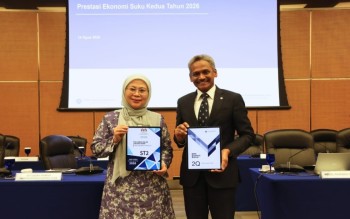
Bank Negara Malaysia remains committed to its 2026 gross domestic product growth forecast of 5.0 per cent, with central bank Governor Datuk Seri Abdul Rasheed Ghaffour stating there is currently insufficient reason to adjust the projection. Speaking at a press conference following the announcement of Malaysia's second-quarter GDP figures, the Governor expressed satisfaction with economic momentum, noting that performance has consistently exceeded internal expectations across the past three quarters, providing confidence in the sustainability of growth trajectories through the remainder of the year.
The Malaysian economy expanded by 6.0 per cent in the second quarter of 2026, outpacing the Department of Statistics Malaysia's preliminary estimate of 5.8 per cent. This stronger-than-anticipated outcome reflects the resilience of multiple economic engines driving expansion. Governor Abdul Rasheed emphasized that formal revisions to annual forecasts typically occur during Budget announcements rather than at intermediate points in the year, suggesting the central bank sees no urgent triggers for mid-course corrections at present.
The foundation of recent growth rests substantially on domestic demand, which has proven far more robust than many regional counterparts have experienced during comparable periods. Household consumption specifically remained resilient, growing at 4.8 per cent in the second quarter, supported by rising incomes among working-age populations, accumulated household savings, and targeted government policy interventions designed to support purchasing power. Governor Abdul Rasheed clarified that consumer borrowing played only a marginal role in driving consumption growth, distinguishing Malaysia's expansion from consumption patterns in other economies increasingly reliant on household leverage to sustain demand.
The external sector has provided substantial supplementary support to economic expansion, though with some variations across quarters. Exports have demonstrated genuine diversification rather than concentration in a single commodity or manufacturing segment. The electrical and electronics sector, traditionally Malaysia's export powerhouse, continued expanding while non-E&E exports also recorded growth, reducing the economy's vulnerability to sector-specific shocks. Additionally, information and communications technology services showed acceleration, indicating that Malaysia's structural shift toward higher-value services activities is progressing, a development significant for long-term competitiveness and productivity improvements.
The breadth of growth across consumption, investment, exports, and tourism represents a genuine advantage for economic stability. Unlike scenarios where expansion concentrates in one or two sectors, wide-based growth distributes economic benefits more equitably across regions and demographic groups while reducing the probability of sharp reversals if individual sectors encounter temporary difficulties. Governor Abdul Rasheed pointed to this multi-dimensional strength when explaining the central bank's confidence in maintaining the 5.0 per cent forecast despite acknowledged external uncertainties.
Yet the Governor acknowledged that headwinds exist in the global environment. Geopolitical tensions and unresolved conflicts create unpredictability for trade flows and investment decisions, while broader economic uncertainties in advanced economies could dampen demand for Malaysian exports. These international complications represent potential brakes on growth, though their impact remains difficult to quantify precisely. The central bank's measured approach—maintaining existing forecasts while warning of possible adjustments—reflects appropriate caution without unnecessary alarm.
El Niño weather patterns present another variable that economists are monitoring closely. The Governor noted that economic impacts from El Niño would likely emerge gradually rather than immediately, and would concentrate primarily in the agricultural sector, which comprises a diminishing share of GDP in Malaysia's increasingly service and manufacturing-oriented economy. However, he stressed that businesses and households should proactively prepare for potential agricultural disruptions and adapt operational practices accordingly, rather than waiting for impacts to materialize before responding.
The strength of household consumption growth deserves particular attention, as it reflects underlying structural conditions in the labour market and household finances. Income growth remains the primary factor supporting consumer spending, suggesting that wage increases and employment expansion continue providing households with rising purchasing capacity. The secondary reliance on savings indicates that Malaysian households have maintained financial buffers, reducing pressure to borrow for consumption—a contrast to debt-driven consumer spending patterns evident in some regional economies. Government policy support, whether through targeted subsidies, social programmes, or other interventions, also contributes meaningfully to consumption capacity, indicating that fiscal policy continues playing a stabilizing role.
For Malaysian policymakers, the maintained forecast reflects a balancing act between prudent realism and measured optimism. The central bank has avoided the pitfall of overestimating growth potential based on a single strong quarter, while equally refusing to become unduly pessimistic given credible evidence of broad-based momentum. This calibrated approach provides businesses and households with reasonable confidence for planning purposes without encouraging complacency regarding external risks.
Regionally, Malaysia's performance carries implications for Southeast Asian economic dynamics. Stronger-than-expected growth in a major regional economy typically supports demand for inputs from neighbouring countries and generates confidence among multinational enterprises managing regional operations. However, the acknowledged uncertainties in the global environment remain relevant to the broader region, with all Southeast Asian economies exposed to similar geopolitical and demand-side risks regardless of individual national performance.
Looking ahead, the critical test of whether 5.0 per cent growth proves achievable through 2026 will depend partly on factors beyond the central bank's direct control. Global trade dynamics, commodity price movements, geopolitical developments, and the health of major trading partners' economies will all influence Malaysia's trajectory. The central bank's confidence appears grounded in tangible evidence of current momentum rather than optimistic assumptions about external conditions improving, a distinction that suggests reasonable resilience even in moderately adverse scenarios.
The decision to maintain the forecast unchanged also communicates consistency in monetary policy guidance, avoiding the confusion that frequent revisions might create. As Malaysia navigates the remainder of 2026 and moves toward 2027, the central bank will presumably continue monitoring actual outcomes against forecasts, prepared to revise if material changes warrant adjustment. For now, the 5.0 per cent projection stands as the official guide for economic policy and business planning, reflecting Bank Negara's assessment that Malaysia's growth drivers remain sufficiently robust to sustain expansion in the near term despite acknowledged uncertainties ahead.

