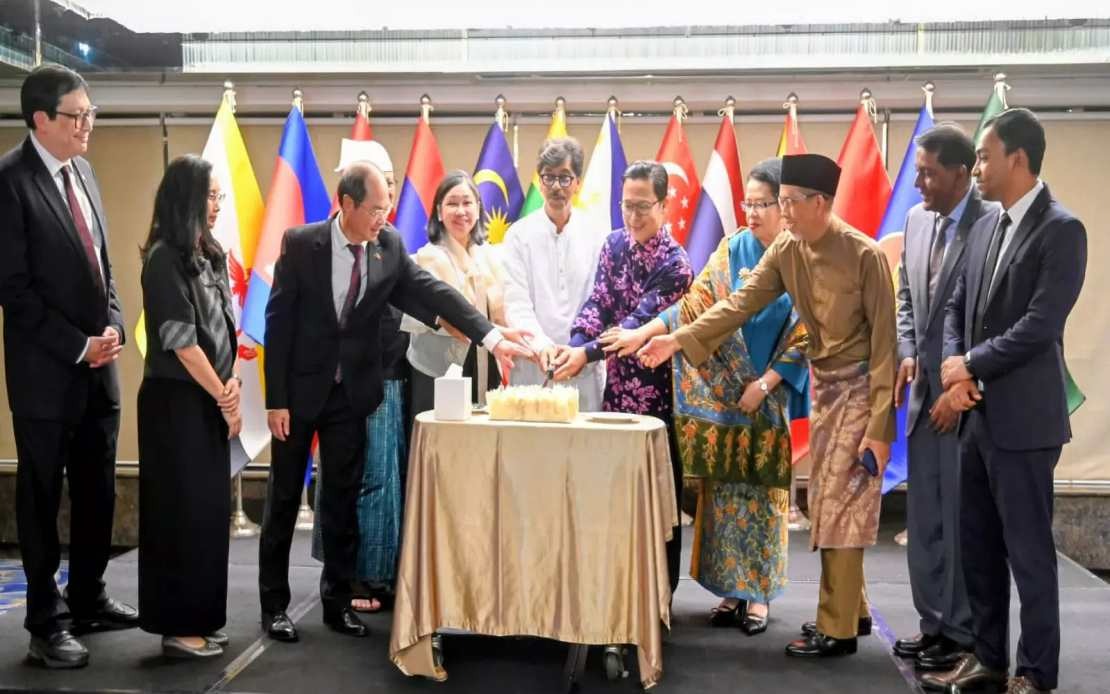
Bangladesh has intensified its bid for greater integration with the Association of Southeast Asian Nations, submitting a formal application to become a Sectoral Dialogue Partner in a strategic move that underscores the country's pivot toward regional multilateralism. Mohammed Aminur Rashid, the Fisheries, Livestock and Agriculture Minister, articulated this commitment at a reception marking the 59th ASEAN Day, hosted by the ASEAN Dhaka Committee at Renaissance Dhaka Gulshan Hotel, emphasising that Bangladesh views the 11-member bloc as essential to its foreign policy architecture.
The minister framed Bangladesh's overture not merely as a diplomatic gesture but as recognition of deep historical and cultural roots binding the nation to Southeast Asia. He pointed to expanding infrastructure connectivity, rising cross-border people-to-people exchanges, and intensifying bilateral commerce as evidence of tangible momentum beneath the diplomatic language. This positioning reflects a deliberate recalibration of Bangladesh's strategic orientation, particularly significant given that Prime Minister Tarique Rahman selected Malaysia for his inaugural overseas visit—a deliberate symbolic choice that signals where Dhaka intends to concentrate its diplomatic energy during this administration's tenure.
The application for Sectoral Dialogue Partner status represents a substantive escalation in Bangladesh's institutional engagement with ASEAN. Currently lacking formal dialogue arrangements comparable to other significant Asian powers, SDP status would provide Bangladesh with structured mechanisms for participating in ASEAN economic frameworks, technical cooperation platforms, and policy coordination forums. For Malaysian and other Southeast Asian policymakers, Bangladesh's overture arrives at a moment when the region is reassessing its relationships with neighbouring South Asian economies, particularly as supply chain diversification and regional economic resilience have become paramount following pandemic disruptions and geopolitical realignments.
Tangible cooperation initiatives already underway demonstrate that Bangladesh's enthusiasm extends beyond ceremonial rhetoric. The ongoing Bangladesh-ASEAN Cooperation Project on Fisheries and Aquaculture, capitalised at US$1 million and administered through Aminur's ministry, addresses shared maritime resource management challenges confronting both the Bay of Bengal region and Southeast Asian waters. The fisheries partnership holds particular relevance for Malaysia and other ASEAN nations facing overfishing pressures and seeking to develop sustainable aquaculture sectors that could simultaneously enhance food security and generate rural employment across the region.
Beyond maritime affairs, Bangladesh has flagged additional collaborative pathways in tourism, information and communications technology, and cultural preservation—sectors where synergies between South Asia and Southeast Asia remain substantially underdeveloped compared to potential. The tourism initiative carries particular promise given that Bangladesh hosts considerable Rohingya refugee populations and cultural attractions spanning ancient Buddhist heritage sites to the Sundarbans mangrove ecosystem, while Southeast Asian nations possess established tourism infrastructure and marketing expertise that could facilitate market integration. Similarly, ICT cooperation could harness Bangladesh's substantial software development sector—increasingly competitive with Indian providers—while creating partnership opportunities for ASEAN technology companies seeking to expand into South Asian markets.
The cultural dimension of Bangladesh's ASEAN overture deserves particular attention. The reception featured indigenous Bangladeshi culinary offerings, notably biryani prepared with Kalijira rice and dishes showcasing Black Bengal Goat, a product bearing Geographical Indication status. This gastronomic diplomacy underscores how Bangladesh positions itself within ASEAN not as a supplicant seeking admission but as a distinct contributor to regional diversity. Malaysian and Southeast Asian diplomats present at the gathering—including Malaysian High Commissioner Mohammad Shuhada Othman and Philippine Ambassador Neena Padilla Cinglet—received this messaging clearly, encountering Bangladesh's cultural distinctiveness through direct sensory experience rather than abstract policy documents.
The timing of Bangladesh's SDP application warrants analytical scrutiny. The administration of Prime Minister Tarique Rahman has signalled a foreign policy recalibration prioritising regional partnerships over potentially fraught relationships with South Asian neighbours. By anchoring itself more firmly within ASEAN institutional frameworks, Bangladesh simultaneously diversifies its diplomatic portfolio, reduces dependency on any single bilateral relationship, and positions itself as a bridge between South Asia and Southeast Asia. For ASEAN members, accepting Bangladesh as an SDP would expand the bloc's influence over South Asian dynamics without requiring full membership, effectively extending ASEAN's policy reach into a critical region adjacent to China's Belt and Road Initiative corridors.
Minister Aminur explicitly appealed to ASEAN diplomatic representatives present to facilitate Bangladesh's aspirations, acknowledging that their support proves instrumental in navigating ASEAN's consensus-based decision-making procedures. This transparent solicitation reflects understanding that ASEAN's institutional mechanisms, while promoting inclusive dialogue, require active coalition-building and demonstrated commitment from incumbent members. The appeal particularly targets Malaysia, which simultaneously chairs regional initiatives and maintains privileged historical relationships with Bangladesh, positioning Kuala Lumpur as a natural advocate for Dhaka's integration efforts.
The strategic calculus underlying Bangladesh's approach recognises that ASEAN's economic dynamism and institutional maturity offer mechanisms for channelling development assistance, facilitating technology transfer, and creating rules-based frameworks for cross-border collaboration that bilateral relationships alone cannot provide. The Sectoral Dialogue Partner status would grant Bangladesh structured access to ASEAN's economic ministers' meetings, specialised working groups, and technical cooperation platforms while falling short of full membership, which currently remains politically infeasible and institutionally complex. This calibrated approach demonstrates sophisticated understanding of ASEAN's institutional boundaries and evolution.
For Malaysian policymakers and broader Southeast Asian stakeholders, Bangladesh's institutional repositioning carries several implications. First, it signals that South Asian countries increasingly view regional integration through an ASEAN lens rather than exclusively through SAARC frameworks, which have stagnated amid bilateral tensions. Second, it creates opportunities for ASEAN to shape South Asian development trajectories through cooperative mechanisms less confrontational than traditional geopolitical competition. Third, it potentially moderates South Asian maritime disputes by embedding them within ASEAN's consensus-based dispute resolution architecture. Malaysian officials, given Malaysia's simultaneous roles as ASEAN participant and major South Asian economic partner, find themselves positioned to influence how this integration unfolds.
The cultural, economic, and institutional dimensions of Bangladesh's ASEAN engagement ultimately reflect a pragmatic recognition that regional bloc membership and structured multilateralism offer pathways to development and stability that isolationism or bilateral client-state relationships cannot furnish. By cultivating deeper connections with Southeast Asia's institutional architecture, Bangladesh simultaneously insulates itself from South Asian bilateral volatility and positions itself within Asia's economically dynamic region. Whether ASEAN members ultimately grant SDP status depends partly on diplomatic advocacy but fundamentally on whether they perceive Bangladesh's integration as advancing their collective interests in regional stability, supply chain resilience, and sustainable maritime governance.

