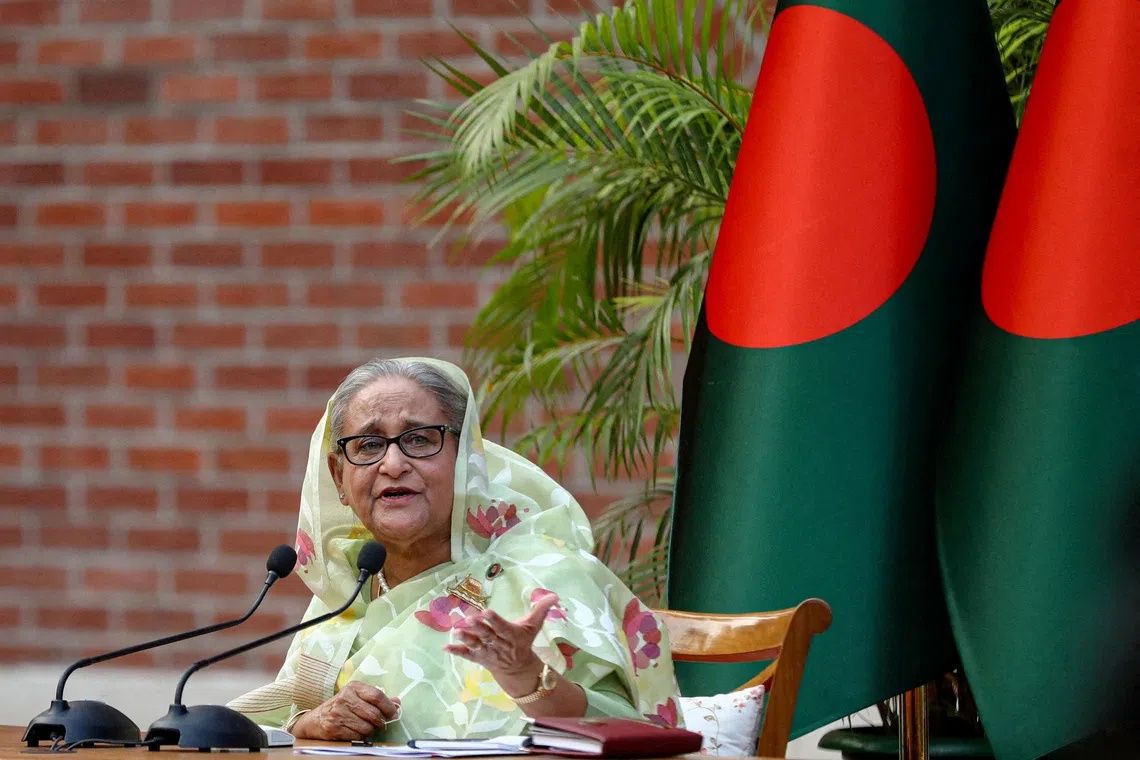
Bangladesh's foreign ministry has formally petitioned India to take a clear stance on exiled former prime minister Sheikh Hasina's plans to address an event in New Delhi by video link, arguing that permitting political activities by someone Dhaka views as a fugitive could jeopardise the two countries' gradually warming relationship. The intervention marks the first official government response to Hasina's announced appearance at an August 5 gathering hosted by the Foreign Correspondents' Club of South Asia in the Indian capital, an event timed to commemorate the second anniversary of the popular uprising that swept her administration from power last year.
The diplomatic tension underscores the delicate balance Bangladesh must maintain with New Delhi as it pursues multiple fronts simultaneously: seeking Hasina's extradition from Indian territory, normalising relations following her ouster, and managing the broader strategic partnership with India. State Minister for Foreign Affairs Shama Obaed Islam articulated Dhaka's position on Monday evening, stressing that the government wished to continue advancing bilateral ties through constructive engagement but could not tolerate what it perceives as hostile political activity emanating from Indian soil. The ministry's language reflected careful diplomacy, stopping short of accusation while making unmistakable the connection between allowing such events and potential deterioration in relations.
Hashina has remained in India since her government collapsed following weeks of intense civil unrest in August 2024, having fled Bangladesh amid mounting pressure from protest movements led primarily by university students. The former prime minister, now 78 years old, has lived under Indian protection for more than eighteen months, during which period Dhaka has submitted formal extradition requests citing multiple criminal charges. Most significantly, a Bangladeshi court sentenced her to death in absentia in 2025 on charges of crimes against humanity stemming from her government's crackdown on demonstrations in 2024, which international observers estimated resulted in up to 1,400 deaths. Despite facing these legal proceedings at home, Hasina has publicly rejected the verdict as politically motivated and legally deficient, while simultaneously telling Reuters that she intends to return to Bangladesh in December—a prospect that adds urgency to the current controversy.
The timing of the August 5 address carries particular symbolic weight in Bangladesh's domestic political context. The date marks the anniversary of the student-led uprising that fundamentally transformed the nation's political landscape, displacing Hasina's long-governing Awami League and leading to the formation of a new administration led by Tarique Rahman following elections held in February 2025. That the former prime minister plans to commemorate this date publicly through a New Delhi platform represents not merely a commemorative gesture but a pointed political statement, suggesting she intends to challenge the legitimacy of her removal and the government that replaced her. Islam's warning carried implicit acknowledgement of this symbolic challenge, as she emphasised that Bangladesh had repeatedly conveyed concerns to Indian officials about Hasina and other Awami League figures making political pronouncements from Indian territory.
India's response to Bangladesh's diplomatic approach has thus far been muted, with the Indian foreign ministry offering no immediate statement addressing Dhaka's concerns. This silence itself carries diplomatic significance, neither confirming nor denying India's position on whether it views the planned speech as problematic. Islam noted, however, that India had previously indicated to Bangladeshi officials that it did not expect fugitives residing on its soil to engage in political activities—a statement that suggests potential room for Indian intervention, should New Delhi choose to exercise it. The Foreign Correspondents' Club of South Asia similarly declined to comment when approached about the Bangladesh government's objections, leaving unclear whether the organisation would consider cancelling or modifying the event in response to diplomatic pressure.
The episode reflects the complex evolution of India-Bangladesh relations since Hasina's departure from office. The two neighbours, long bound by geopolitical and economic ties, experienced significant strain during Hasina's final months in power and in the immediate aftermath of her ouster. However, both governments have recently signalled interest in rebuilding the relationship through sustained engagement and expanded cooperation, with Rahman's administration seeking to chart a course that maintains beneficial ties to New Delhi while asserting Bangladesh's own foreign policy autonomy. This delicate recalibration makes the Hasina speech issue particularly fraught, as it threatens to become a test case of whether India will privilege its relationship with Dhaka over considerations of providing space for exiled political figures.
For Malaysia and other Southeast Asian nations watching the dispute unfold, the Bangladesh-India dynamic offers insights into how regional powers manage complex relationships when key political figures become geographically separated from their home countries. The situation touches on fundamental questions of sovereignty, asylum, and the limits of permissible political activity by exiled leaders on foreign soil. Malaysia itself has hosted various international figures and dissidents over the decades, making this particular question of direct relevance to how regional states calibrate their positions on comparable issues. The precedent that emerges from India's ultimate decision could influence how other countries in South and Southeast Asia approach similar scenarios.
Bangladesh's approach to the matter demonstrates a careful calibration designed to achieve diplomatic objectives without provoking India unnecessarily. Islam's repeated emphasis that Dhaka values improving bilateral relations, combined with the acknowledgement that the event is not government-organised, suggests Bangladesh is seeking to influence Indian decision-making through persuasion rather than confrontation. The indication that Dhaka may resort to formal diplomatic channels if necessary represents a measured escalation pathway rather than an immediate threat. This measured approach reflects the reality that Bangladesh, despite its legitimate grievances, lacks the geopolitical leverage to force India's hand on matters concerning persons residing within Indian territory.
Hashina's own position adds another layer to this unfolding diplomatic drama. Her insistence that she will return to Bangladesh in December appears designed partly to reassert her political relevance and partly to suggest she views her exile as temporary rather than permanent. The planned August 5 address could be interpreted as part of a broader strategy to maintain political momentum and credibility among supporters and opponents alike, demonstrating that she remains active and willing to challenge her successors' legitimacy from abroad. Whether such activities strengthen or ultimately undermine her prospects for eventual return remains unclear, but they certainly complicate the diplomatic environment within which Bangladesh and India must navigate their relationship.
The Foreign Correspondents' Club decision to provide Hasina a platform reflects media freedom principles that many would defend as fundamental to democratic societies. Yet the club's role also illustrates how non-governmental actors can inadvertently become entangled in state-level diplomatic disputes when they provide platforms to politically significant figures. The club's silence in response to Bangladesh's concerns suggests either that it has not engaged substantially with the diplomatic pressure or that it has decided to proceed regardless. Either interpretation points toward the likely continuation of the planned event, leaving the burden of response to Indian and Bangladeshi authorities.

