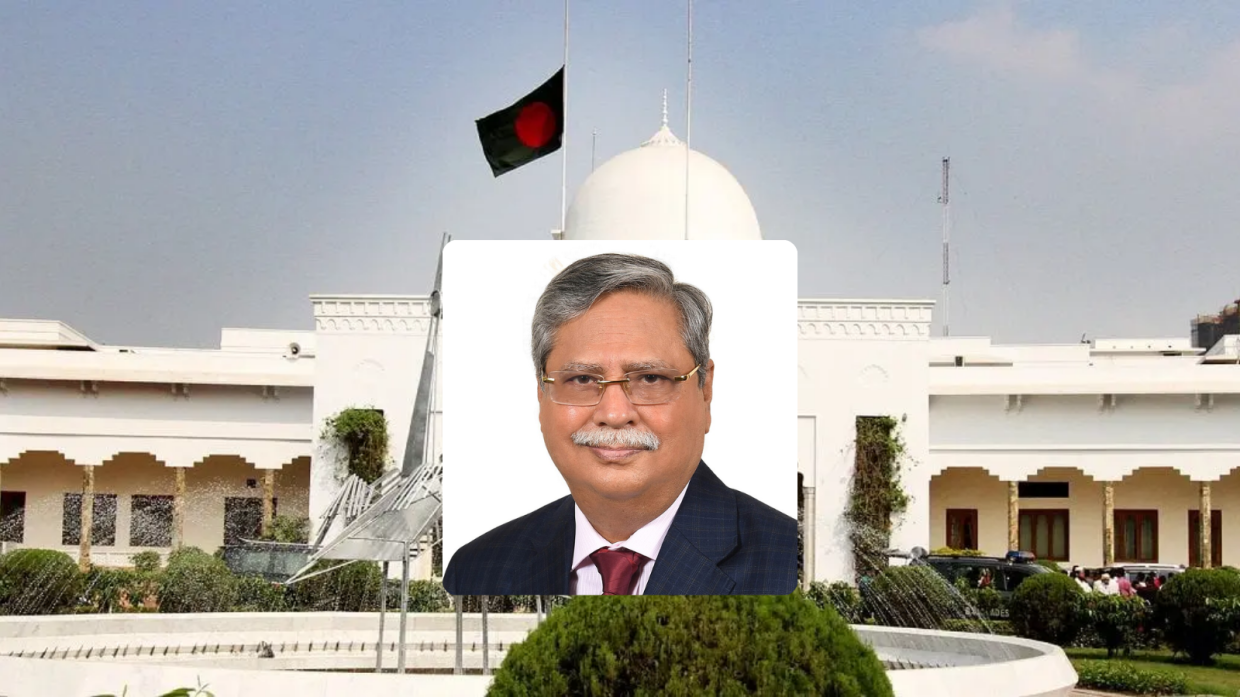
Bangladesh's President Mohammed Shahabuddin appears poised to step down from office, signalling a decisive political transition for the South Asian nation as its ruling administration consolidates control following last year's tumultuous uprising. Multiple sources close to the government and presidential palace have indicated that his departure could come within days, though no formal announcement has been made and the precise timing remains fluid.
Shahabuddin, who assumed the largely ceremonial presidency in April 2023, holds a unique and increasingly uncomfortable position as the sole senior constitutional figure retained from the previous political order. When a mass uprising upended Bangladesh in July 2024, triggering the departure of longtime Prime Minister Sheikh Hasina and leading to the installation of an interim government, Shahabuddin remained at his post. Now, with the Bangladesh Nationalist Party assuming full governmental power earlier this year, his continued presence appears increasingly untenable to the new administration.
The mounting pressure on the president intensified following revelations of a confidential phone conversation he conducted with exiled former premier Hasina during a May visit to London for medical reasons. Intelligence agencies subsequently learned of this communication, and government officials conveyed an implicit message suggesting his resignation would be prudent. However, senior ruling party figures insist this single incident merely surfaced broader concerns about his suitability to remain in office, with one BNP leader characterizing the situation as substantially more intricate than any isolated phone call.
Hasina, who maintains a death sentence in absentia and leads a party whose operations remain officially proscribed, announced in July her intention to return to Bangladesh around December alongside senior Awami League colleagues to face the justice system. This declaration has rattled the current government, which perceives her potential repatriation as a destabilizing threat to the new political settlement. Authorities have simultaneously been tracking attempts by scattered Awami League operatives within Bangladesh to reconstitute their organization's structures, further concentrating official minds on eradicating vestiges of the previous regime.
Government insiders have characterized Shahabuddin's departure as both inevitable and natural, with one high-ranking source dismissing it as merely a matter of timing rather than possibility. Officials have expressed particular displeasure over reports that the president sought to reactivate dormant political contacts, viewing such outreach as incompatible with his constitutional office. The broader calculation appears straightforward: maintaining a presidential figure associated with the ancien régime undermines the legitimacy and consolidation of the new political order, regardless of the presidency's limited executive authority.
Prime Minister Tarique Rahman has already signalled the government's uncompromising stance toward remnants of the previous administration. In mid-July, during a Cabinet session, he directed relevant authorities to intensify crackdowns against the Awami League and its affiliated youth and student wings, demonstrating that eliminating traces of the displaced regime remains a governmental priority. In this context, Shahabuddin's continued occupancy of the nation's highest constitutional office represents an awkward anachronism that the administration views as requiring urgent resolution.
Shahabuddin himself has demonstrated flexibility regarding his position, though circumstances have evolved dramatically since his earlier statements. During the tenure of the interim government last December, he indicated willingness to depart midway through his term following the scheduled February parliamentary elections, citing feelings of humiliation at his treatment by the administration led by Muhammad Yunus. After the BNP assumed office, the president acknowledged in February interviews that he would respect governmental preference regarding his tenure, professing willingness either to continue serving or to resign at the administration's preference.
The constitutional framework governing presidential succession is straightforward. Should Shahabuddin resign, the Speaker of Parliament will automatically assume the role of acting president pending the election of his replacement, a process that would likely proceed swiftly given the government's apparent consensus on the matter. Political observers anticipate that the BNP administration would move efficiently to select a successor more aligned with the current regime, potentially someone with stronger connections to the nationalist movement.
For Malaysia and other Southeast Asian observers, Shahabuddin's likely departure underscores the ongoing structural reorganization of Bangladesh's political system following the July 2024 uprising. The incident demonstrates how thorough the disruption has been, extending even to ceremonial offices traditionally considered insulated from political turbulence. It also reveals the new government's determination to eliminate all institutional remnants of the previous order, regardless of formal constitutional protections that might ordinarily shield such positions from partisan pressure. Regional governments monitoring Bangladesh's stabilization will view this as confirmation that the political transition, while dramatic, continues progressing toward consolidation under BNP leadership rather than threatening renewed instability.
Sources close to the presidential residence suggested that a formal decision might materialize within one or two days as of late July, with a scheduled meeting between the president and non-resident ambassadors from four countries set for July 29, potentially providing a ceremonial occasion for any announcement. The timing and manner of any resignation announcement will likely be carefully choreographed to minimize domestic disruption while signalling to both domestic constituencies and international partners that Bangladesh's political reorganization proceeds according to plan.

