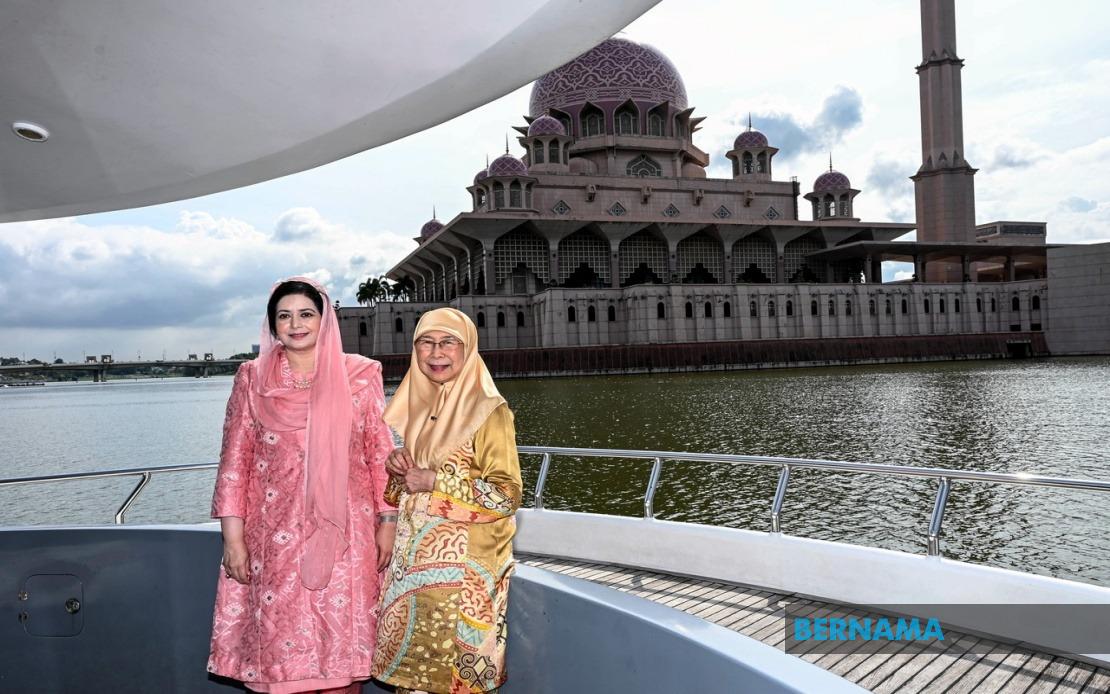
Dr Zubaida Rahman, spouse of Bangladesh Prime Minister Tarique Rahman, enjoyed a leisurely boat tour across Putrajaya Lake on Saturday morning, where she observed the administrative capital's distinctive architectural and natural features from the water. The visit showcased the country's flagship development while building personal connections between the two nations' leadership families during the premiers' high-profile bilateral engagement.
Arranged as part of her husband's two-day official visit, the morning excursion saw Dr Zubaida welcomed by Datuk Seri Dr Wan Azizah Wan Ismail, wife of Malaysian Prime Minister Datuk Seri Anwar Ibrahim, alongside Hannah Yeoh, Minister in the Prime Minister's Department (Federal Territories). The three women spent approximately one hour touring the lake together, during which they enjoyed panoramic views of Putrajaya's signature buildings and green spaces while engaging in conversation.
The presence of both Dr Wan Azizah and Hannah Yeoh underscored the diplomatic significance of the occasion. As Malaysia's First Lady, Dr Wan Azizah represents the country's highest ceremonial spheres, while Hannah Yeoh's role as Federal Territories minister positioned her to discuss Putrajaya's development and governance directly with the visiting dignitary. Their joint appearance reflected efforts to create a warm, welcoming atmosphere that extended beyond formal government interactions.
Tarique Rahman's visit marks a milestone in Bangladesh's contemporary diplomatic calendar. Since assuming his position in February 2026, this represents his inaugural official bilateral trip abroad, signalling that Malaysia holds particular importance in his administration's foreign policy priorities. The two-day engagement was extended at the invitation of Prime Minister Anwar Ibrahim, suggesting mutual commitment to deepening the relationship between the two nations at the highest levels.
Economic considerations underscore the strategic value of this visit. Bangladesh currently ranks as Malaysia's 28th-largest trading partner worldwide, with bilateral commerce reaching RM12.18 billion in recent tallies. More significantly within the regional context, Bangladesh serves as Malaysia's second-most important trading partner throughout South Asia, trailing only India. These figures demonstrate substantial commercial interdependence despite the geographic and political differences between the two nations.
The lake cruise served dual purposes within the broader diplomatic programme. Beyond its ceremonial function of honouring the visiting delegation, the scenic tour allowed Dr Zubaida to witness Malaysia's urban planning achievements firsthand. Putrajaya's carefully designed layout, featuring the Federal Government Administrative Centre as its centrepiece, represents a significant investment in Malaysia's administrative infrastructure and technological modernisation.
For Malaysian readers, the visit carries implications beyond bilateral courtesies. Bangladesh's growing economic prominence in South Asia makes strengthening ties with Dhaka strategically sound, particularly as Malaysia seeks to expand its commercial footprint across the subcontinent. Deepened engagement with Bangladesh's leadership offers pathways for Malaysian businesses to explore new markets, while also positioning Malaysia as a preferred development partner in the region.
The symbolism of hosting Bangladesh's premier couple during his first overseas trip since taking office cannot be understated. It reflects Anwar's administration's commitment to maintaining warm relationships across South Asia, a region increasingly significant to Malaysian trade and investment strategies. The informal atmosphere of a lake cruise, rather than purely ceremonial state functions, suggests an approach to diplomacy that emphasizes personal rapport alongside formal protocols.
These visits often set templates for future engagement. By introducing Dr Zubaida to Malaysia's showcase capital and facilitating extended conversation between the accompanying officials, organisers created opportunities for relationship-building that may facilitate smoother cooperation on subsequent matters. Personal connections forged in such settings frequently translate into more productive governmental collaboration on trade, education, and cultural initiatives.
Looking ahead, observers should monitor whether this visit precipitates concrete outcomes in bilateral cooperation. Both nations have expressed interest in strengthening ties across multiple sectors, and the high-level attention evident during this visit suggests serious intent. For Malaysian enterprises, Bangladesh's substantial population and developing economy present considerable opportunities, while Bangladesh's leadership may view Malaysia's technological and administrative experience as relevant to their own development ambitions.