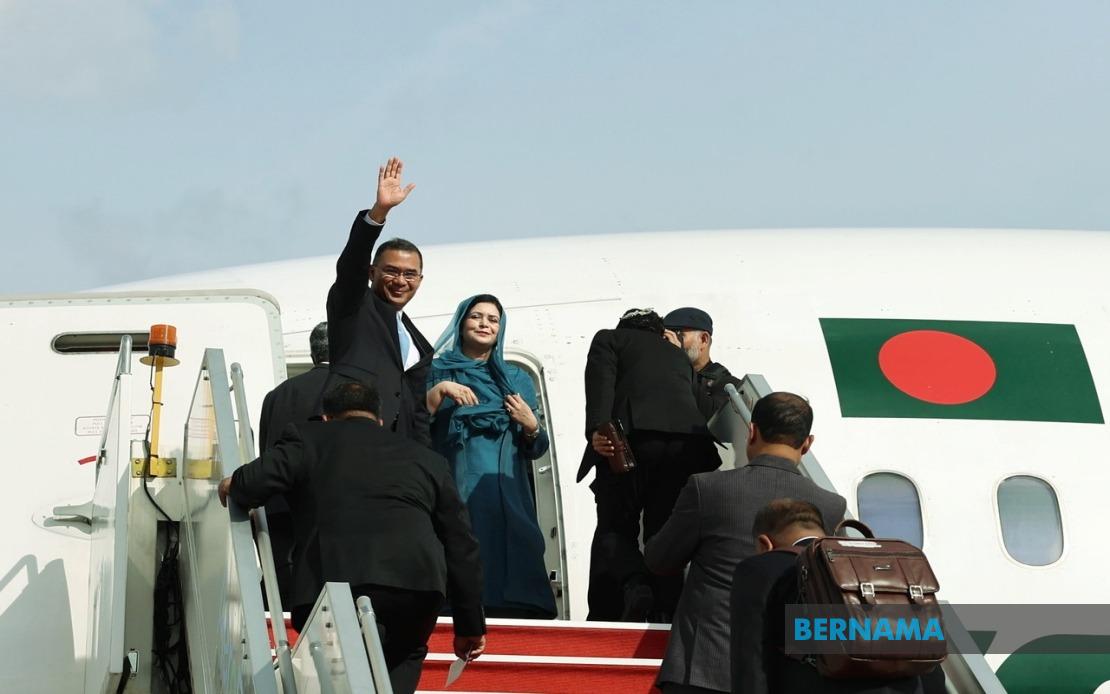
Bangladesh Prime Minister Tarique Rahman departed Malaysia on June 22 bound for China, concluding a two-day official visit that showcased renewed diplomatic ties between Kuala Lumpur and Dhaka. The Premier and his delegation lifted off from Kuala Lumpur International Airport's Bunga Raya Complex at 5 pm aboard a special aircraft, receiving ceremonial honours befitting a visiting head of government. The send-off, which included a guard of honour comprising 28 officers from the First Battalion of the Royal Ranger Regiment, underscored the formal nature of the engagement. Minister in the Prime Minister's Department (Religious Affairs) Dr Zulkifli Hasan represented Malaysia in bidding farewell to Tarique, his spouse Dr Zubaida Rahman, and the accompanying delegation.
The departure capped what officials characterised as a productive bilateral meeting earlier that day between Tarique and Prime Minister Datuk Seri Anwar Ibrahim at the Perdana Putra Complex. The two leaders engaged in substantive discussions spanning both regional and global dimensions, with particular emphasis on economic cooperation and strategic alignment on international challenges. Their exchange touched on matters directly impacting Malaysia's national interests and the broader Southeast Asian landscape, signalling that Bangladesh views engagement with the region as integral to its foreign policy calculus.
Economic cooperation emerged as the centrepiece of the bilateral engagement. Malaysian and Bangladeshi officials identified numerous sectors ripe for expanded collaboration, including trade and investment, human resource development, semiconductor manufacturing, energy production, agricultural initiatives, and educational exchanges. The emphasis on semiconductors reflects Bangladesh's strategic interest in diversifying its industrial base beyond traditional sectors like textiles, while Malaysia's positioning as a regional semiconductor hub positions it as a natural partner. Similarly, energy cooperation speaks to both nations' development imperatives, with Bangladesh seeking to secure long-term supply partnerships and Malaysia keen to expand its market reach in South Asia's expanding economy.
The visit produced three formal instruments documenting bilateral commitment. Leaders witnessed the signing of a Memorandum of Understanding on Cultural Cooperation, alongside two Exchanges of Notes addressing Counter-Terrorism Research and Investment Promotion and Facilitation. These documents, while often ceremonial in nature, establish institutional frameworks through which both governments can operationalise cooperation at technical levels. The counter-terrorism component reflects shared security concerns in an era of transnational extremism, a particular concern for Southeast Asian nations grappling with the residual threat from various militant networks.
Among the most significant outcomes was mutual agreement to pursue a fast-track free trade agreement, a mechanism designed to accelerate commercial liberalisation between the two economies. Such arrangements typically reduce tariff barriers and streamline customs procedures, benefiting exporters on both sides. Given that Malaysia and Bangladesh conducted RM12.18 billion in bilateral trade during 2025—with Malaysian exports reaching RM10.08 billion—an FTA could unlock additional volumes by reducing non-tariff impediments. Bangladesh's particular interest in Malaysia's energy sector and halal industry underscores its diversification strategy and alignment with Islamic economies globally.
Bangladesh's aspirations within regional architecture also featured prominently during discussions. Tarique reiterated his country's desire to secure ASEAN Sectoral Dialogue Partner status, a stepping stone toward fuller integration within Southeast Asian multilateral structures. Bangladeshi policymakers view RCEP accession as strategically essential, positioning their nation within the world's largest trading bloc by population and offering preferential access to major markets including China, India, and ASEAN members. Malaysia, as an ASEAN stalwart, can facilitate or hinder these ambitions through its influence within regional forums, making bilateral engagement consequential for Bangladesh's regional integration trajectory.
The leaders demonstrated convergence on several geopolitical flashpoints, reaffirming traditional solidarity with the Palestinian cause and expressing shared concern regarding the humanitarian catastrophe unfolding in Gaza. Their joint statements on Iran and Gulf stability reflect broader non-aligned positioning, refusing alignment with either Western or Chinese blocs while advocating for multilateral approaches to intractable regional conflicts. This diplomatic language, while sometimes dismissed as formulaic, serves important signalling functions within the Global South, where nations navigate between competing great powers.
The Rohingya refugee question, which continues to burden Bangladesh hosting over 900,000 stateless persons in sprawling camps, received explicit attention during bilateral discussions. Malaysian and Bangladeshi officials committed to leveraging ASEAN mechanisms to pressure Myanmar toward recognising Rohingya rights and facilitating voluntary repatriation. This coordination is significant given Malaysia's own constraints in accommodating further refugee populations and its role as a humanitarian concern champion within the Association. ASEAN's consensus-based decision-making often frustrates advocates for stronger Myanmar accountability, yet Malaysia's engagement signals that Kuala Lumpur remains invested in resolving this humanitarian crisis despite diplomatic complexity.
Tarique's visit marked his inaugural bilateral overseas journey since assuming office in February 2026, a symbolic choice reflecting the importance Malaysia holds in Bangladesh's diplomatic priorities. By travelling to Kuala Lumpur before other capitals, the Bangladesh Prime Minister signalled that Southeast Asian partnership ranks highly in his administration's foreign policy hierarchy. This sequencing matters in international relations, as destination choices communicate geopolitical preferences and power relationships to global audiences and domestic constituencies alike.
The bilateral trade relationship reflects significant economic interdependence, with Bangladesh ranking as Malaysia's 28th-largest trading partner globally and second-largest within South Asia after India. Malaysian petroleum exports dominated outbound flows, reflecting Bangladesh's energy needs and Malaysia's competitive positioning in hydrocarbons. Conversely, Bangladeshi textiles, apparel, and footwear constitute the primary imports, showcasing complementary industrial structures and comparative advantages. These trade patterns suggest substantial growth potential should bilateral policies actively facilitate greater commercial engagement through mechanisms like the proposed FTA.
Tarique's onward journey to China following Malaysia underscores the centrality of Beijing to any nation's regional diplomatic agenda. Bangladesh, like most Southeast Asian countries, seeks balanced great power engagement, avoiding exclusive dependence on Washington or Beijing while maximising economic opportunities from both. China's Belt and Road Initiative investments in Bangladesh, including the Chattogram Port and Padma Rail Link, demonstrate the intensity of Sino-Bangladeshi ties. Malaysia's own complex relationship with Beijing means that understanding regional capitals' China policies proves essential for bilateral relationship management.
The Malaysia-Bangladesh engagement during this visit illustrates how smaller and medium-sized nations navigate contemporary international relations through strategic partnership cultivation. By advancing formal mechanisms, pursuing trade liberalisation, and aligning on regional institution-building, both countries seek to enhance their influence within multilateral structures while advancing national development objectives. For Malaysia, deeper Bangladesh engagement expands its South Asian footprint and provides counterweight to India's regional dominance, while for Bangladesh, Malaysia offers a model of developmental achievement and Southeast Asian pathway to prosperity worthy of emulation and partnership.