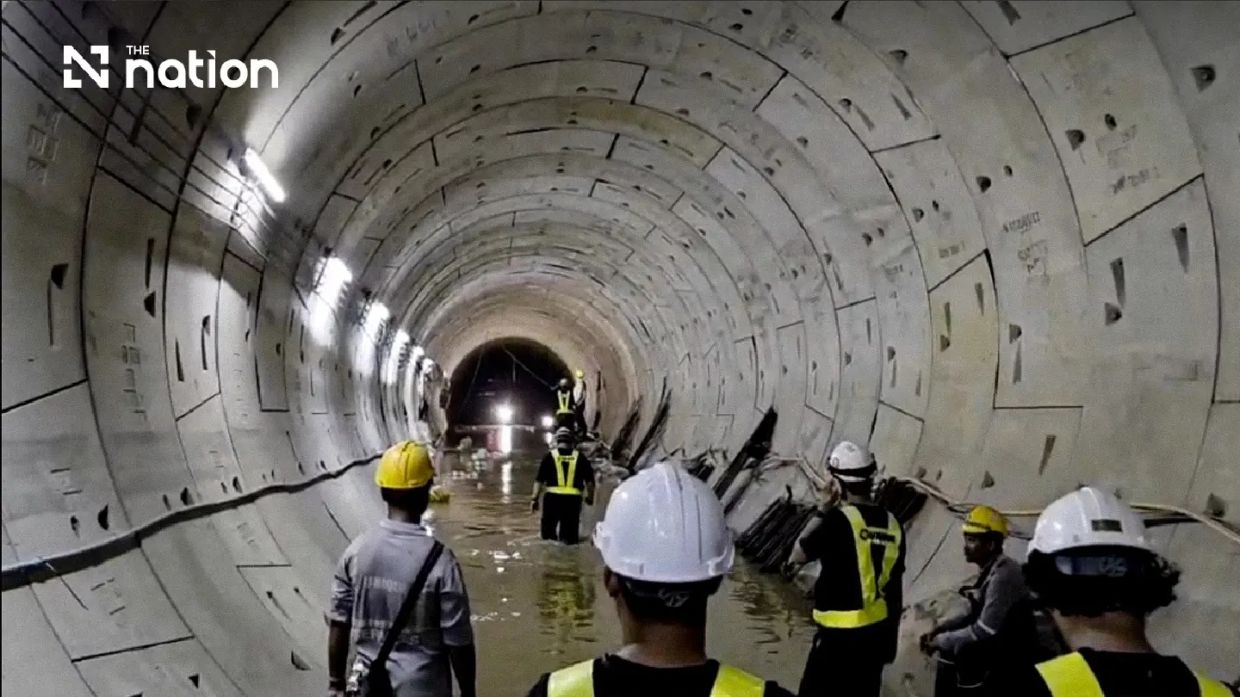
Bangkok's troubled Purple Line mass transit project faced fresh complications on Wednesday night when water penetrated a construction shaft during intense rainfall, forcing Prime Minister Anutin Charnvirakul and several senior transport officials to rush to Wongwian Yai for an emergency inspection. The breach occurred in an underground section of the southern extension, specifically within the Tao Poon–Rat Burana tunnel area that forms part of the ambitious Kanchanaphisek Ring Road component. The incident underscored persistent challenges dogging Thailand's flagship transit development and reignited concerns about structural integrity in excavation work that has already produced one catastrophic collapse.
Water began accumulating within the construction worksite early on July 8 as monsoon rain continued throughout the day. Engineers monitoring the Saphan Phut–Dao Khanong section discovered that water levels were rising within the shaft beneath the active tunnel area, prompting immediate escalation to transport authorities. The situation deteriorated sufficiently that Deputy Prime Minister Phiphat Ratchakitprakarn, along with Deputy Transport Ministers Siripong Angsakulkiat, Phattharaphong Phatraprasit, and Sanphet Boonyamanee, arrived at the site to assess conditions. Anutin's midnight arrival signalled the gravity with which Thailand's political leadership viewed the problem, reflecting anxiety about reputational damage and public confidence in infrastructure safety.
The affected section falls under Contract 4 of the Purple Line's southern expansion, a 14.982 billion baht undertaking being executed by Unique Engineering and Construction Public Company Limited, or UNIQ. Current operations focus on tunnel boring and retaining wall construction in an exceptionally congested urban environment where the margins for error are minimal. The contractor's performance carries heightened scrutiny following the September 2025 collapse near Vajira Hospital, which saw tunnel infrastructure fail catastrophically and pull surface soil into subsidence craters. That incident transformed public perception of the entire project and intensified official oversight mechanisms.
Phattharaphong reported that initial assessments suggested the leak remained manageable, though he immediately issued directives for comprehensive technical evaluation to pinpoint the exact breach location and underlying causes. The Transport Ministry mandated that MRTA and UNIQ establish continuous surveillance protocols, conduct full structural analysis, and implement corrective measures with extreme urgency. Officials particularly emphasized preventing water escalation that might compromise tunnel integrity, threaten public safety, or derail the already-delayed project schedule. All parties received instructions to document progress systematically and demonstrate compliance with engineering standards and safety protocols.
Anutin characterised the response as fundamentally engineering-driven, with dual focus on immediate water management and longer-term preventive approaches. The government's assessment diverged substantially from the Vajira incident, where structural failure preceded detection and rapid surface deterioration. In contrast, the Wongwian Yai situation involved early observation of seepage, allowing authorities to implement containment measures before critical thresholds emerged. Officials maintained that accumulated water had not reached levels necessitating nearby road closures or mass evacuation protocols, though the precautionary nature of the high-level ministerial response suggested deeper anxieties about potential complications.
The prime minister indicated that workforce efforts beginning at dawn had successfully stabilized water accumulation, with no evidence of dangerous rate escalation. The MRTA concurrently deployed specialized instrumentation to monitor structural movement in surrounding buildings and infrastructure, vigilance that reflected lessons learned from previous incidents. Anutin stressed that monitoring had detected no abnormal displacement patterns thus far, yet emphasized the necessity for prolonged observation given the unpredictable nature of subsurface conditions and the dense urban setting surrounding the construction zone. The accelerated inspection timeline reflected political pressure to demonstrate competent crisis management and restore public confidence.
When questioned about the unusually rapid ministerial mobilization, Anutin suggested the enquiry had emerged informally through group messaging rather than constituting a formal emergency declaration. His late-night site visit reflected personal determination to verify that problems received adequate attention before cascading into secondary crises. This framing attempted to normalize the response while simultaneously emphasizing the prime minister's direct engagement with critical infrastructure challenges. The answer implicitly acknowledged that Thailand's political class had internalized lessons from the Vajira catastrophe and now prioritized preemptive action over reactive damage control.
The Purple Line project has long symbolized Bangkok's ambitions for comprehensive mass transit modernization, yet execution has proven persistently problematic. This latest incident exemplifies the technical complexity and financial stakes characterizing such massive underground construction in an unforgiving tropical climate with monsoonal precipitation patterns. The southern extension represents crucial connectivity for southwestern districts, yet persistent setbacks have eroded public confidence and complicated project financing. Water ingress during heavy rainfall particularly concerns engineers because such breaches can propagate rapidly through foundation systems, destabilize adjacent structures, and necessitate extended closures for repair operations.
The contractor's reputation and financial performance increasingly depend on demonstrating reliable safety protocols and transparent communication with regulatory authorities. UNIQ faces implicit pressure to execute repairs swiftly while maintaining scrupulous documentation of all remediation efforts. Failure to convince officials of adequate preventive measures could result in work suspension, contract renegotiation, or replacement. Government officials, conversely, must balance assurance to the traveling public with transparency about actual risk levels, a delicate equilibrium that the Vajira precedent has rendered considerably more challenging.
For Southeast Asian infrastructure observers, the incident illustrates the vulnerability of major transit projects to climate impacts and the political consequences of structural failures in democracies where media scrutiny and public accountability mechanisms remain robust. Thailand's willingness to mobilize senior leadership for night-time site inspections contrasts sharply with regulatory capture scenarios in some regional jurisdictions, yet also reflects systemic inefficiencies that might permit such serious problems to emerge despite existing oversight frameworks. The Purple Line's trajectory will significantly influence future investor confidence in Thai infrastructure development and the viability of comparable transit megaprojects across the region.

