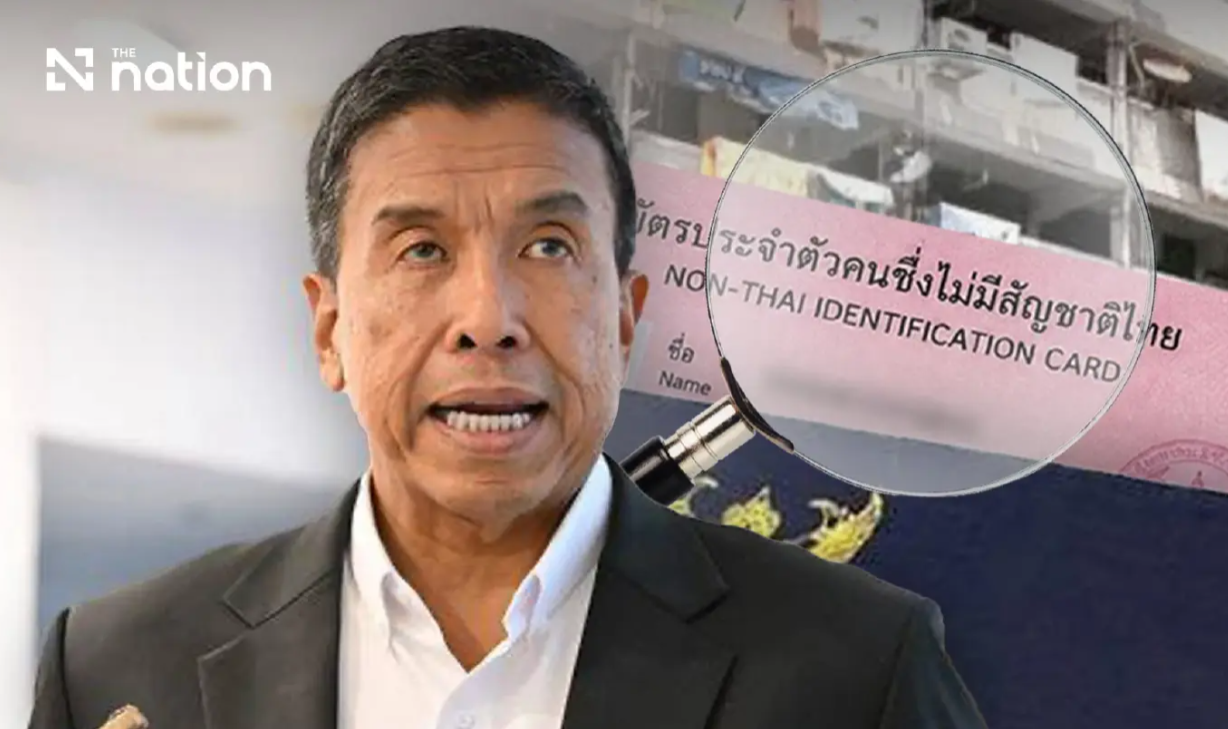
Bangkok Governor Chadchart Sittipunt has instructed all 50 district offices across the Thai capital to conduct a comprehensive 10-year audit of household-registration records, responding to mounting evidence of coordinated fraud in the issuance of pink cards—the identification documentation provided to foreign nationals legally residing in Thailand. The sweeping review, which encompasses records dating back to 2017, aims to uncover whether non-Thai nationals were systematically registered into Thai household units through irregular channels, thereby creating the paperwork foundation needed to apply for pink-card identification.
The suspected fraud operates by exploiting structural gaps in Thailand's civil-registration machinery, allowing perpetrators to assume or manipulate another person's official residential status. District offices received orders to submit initial findings by Friday, August 21, signalling the urgency Bangkok authorities place on the investigation. The scheme's mechanics reveal a sophisticated understanding of Thailand's registration bureaucracy, with multiple techniques allegedly deployed depending on circumstances and opportunity.
One method identified by investigators involved birth certificates belonging to children born to foreign parents in Thailand who subsequently returned abroad with their families. These certificates remained in Thai records and were allegedly repurposed to transfer unrelated individuals into household registrations under false identities. A second approach apparently moved names from centralised household registers into ordinary residential registrations, while a third technique created fraudulent familial relationships between adults and children, colloquially termed "phantom child" and "phantom father" arrangements by Thai officials. Each method accomplished the same objective: establishing a paper trail that made pink-card applications appear legitimate.
The Bangkok Metropolitan Administration detected the irregularities initially in Din Daeng district, where the sheer density of suspicious registrations became impossible to ignore. One residential property measuring merely 40 square metres somehow maintained household registrations for between 40 and 45 individuals—a physical impossibility that prompted closer scrutiny. Subsequent examination of Din Daeng's 2024 records identified more than 2,000 apparently irregular address transfers, suggesting that either widespread corruption was concentrated in that district or it served as a hub for brokers facilitating fraudulent registrations across Bangkok.
The investigation has already resulted in administrative consequences for four Bangkok officials linked to the matter, all of whom have been temporarily removed from their posts pending formal disciplinary inquiries. The administrative action does not constitute a finding of wrongdoing, yet it signals that authorities are treating the matter seriously and are prepared to hold employees accountable if evidence warrants. A fourth Din Daeng employee's removal broadened the investigation's scope, suggesting that multiple officials may have been involved in processing fraudulent applications or turning a blind eye to irregular submissions.
Chadchart acknowledged that the suspected fraud scheme likely involves collaboration between brokers—individuals who profit by facilitating the fraudulent registrations—and government employees willing to approve questionable applications. However, the Bangkok Metropolitan Administration faces significant investigative constraints. The BMA cannot independently compel non-governmental actors to disclose financial information or trace monetary transactions between brokers and officials. Consequently, police assistance becomes essential to map money flows and establish whether payments changed hands between suspected facilitators and corrupt officials. An investigation committee will be established to examine both the registration records themselves and the conduct of implicated individuals.
Governor Chadchart committed to pursuing the investigation wherever evidence leads, explicitly stating that the inquiry would not spare senior executives or retired officials if their involvement emerged during the probe. This commitment reflects broader anti-corruption pledges but also acknowledges that pink-card fraud may have systemic roots extending beyond junior staff. The preliminary estimate of approximately 3,000 questionable registrations remains unconfirmed, and Chadchart cautioned that these cases may be distributed across multiple properties rather than concentrated geographically, which would complicate systematic detection but suggest a wider network of fraud.
The screening methodology will initially focus on properties with at least 15 registered residents, a threshold that may subsequently be lowered to permit random audits of individual homes. This calibrated approach attempts to balance thorough investigation with the need to avoid disrupting legitimate residents. The BMA is simultaneously preparing procedural reforms designed to prevent future fraud by closing the loopholes that facilitated the current scheme. District directors and section heads will share responsibility for registration approvals, reducing the power of individual officers to approve questionable applications unilaterally.
Additional safeguards include periodic rotation of officials assigned to sensitive registration positions, mitigating the risk that prolonged tenure in a single department creates entrenched relationships susceptible to corruption. The Bangkok Metropolitan Administration is also expanding its anti-corruption policies to place greater emphasis on administrative affairs and civil registration. Working procedures will be reviewed to enhance transparency while ensuring that legitimate applicants are not unfairly penalised during the investigation phase—a delicate balance that will require careful procedural calibration.
For Malaysia and other Southeast Asian nations, Bangkok's pink-card fraud investigation carries broader implications. Thailand's identity-card irregularities underscore how criminal networks can exploit administrative vulnerabilities to circumvent immigration and residency controls. The scheme's scope—potentially involving hundreds or thousands of individuals—suggests that organised brokers have developed sophisticated understanding of registration processes across multiple districts. Southeast Asian governments, including Malaysia, should examine whether similar vulnerabilities exist in their own household-registration and identity-documentation systems. The investigation also highlights how corruption within immigration and civil-registration bureaucracies can be difficult to detect until patterns become statistically impossible to explain away, arguing for regular audits and improved transparency in residency and documentation processes throughout the region.

