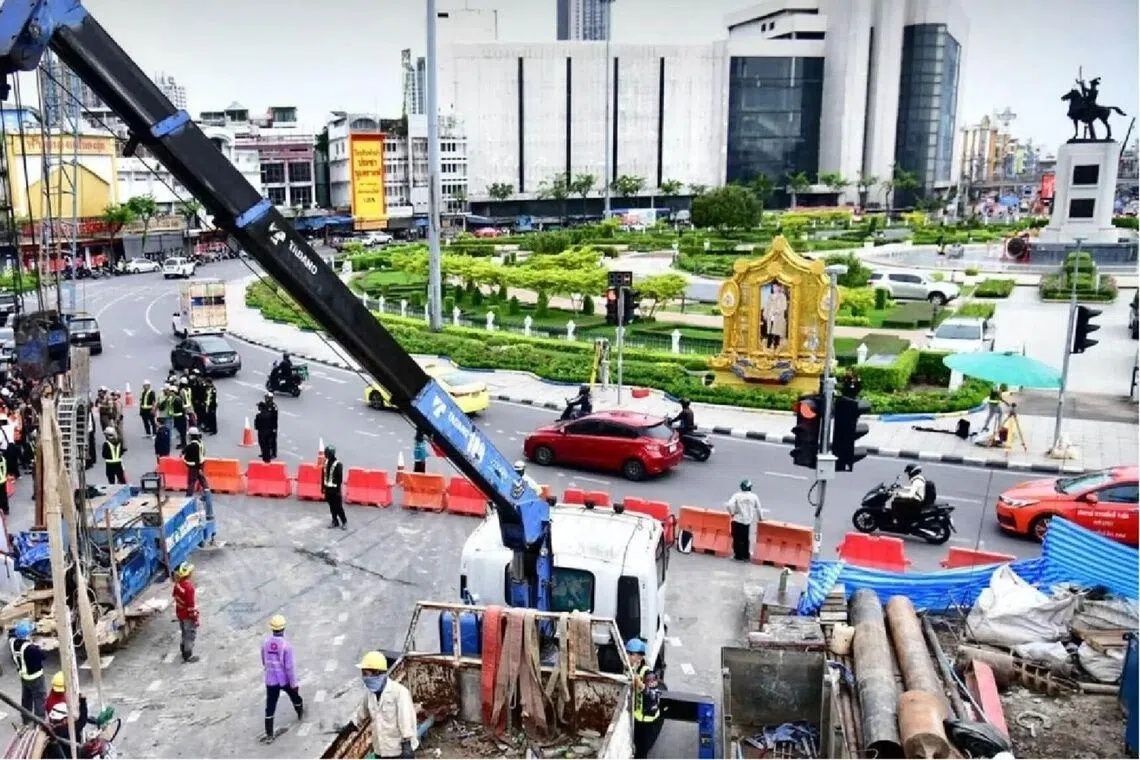
Bangkok's response to an emerging geological hazard intensified over the past week as city authorities evacuated around 60 people from three commercial buildings within 30 metres of a subsidence site near Wongwian Yai, following water infiltration at a subway construction tunnel. The incident has brought fresh scrutiny to the southern Purple Line project, which has already encountered significant complications during its development across the capital's crowded urban landscape.
The problem originated when water began seeping into a drainage sump located at the lowest point of the southern Purple Line construction tunnel. This seemingly contained engineering failure triggered a chain of consequences: as the sump filled with water, surrounding soil particles were drawn into the underground structure, destabilised the ground layer above, and caused visible subsidence of the road surface. The cascading nature of the failure pattern raised immediate concerns about structural integrity in adjacent buildings, prompting authorities to take precautionary action.
Bangkok governor Chadchart Sittipunt personally visited the affected site on July 9 alongside deputy governor Wisanu Subsompon and deputy permanent secretary Kanokwan Iamlim, underscoring the seriousness with which city leadership has approached the incident. Early assessments indicated that water levels had begun stabilising and the rate of subsidence had slowed, though officials emphasised that continuous monitoring would remain essential. This initial stabilisation proved significant enough to allow residents to return within a week rather than face longer-term displacement.
The evacuated residents from the three commercial buildings have been relocated to temporary accommodation, primarily hotels, with all associated costs—housing, compensation, and related expenses—to be borne by the Mass Rapid Transit Authority of Thailand's project contractor. Authorities stated they would conduct comprehensive structural assessments of the buildings and surrounding infrastructure before permitting residents to return or lifting any restrictions on building access and use. This methodical approach reflects lessons learned from previous subsidence incidents in the city.
To mitigate further risk, the Department of Disaster Prevention and Mitigation deployed two Rescue Guardian monitoring units within 30 metres of where cracks appeared in the road surface. These sophisticated sensor systems track tilting and structural movement continuously in real time, transmitting data to a centralised monitoring station that immediately alerts operators if abnormal movement patterns emerge. This technological safeguard provides early warning of any deterioration that might necessitate additional evacuations or structural interventions.
Engineers from Thailand's national Urban Search and Rescue team joined the inspection effort to evaluate surrounding structures and ensure that response measures adhered to established engineering and public safety standards. The Department of Disaster Prevention and Mitigation deployed generators, specialised lighting equipment, and other machinery to support round-the-clock operations. Rescue foundations and volunteer organisations were positioned on standby to provide emergency medical assistance or patient transfers if required. A forward command centre was established near the subsidence point, creating a coordinated hub connecting the Bangkok Metropolitan Administration, the Mass Rapid Transit Authority of Thailand, the project contractor, district authorities, police, and emergency response teams.
Immediate engineering priorities focused on sealing the water leak and preventing additional soil from being drawn into the tunnel. Continuous monitoring instrumentation tracked road surface changes, soil movement patterns, water leakage volumes, and building condition indicators. Authorities closed all outbound lanes of Prajadhipok Road over a 200-metre stretch from Ban Khaek intersection toward the King Taksin the Great Monument at Wongwian Yai. This closure was designed to reduce traffic vibration that might further destabilise soil or stress nearby buildings. Traffic management authorities temporarily converted two inbound lanes for outbound vehicle use.
The sinkhole's location creates particular challenges for traffic management in a critical urban bottleneck. Motorists arriving from Memorial Bridge or Phra Pok Klao Bridge have been directed to turn at Ban Khaek intersection and use alternative routes via Itsaraphap, Lat Ya, or Somdet Chao Phraya roads. The closure area sits near major educational institutions, including Suankularb Wittayalai School and Suksanari School, meaning that the road restrictions directly affect daily school transport patterns. Governor Chadchart indicated that Bangkok may implement measures previously deployed following the subsidence incident near Vajira Hospital, potentially including additional shuttle services to reduce parent vehicle volumes in the affected zone.
This incident represents the second significant subsidence event affecting the southern Purple Line project, as the same tunnel alignment experienced a road collapse near Vajira Hospital previously. However, authorities noted that different contractors managed the two construction sections. The recurrence of geological complications raises questions about ground investigation methodologies, contractor supervision, and the inherent risks of deep underground construction in Bangkok's complex soil conditions. The city's rapid urbanisation, existing utility networks, and variable geological strata create substantial challenges for major infrastructure projects.
Authorities made clear that all restrictions would remain in place until engineers confirmed that buildings, road surfaces, and surrounding infrastructure met safety standards. Further traffic arrangements would be announced once officials determined the necessary duration of the road closure. The incident underscores ongoing tensions between Bangkok's infrastructure development needs and the risks posed to existing urban communities. For residents and businesses in affected areas, such disruptions represent significant inconvenience and financial impact, while for city planners, they illuminate the technical complexities of delivering major transit projects beneath a densely populated metropolis.

