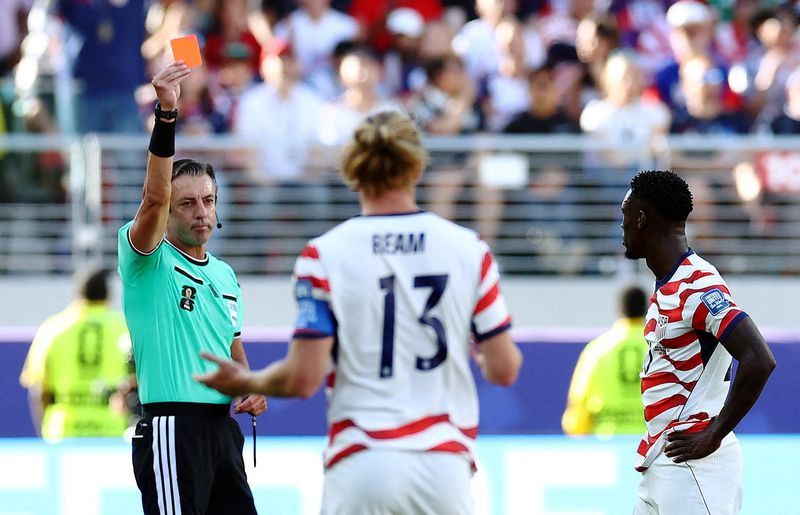
The fallout from FIFA's decision to allow U.S. forward Folarin Balogun to play despite receiving a World Cup red card threatens to erode confidence in football's officiating and disciplinary processes, according to warnings from Premier League refereeing chief Howard Webb and chief executive Richard Masters. The controversy surrounding the striker's dismissal and subsequent suspension reversal has created a damaging narrative that could extend well beyond the global tournament and contaminate perceptions of fairness throughout the domestic English season, which commenced on Friday.
Balogun's red card dismissal stands as one of the most contentious moments of the recent World Cup campaign, particularly given the circumstances surrounding its overturn. U.S. President Donald Trump publicly intervened in the matter, and FIFA subsequently lifted the American striker's suspension through a process that observers have criticised for lacking transparency and proper procedural safeguards. This sequence of events has created a perfect storm of concern for football's governing bodies, as it appears to validate suspicions that political pressure can influence sporting outcomes.
Webb, who heads Pro Ref (the successor to the Professional Game Match Officials Limited or PGMOL), articulated his concerns by distinguishing between legitimate debate about the original decision and the problematic perceptions created by the subsequent chain of events. Rather than focusing his criticism on whether referees got the initial call right or wrong, Webb emphasised that the real damage stems from the manner in which the suspension was handled after the match. The intervention of political figures and the apparent creation of an unprecedented resolution process have fundamentally undermined the appearance of impartiality that football officials depend upon.
"I was really troubled by it," Webb stated, drawing on his experience as the referee who officiated the 2010 World Cup final. He highlighted the fundamental problem: the suspension was lifted through a procedure that seemingly did not exist prior to the tournament's commencement, following admitted political pressure placed on FIFA. This ad hoc approach has raised troubling questions about the organisation's commitment to consistent, rule-based governance and has provided ammunition to those who harbour doubts about the integrity of football's institutional systems.
The timing of this controversy could not be worse, according to Webb's analysis. Football's regulatory environment already faces mounting challenges from social media amplification of controversial decisions and the tendency of online commentators to attribute questionable motives to officials without evidence or factual foundation. When fans and analysts encounter disagreeable decisions, they increasingly frame these moments as evidence of systemic corruption, spinning elaborate theories about behind-the-scenes manipulation. The Balogun episode, by appearing to confirm that external pressure can influence FIFA's decision-making, has provided apparent validation for these conspiratorial narratives, making it significantly harder for officials to maintain credibility when defending controversial calls.
Webb expressed particular alarm at how the incident might contaminate the Premier League season ahead. The concern is not theoretical; with millions watching every match and social media providing instant platforms for scrutiny, every marginal refereeing decision will face intense examination. The backdrop of the Balogun affair means that officials' judgment calls will be interpreted through a lens of suspicion that the affair has now activated. As Webb put it, the episode "doesn't help" and represents "the sort of influence that can be had, which is just really not reflective of the game that I know." This sentiment underscores how deeply troubling senior football figures find the implications of FIFA's handling of the situation.
Richard Masters, the Premier League's chief executive, lamented that the World Cup narrative has become dominated by administrative and off-field controversies rather than the quality of football itself. He noted that the tournament featured compelling storylines worthy of celebration—Spain's dominance as the finest team on display and England's agonising semi-final elimination—yet these narrative threads have been overshadowed entirely by discussions of disciplinary processes and political intervention. This represents a significant opportunity cost for the sport, as the global tournament's cultural significance has been diminished by institutional failures.
Masters also identified a structural deficiency in FIFA's regulatory framework that the Balogun situation has exposed. Unlike many domestic competitions, FIFA's disciplinary regulations do not provide a mechanism to review and overturn red card decisions through proper appeals processes. This absence of formal procedures created the conditions for the ad hoc, seemingly improvised solution that the Balogun situation necessitated. Masters characterised the episode as "very difficult to comprehend," acknowledging that the absence of standard mechanisms for addressing red card decisions created unnecessary controversy and undermined FIFA's credibility.
The implications extend into the Premier League season with considerable force. As the world's most heavily scrutinised domestic competition, every major refereeing decision and VAR intervention will face intense examination and contestation. Webb has expressed particular concern that the World Cup fallout has armed critics with fresh arguments that officials' integrity is compromised. This represents a substantial challenge to the governance of the sport, as officials require a baseline level of public confidence to function effectively.
Adding complexity to this environment, Webb announced that the new Premier League season will be governed by an unprecedented number of new laws designed to reduce time-wasting and increase match tempo. These regulatory changes will result in fewer cautionary warnings from referees and more situations being penalised across the board. Webb indicated that fans should anticipate a visible shift in enforcement philosophy, with officials applying stricter standards not merely in opening weeks but throughout the season's duration.
The strategy underlying these new enforcement standards reflects a belief that penalising offences more consistently will force tactical adjustments among players, ultimately reducing the frequency of problematic situations. Webb noted that while physical contact remains part of football's fundamental nature and a high threshold for intervention will be maintained, the overall trajectory points toward stricter application of existing rules. This enforcement shift could amplify tensions if fans interpret stricter penalties as evidence of inconsistency or bias, particularly given the damaged credibility stemming from the Balogun affair.
For Malaysian and Southeast Asian football communities, this English domestic situation carries meaningful implications. The Premier League maintains enormous global viewership and cultural influence across Asia, shaping perceptions of how professional football should be administered. The apparent willingness of FIFA to override established processes under political pressure, combined with the regulatory gaps that enabled the Balogun controversy, sends troubling signals about institutional governance in international sport. As Asian football administrators develop their own regulatory frameworks and confront political pressures of their own, the Premier League's situation offers cautionary lessons about the importance of transparent, consistent, and pressure-resistant disciplinary processes.

