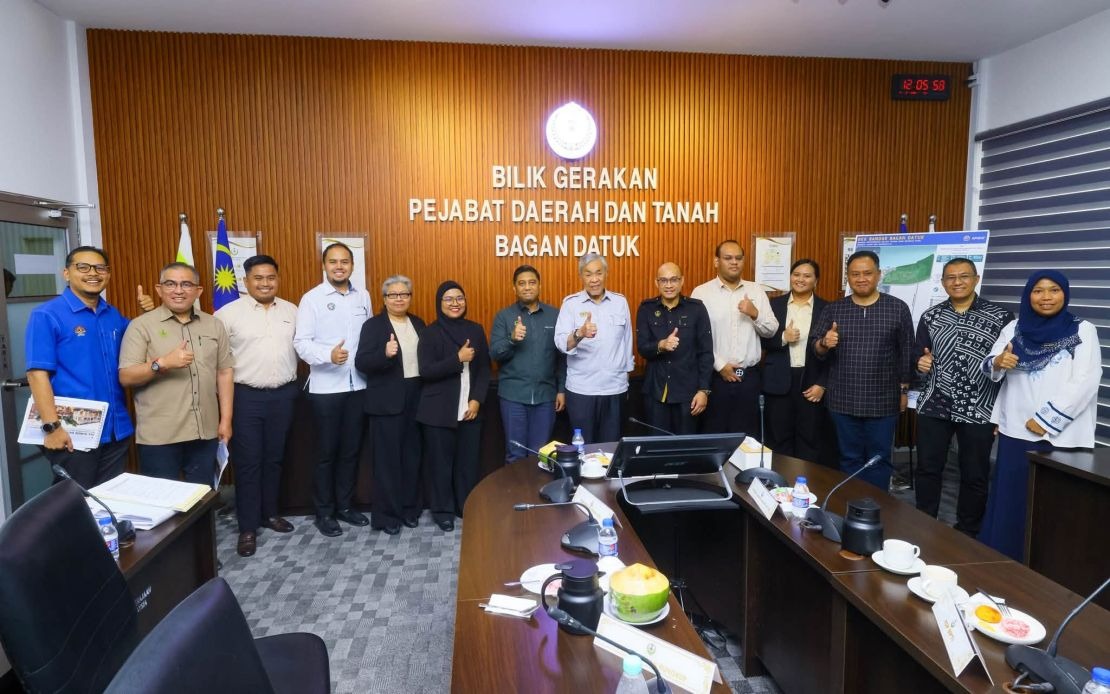
Deputy Prime Minister Datuk Seri Dr Ahmad Zahid Hamidi has articulated an ambitious vision for transforming Bagan Datuk into a modern administrative hub, positioning the Perak parliamentary constituency as a model for planned urban development in Malaysia. Speaking after reviewing the special area plan for the region, Zahid emphasised the township's capacity to evolve into a distinctive centre that balances administrative functions with residential comfort and business viability.
Zahid, who represents Bagan Datuk in Parliament, underscored the critical importance of translating the district's inherent assets into tangible improvements for constituents. His remarks came during a structured engagement with the Teluk Intan Municipal Council, Bagan Datuk District authorities, and land office officials, alongside planning consultants tasked with refining the Bagan Datuk special area plan (RKK). This collaborative approach signals an intention to align municipal governance with long-term spatial design objectives.
The deputy premier stressed that developing Bagan Datuk as a competitive administrative town requires careful attention to multiple dimensions. Beyond administrative capacity, the vision encompasses residential livability—a crucial consideration for attracting and retaining skilled professionals and families. The concept of an "administrative town in a park" suggests integration of green spaces and environmental sustainability into the urban fabric, differentiating the constituency from conventional sprawling developments across Malaysia.
Zahid's personal connection to Bagan Datuk informs his commitment to the constituency's advancement. As a native of the area, he framed development aspirations through the lens of local affection and stewardship, positioning himself as an advocate for planned, community-informed growth rather than haphazard expansion. This resonates with contemporary Malaysian debates about equitable regional development and the importance of nurturing secondary cities and towns beyond Kuala Lumpur and major metropolitan centres.
The special area plan study represents a formal mechanism for translating abstract aspirations into actionable urban design frameworks. Such plans typically address zoning configurations, transportation networks, commercial districts, residential neighbourhoods, public amenities, and environmental safeguards. By engaging municipal councils and land authorities early, planners can align regulatory mechanisms with development goals and ensure coordination across jurisdictions—a persistent challenge in Malaysian governance.
Broader economic opportunities constitute a central pillar of Zahid's development thesis. For Bagan Datuk to emerge as a competitive administrative town, it must generate diversified employment prospects beyond government services. This requires targeted industrial development, support for small and medium enterprises, and attraction of knowledge-intensive sectors. The administrative designation itself could catalyse private investment if properly marketed to businesses seeking alternatives to congested metropolitan areas.
The emphasis on infrastructure quality acknowledges a fundamental reality: Malaysia's secondary towns often struggle with inadequate transportation networks, digital connectivity, and utility systems. Bagan Datuk's potential remains constrained without addressing these foundational requirements. Strategic infrastructure investments—including improved road access to Kuala Lumpur and regional hubs, broadband expansion, and reliable water and power systems—would meaningfully enhance the constituency's attractiveness to both residents and investors.
Zahid's framing of development as a collective responsibility distributed among stakeholders reflects contemporary governance philosophy emphasising multi-actor collaboration. However, translating such aspirations into reality demands sustained funding, political will across electoral cycles, and technical capacity within municipal administrations. Malaysian constituencies have witnessed numerous development plans that remained incompletely realised owing to budget constraints, competing priorities, and administrative discontinuities.
For Malaysian and Southeast Asian observers, Bagan Datuk's trajectory carries relevance beyond Perak's borders. The region faces persistent imbalances between capital cities and provincial areas, fuelling urbanisation pressures and regional inequality. Successful transformation of secondary constituencies into genuinely competitive, livable administrative centres could provide a replicable template for balanced national development. This model challenges the assumption that only metropolitan consolidation drives prosperity.
The timing of these development discussions merits consideration within Malaysia's broader economic recovery and infrastructure spending cycles. As federal and state governments allocate resources, constituencies with articulate, politically influential advocates—such as a Deputy Prime Minister—often secure preferential access to funding and implementation support. This reality, while commonplace, underscores the persistent tension between merit-based planning and political patronage in Malaysian development allocation.
Zahid's commitment to ensure development benefits constituents specifically acknowledges residents' legitimate concerns about gentrification, displacement, and exclusion from prosperity narratives. Bagan Datuk's transformation must preserve affordability, maintain community cohesion, and genuinely improve living standards for existing populations rather than exclusively attracting external migrants and capital. Whether the planned approach adequately safeguards these dimensions remains to be demonstrated through implementation.
Moving forward, the success of Bagan Datuk's administrative town vision will depend on transparent planning processes that incorporate local feedback, realistic budget allocation sustained across political cycles, and institutional capacity to execute complex urban development. The special area plan's completion represents a crucial intermediate step; the genuine test emerges during implementation, when abstract blueprints encounter financial constraints, competing land interests, and the practical complexities of Malaysian municipal governance.

