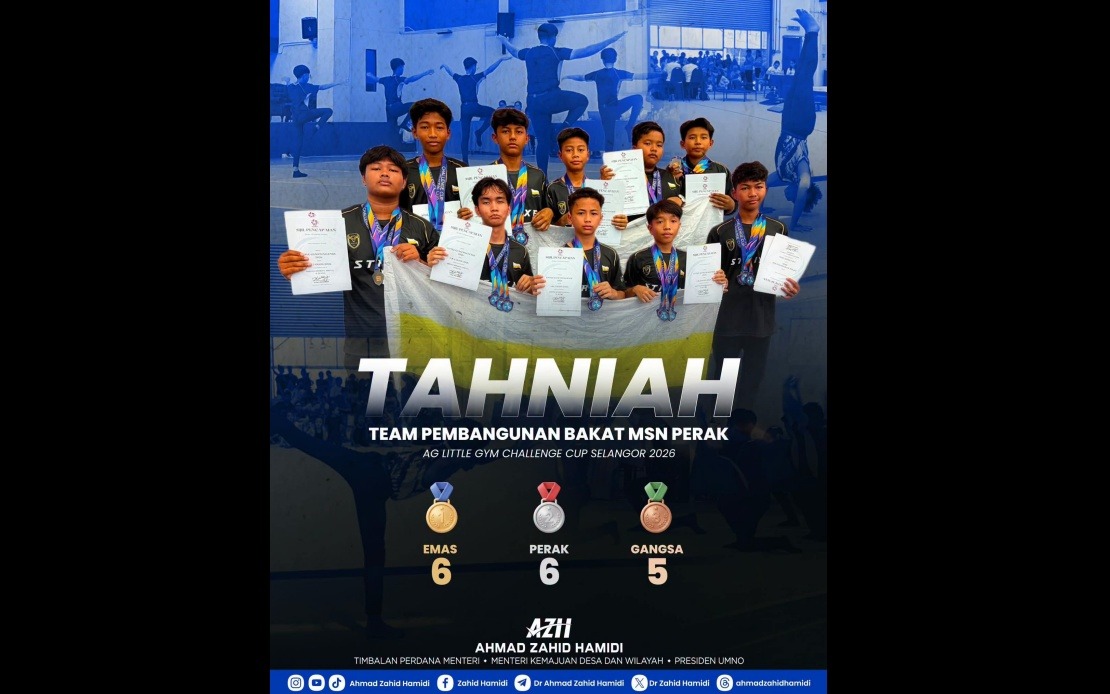
Young gymnasts representing Bagan Datuk have etched their names into the district's sporting history by delivering an exceptional medal haul at the AG Little Gym Challenge Cup Selangor 2026, a regional competition held in Kajang on August 1. The team's six gold medals, complemented by six silver and five bronze medals, represent a breakthrough performance that underscores the emerging talent pool within the constituency and signals growing competitiveness in youth gymnastics across Selangor.
The achievement has resonated at the highest echelons of Malaysian politics, with Deputy Prime Minister Datuk Seri Dr Ahmad Zahid Hamidi, the Member of Parliament for Bagan Datuk, publicly celebrating the success through social media. His endorsement carries weight beyond ceremonial acknowledgment, signalling the government's investment in youth athletic development and the wider recognition that sporting excellence contributes to national competitiveness. Zahid's intervention reflects an understanding that grassroots sporting achievements can serve as catalysts for community pride and recruitment into competitive programmes.
In his remarks, the Deputy Prime Minister emphasised that the Bagan Datuk gymnasts have demonstrated the district's capacity to nurture excellence beyond the academic sphere. He underscored a critical narrative gaining traction in Malaysian education policy: that young people in smaller districts and towns possess latent sporting talent that merely requires appropriate infrastructure, coaching expertise, and parental support to flourish. This framing counters perceptions that athletic development clusters primarily around major urban centres and metropolitan schools.
The distinction Zahid drew between academic achievement and sporting prowess is strategically significant. Historically, Malaysian discussions of youth excellence have tilted heavily toward examination results and university placements. By celebrating gymnastics medals with equivalent enthusiasm, the Deputy Prime Minister signals a recalibration of national values that recognises physical discipline, artistic expression, and competitive athletics as legitimate pathways to distinction. This messaging resonates particularly in smaller constituencies where sports clubs may represent accessible advancement routes for young people.
The Bagan Datuk Generasi Muda Gymnastics Club, the grassroots organisation behind the medal sweep, framed their victory not as a culmination but as an intermediate milestone within a longer developmental trajectory. Their public statement emphasised the interconnected elements that produced the result: individual talent, systematic training regimens, mental resilience, and institutional support. This vocabulary—reflecting contemporary sports science principles—suggests the club operates with professional coaching standards rather than informal recreational guidance, indicating institutional maturation within the district's sporting infrastructure.
The gymnasium club's assertion that "every medal reflects your hard work, discipline, and countless hours of training" articulates a philosophy that resonates with Malaysian aspirational values centring on meritocratic advancement through persistent effort. This framing also implicitly challenges perceptions of Malaysian youth as insufficiently disciplined or physically inactive—concerns occasionally raised in public health discourse. The Bagan Datuk team becomes a counternarrative, embodying values that align with official rhetoric around national development.
For Selangor specifically, Bagan Datuk's performance at the state-level AG Little Gym Challenge Cup indicates diversifying talent distribution across the state. Traditionally, gymnastics competitiveness has concentrated in certain enclaves, with access to facilities and elite coaching restricted to affluent areas. A smaller district municipality achieving such prominence suggests either increasing investment in grassroots facilities, improving talent identification mechanisms, or both. This dispersion strengthens Selangor's athletic pipeline and creates competitive pressure that may elevate standards across state-level competitions.
The club's commitment to "train harder and come back even stronger" signals competitive ambitions extending beyond regional competitions. National-level events and potentially international junior circuits may feature Bagan Datuk representatives in coming years. Malaysian gymnastics, while not a traditional strength internationally compared to weightlifting or badminton, has shown incremental improvement in technical execution and consistency. Young cohorts from emerging regional programmes contribute to this gradual elevation of standards.
Parental involvement, explicitly acknowledged in both Zahid's tribute and the gymnastics club's messaging, represents a foundational layer often underestimated in Malaysian sporting discourse. The willingness of families to commit time, resources, and logistical support to training and competition schedules reflects changing attitudes toward non-academic enrichment. For a district like Bagan Datuk, this represents a cultural shift where competitive gymnastics sits alongside—rather than subordinate to—academic pursuits as a legitimate developmental channel.
The medal distribution itself—six gold, six silver, five bronze—indicates competitive depth within the squad rather than reliance on isolated champions. This balanced distribution suggests systematic programme development targeting multiple athletes across various age categories or apparatus disciplines. Such an approach proves more sustainable than programmes dependent on individual prodigies, as it builds institutional capacity and provides development benchmarks across cohorts.
Looking forward, the Bagan Datuk success may catalyse increased investment in gymnastics infrastructure within the district and potentially other similar constituencies. Success breeds resources; competitive advantage attracts coaching talent and funding. Neighbouring districts may similarly assess their sporting potential, generating beneficial rivalry. For Malaysian gymnastics federally, emerging programmes outside traditional strongholds broaden the recruitment base for national teams and reduce geographic disparities in athletic development.

