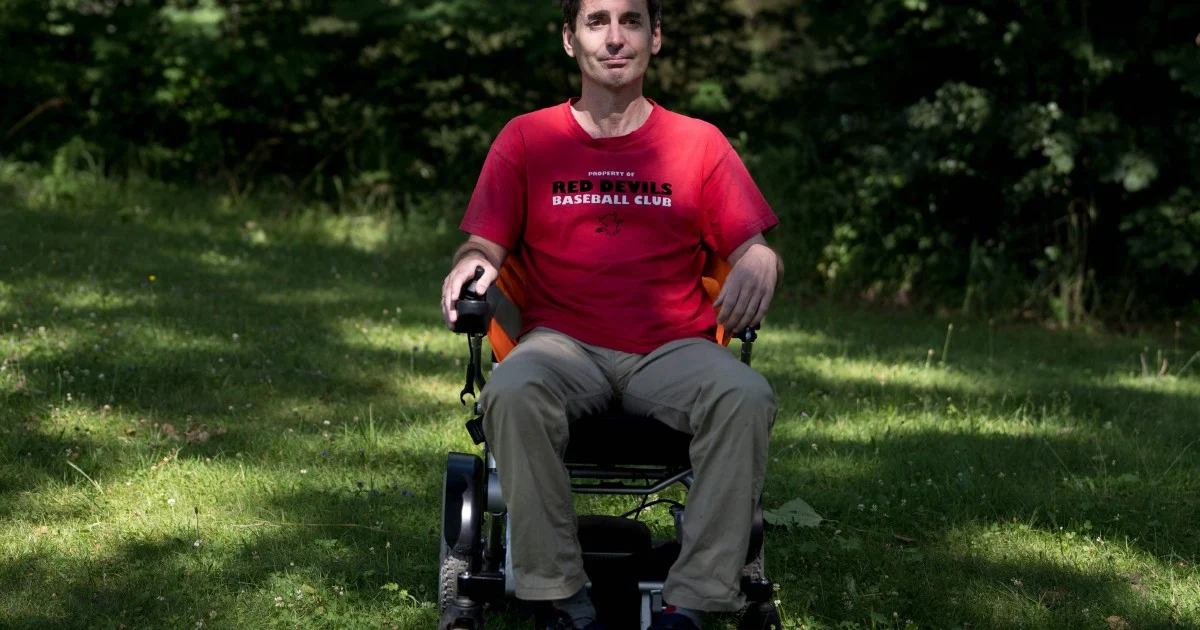
An Austrian man with mobility disabilities has taken the extraordinary step of pursuing legal proceedings against his own government at the European Court of Human Rights, contending that Austria's sluggish approach to climate change constitutes a breach of his basic human entitlements. Mex Muellner, confined to a wheelchair, has grown increasingly convinced of his case's merit as he navigates successive heatwaves with minimal respite, his medical condition making him particularly vulnerable to the escalating temperatures sweeping across Europe.
The Austrian's grievance represents a novel legal approach to climate accountability in the region. Rather than framing the dispute as an environmental matter alone, Muellner's claim explicitly links climate inaction to violations of established human rights protections. This argumentative strategy reflects a growing international movement among civil society and legal practitioners to establish direct causal connections between governmental climate negligence and infringements of fundamental freedoms and dignities.
Muellner's personal circumstances illustrate the asymmetrical impact of climate breakdown across different population segments. Individuals with restricted mobility face compounded dangers during extreme heat episodes. His inability to easily relocate to cooler environments, access air-conditioned public facilities without obstruction, or engage in heat-mitigation activities available to the general population creates a protective deficit that he attributes directly to state failings in climate policy implementation. The predicament highlights how climate justice intersects with disability rights—a connection often overlooked in mainstream climate discourse.
Austria, despite positioning itself as an environmentally conscious European nation, has faced mounting criticism for falling short on its climate commitments. The country has repeatedly missed intermediate targets for greenhouse gas reductions and has been comparatively slow in transitioning away from fossil fuel dependency relative to peer economies. Muellner's legal challenge essentially forces the Austrian state to answer whether its current climate trajectory meets the constitutional and international obligations it has undertaken.
The case carries significant implications for Southeast Asian nations already grappling with intensifying heat stress and vulnerability patterns. Countries across the region—including Malaysia, Thailand, Vietnam, and Indonesia—experience even more pronounced temperature extremes than Central Europe, yet often lack the institutional capacity or financial resources that Austria possesses for climate adaptation and mitigation. If Muellner's arguments gain traction in European jurisprudence, it could establish precedent that extracts stronger climate accountability measures from governments worldwide, including those in the developing world where adaptive capacity remains limited.
The European Court of Human Rights mechanism itself represents one of the world's most influential human rights institutions. A successful ruling in Muellner's favour could reshape how courts globally interpret state obligations regarding climate governance. Rather than treating climate policy as a technical or political matter beyond judicial scrutiny, such a judgment would embed climate action within the framework of enforceable human rights obligations. This reframing matters enormously for developing nations, where judicial systems might otherwise defer entirely to executive discretion on environmental matters.
Disability advocacy networks across Europe have rallied behind Muellner's case as a test of whether existing human rights law adequately protects marginalised populations from climate-related harms. The argument possesses logical force: if a state recognises duties to provide reasonable accommodation for people with disabilities in other contexts—employment, transportation, public services—does it not equally bear responsibility for ensuring that climate impacts do not systematically exclude disabled individuals from accessing essential public goods or safe living conditions?
Meanwhile, Austria confronts uncomfortable questions about its climate governance model. The nation prides itself on environmental standards and participates actively in European Union climate frameworks. Yet Muellner's suit suggests a gap between formal commitments and substantive implementation. This accountability gap resonates across wealthy democracies in Southeast Asia's neighbouring regions, where similar contradictions often emerge between rhetorical environmental leadership and actual policy outcomes.
The broader pattern of using human rights courts to force climate accountability represents a tactical shift in environmental activism and advocacy. Rather than relying solely on political mobilisation, international climate agreements, or domestic legislative processes—all of which have proven slow and insufficient—civil society actors increasingly invoke established rights frameworks to compel governmental action. This approach sidesteps purely political calculations and appeals instead to judges' interpretation of fundamental human protections that transcend ordinary legislative revision cycles.
Muellner's experiences during successive heatwaves underscore the lived reality behind abstract climate statistics. When external temperatures soar beyond habitable thresholds for someone lacking independent mobility, climate change transforms from a future abstraction into an immediate, visceral threat. His determination to pursue legal remedy reflects growing insistence among climate-vulnerable populations that states cannot defer indefinitely the costly transitions necessary to prevent such human suffering.
The case's progression through European courts will likely attract similar suits from other claimants across the continent and potentially internationally. Climate activists, disability advocates, and vulnerable populations increasingly recognise that human rights litigation offers mechanisms for compelling governmental responsiveness when political processes falter. For countries throughout Southeast Asia already experiencing accelerated climate deterioration with limited institutional response, Muellner's challenge offers both encouragement that legal accountability remains possible and cautionary evidence about the inadequacy of current governmental measures.

