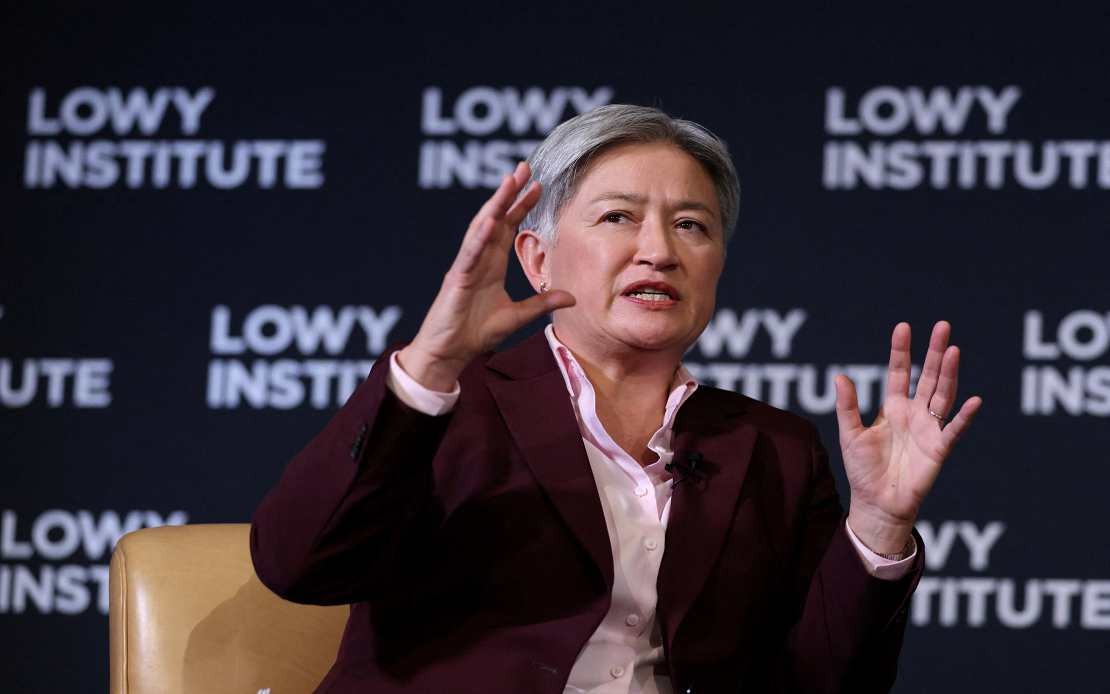
Australia's Foreign Minister Penny Wong has delivered a forceful rebuttal to the country's growing monocultural movement, arguing that abandoning the nation's multicultural foundations would cripple its economic resilience and international standing. Speaking at the Lowy Institute in Sydney, Wong characterised the push for a monocultural society as a "melancholic fantasy" that runs counter to Australia's historical identity and contemporary interests. Her intervention comes as the political debate over migration and national identity intensifies ahead of the 2028 general election.
Wong's remarks were framed as a direct response to populist Senator Pauline Hanson, whose One Nation party has emerged as a significant political force in Australian politics. In June, Hanson articulated a vision of Australia as an explicitly monocultural nation, tapping into broader anxieties about demographic change and cultural cohesion. The One Nation platform includes ambitious commitments to sharply curtail immigration levels, slash foreign aid expenditure, and extract Australia from multilateral institutions should the party secure power in the next federal election. This represents a fundamental challenge to the bipartisan consensus on open trade and international cooperation that has dominated Australian politics for decades.
The Foreign Minister framed her opposition in strategic rather than purely moral terms. Wong emphasised that calls for cultural homogeneity would force Australia to "curtail our choices and cut off our connections," creating a nation that turns inward while surrendering economic opportunities and diplomatic influence. She suggested that a monocultural approach would leave Australia isolated, stripped of trading partners, strategic allies, and growth avenues. This argument reflects the government's concern that One Nation's surge threatens Australia's carefully constructed regional relationships, particularly critical given Australia's dependence on trade and security partnerships across the Indo-Pacific.
One Nation's political ascendancy has been dramatic. Recent polling by YouGov Australia conducted in July found that support for Hanson's party has quadrupled compared to the 2025 election result, with 26 per cent of respondents indicating they would vote for One Nation at the next ballot. This contrasts sharply with the party's 6.4 per cent vote share from the previous election, marking the sharpest trajectory of support among major political contenders. The surge appears to reflect genuine dissatisfaction with established parties rather than merely a protest vote, as One Nation is organising substantive policy platforms around border control and economic nationalism.
The collapse in support for both major coalitions demonstrates the significant political realignment underway. The governing Labour Party has seen its backing decline to 28 per cent from 34.5 per cent at the 2025 election, while the conservative Coalition has fallen more sharply to just 20 per cent from 31.8 per cent. This fragmentation creates profound uncertainty about Australia's policy direction over the coming years and opens space for parties with clearer, if more contentious, ideological positions to gain ground. The traditional political centre is hollowing out as voters drift toward more defined ideological choices.
Community sentiment on immigration has shifted substantially in the direction that benefits One Nation's narrative. The Lowy Institute's annual 2026 poll, released in June, found that 55 per cent of Australians believe immigration intake is excessive, up from 53 per cent the previous year and 48 per cent in 2024. This steady year-on-year increase suggests a hardening of public opinion rather than a temporary fluctuation, reflecting genuine unease about rapid demographic change and possibly the impacts of recent migration waves on housing availability, wages, and community cohesion. This sentiment provides One Nation with a substantial reservoir of potential voters who share concerns about national identity and social stability.
The timing of Wong's intervention reflects growing anxiety within the government about the political trajectory. Rather than dismissing One Nation as a fringe movement, the Foreign Minister has chosen to engage directly with its central ideological claim, suggesting that senior government figures recognise the party's mainstream appeal. Wong's framing—that monoculturalism makes Australia "weaker and more vulnerable"—attempts to recast the debate from identity politics to national interest, a rhetorical strategy that acknowledges the government's concern that purely cultural arguments may not resonate with swing voters increasingly focused on economic security and social order.
The implications for regional stability and Australian foreign policy are significant. Australia's influence across Southeast Asia, the Pacific, and beyond depends substantially on the networks of diaspora communities, international education and labour mobility, and cultural soft power that spring from multiculturalism. A genuine shift toward monocultural policies would require renegotiation of Australia's regional role and could create diplomatic friction with neighbouring nations, particularly given the significant numbers of Australians of South Asian and Southeast Asian descent. This could complicate defence and security partnerships at a moment when regional geopolitical tensions are rising.
Wong's argument also carries implications for how Australia manages its relationship with diaspora communities in Malaysia and across ASEAN. Australian engagement with the region depends partly on cultural familiarity and networks rooted in multiculturalism. Any political shift toward monoculturalism would reverberate across the region and potentially complicate the bilateral relationships that form the foundation of Australia's regional strategy. Malaysian observers will likely monitor how One Nation's rise shapes Australia's engagement with ASEAN and Southeast Asian communities, particularly if migration and cultural integration become more fraught political issues.
The 2028 election will serve as a referendum on whether Australians prioritise Wong's vision of multicultural cosmopolitanism or Hanson's advocacy for cultural consolidation. The trend lines favour One Nation, but the party's elevation to government remains uncertain, particularly given Australia's complex electoral system. Nonetheless, the direction of travel is clear: Australian politics is becoming more polarised around questions of identity, belonging, and cultural boundaries, with populist voices gaining relative advantage as establishment parties struggle to articulate compelling responses to constituent anxieties about rapid social change.

