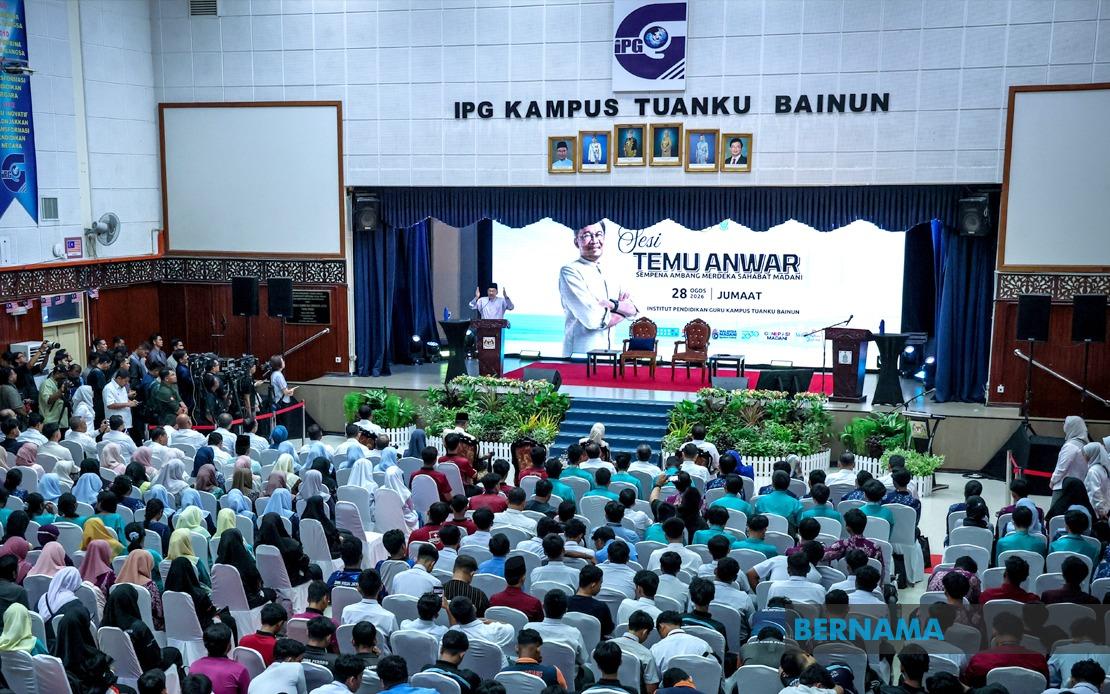
Prime Minister Datuk Seri Anwar Ibrahim has reaffirmed the government's commitment to dismantling the Universities and University Colleges Act 1971 (AUKU), framing the controversial move as a necessary step to unlock student potential and strengthen democratic values within Malaysia's higher education system. Speaking during a town hall session in Bukit Mertajam on August 28, Anwar articulated a vision of university campuses as spaces where young minds can engage in open intellectual discourse without fear of institutional censure, positioning the repeal as central to nurturing a generation equipped with the analytical capabilities demanded by an increasingly complex world.
The Prime Minister's intervention comes amid ongoing debate about the pace and implications of dismantling decades-old regulations that have historically constrained student political activism and public commentary on contentious issues. Anwar's justification centres on a fundamental demographic and civic argument: young Malaysians aged 18 and above already possess voting rights and legal adulthood, making age-based restrictions on their expression logically inconsistent with broader democratic principles. This reasoning reflects a broader modernisation agenda within the current administration, one that seeks to align Malaysian governance norms with contemporary understandings of youth participation and civil society engagement.
The AUKU, enacted in 1971 during a period of heightened social tension, has long served as a regulatory framework governing student conduct within public universities. Its provisions prohibit undergraduates from engaging in partisan political activities, holding office in political parties, and participating in strikes or demonstrations without institutional permission. For decades, the act functioned as a mechanism through which successive governments could manage student movements and maintain institutional stability. However, critics contend that these restrictions have stunted civic engagement, discouraged informed debate on pressing national issues, and created an insulated academic environment disconnected from broader democratic processes.
Anwar's articulation of the repeal's rationale emphasises the cultivation of intellectual independence and creative problem-solving as essential outcomes of university education. By removing legal barriers to student expression, the government posits that campuses will become laboratories for testing ideas, debating policy alternatives, and developing the reasoning skills necessary for effective citizenship and professional leadership. This framing aligns the AUKU repeal with wider efforts to position Malaysia as a knowledge-driven economy, where educational institutions serve not merely as credential-dispensing facilities but as incubators of innovation and critical discourse.
The Prime Minister also acknowledged that student opinions will not invariably prove correct, suggesting a philosophical stance that values the process of reasoned debate and iterative learning over predetermined ideological alignment. This nuance is significant: rather than suggesting that students should be uncritically supported regardless of the merit of their positions, Anwar's formulation emphasises exposure to competing viewpoints, rigorous intellectual engagement, and the development of argumentative capacity. Such an approach differs markedly from previous justifications for student restrictions, which often invoked social stability and institutional order as paramount concerns.
Education Minister Datuk Seri Fadhlina Sidek's attendance at the town hall underscored the cross-ministerial commitment to implementing the AUKU repeal and overseeing the transition of university governance frameworks. The Ministry of Education plays a pivotal role in translating policy directives into institutional practice, necessitating coordination with university administrations to establish new codes of conduct, clarify the boundaries of permissible student activity, and train institutional stakeholders in managing a more open campus environment. This transitional period will test whether universities can sustain academic freedom while maintaining standards of professional conduct and institutional integrity.
For Malaysian higher education, the AUKU repeal represents a watershed moment with ramifications extending beyond student activism into broader questions about university autonomy, state-society relations, and the role of educational institutions in democratic societies. Universities globally have increasingly positioned themselves as spaces where diverse viewpoints are tolerated and contested, viewing intellectual pluralism as essential to their mission. Malaysia's move toward dismantling student speech restrictions aligns with this international norm, though implementation will reveal whether the underlying institutional cultures and faculty orientations support such an environment.
The implications for Southeast Asia warrant consideration as well. Malaysia's experience will likely be scrutinised by neighbouring nations grappling with similar questions about student participation, youth engagement, and the relationship between educational institutions and political systems. Countries across the region confront comparable tensions between maintaining institutional stability and fostering democratic values, making Malaysia's policy choices instructive for regional discourse on governance and education.
Practical challenges will emerge as institutions navigate the transition from a heavily regulated to a more permissive environment. Universities will need to establish clear guidelines distinguishing between protected student expression and conduct that violates professional standards or compromises institutional functioning. Questions regarding funding accountability, institutional representation in decision-making, and the boundaries of permissible campus political organising will require careful calibration. Moreover, ensuring that increased student freedom does not inadvertently marginalise vulnerable student populations or enable intimidation will demand attentive institutional stewardship.
The AUKU repeal also signals evolving perceptions of student maturity and civic capacity within Malaysian political culture. Recognising that legal adulthood and voting rights convey expectations of responsible participation reflects an investment in young people as stakeholders in national conversations. This perspective contrasts with governance approaches that treat youth as subjects requiring paternalistic management, instead framing students as emerging citizens whose development through engaged learning strengthens democratic institutions.
Moving forward, the success of the AUKU repeal will be measured not merely by the formal removal of prohibitions but by the extent to which universities create substantive spaces for student-led intellectual engagement, debate, and civic participation. This requires institutional commitment at multiple levels, from university leadership to faculty members to student organisations themselves. The government's symbolic commitment through legislative action must be complemented by resource allocation, training initiatives, and protective institutional cultures that genuinely value the expression of diverse student voices.

