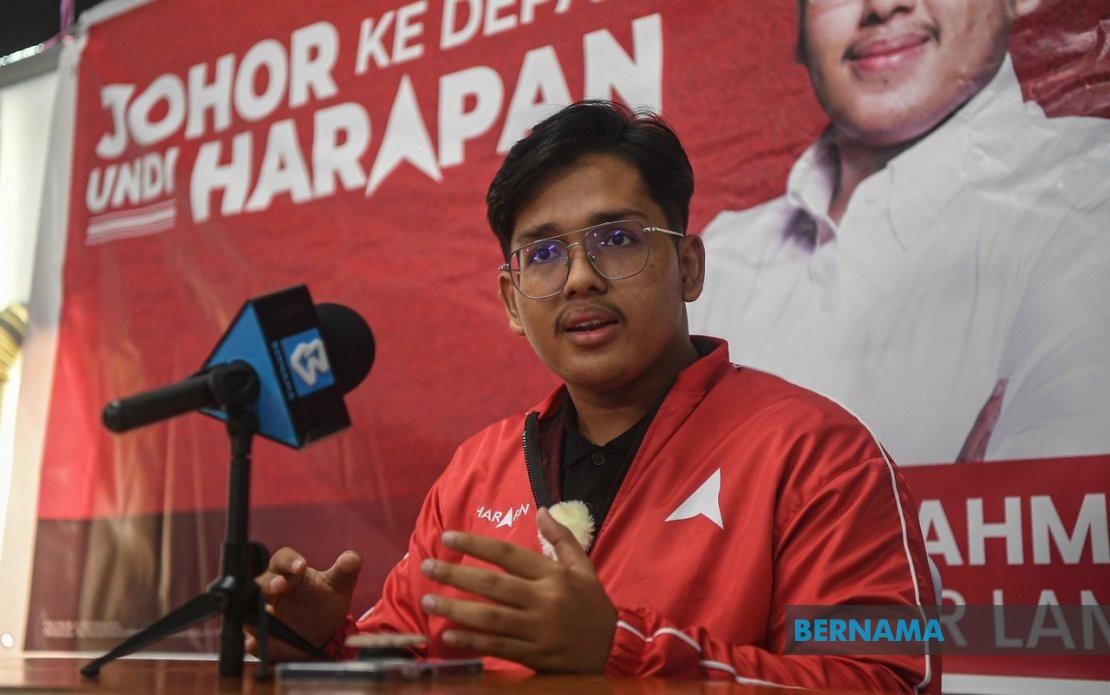
Danish Hossman Abd Rahman, at just 23 years old, represents a markedly different political profile in the 16th Johor state election, where he stands as Pakatan Harapan's candidate contesting the Johor Lama constituency. The Information Technology student from Universiti Tun Hussein Onn Malaysia has framed his candidacy around a distinctive positioning: bridging the pragmatic wisdom of experienced leaders with the innovative energy that younger voters seek. This generational approach has resonated with voters across different demographic segments, translating into what Hossman characterises as encouraging momentum heading into the final week of campaigning.
The reception Hossman has encountered while conducting extensive fieldwork throughout Johor Lama has crystallised his determination to mount a genuine challenge in what shapes up as a competitive three-way contest. His intensive engagement with constituents has proven particularly effective in building credibility with older voters, a cohort typically sceptical of youthful political candidates. Veterans and senior citizens have specifically highlighted his genuine enthusiasm for ground-level political work, contrasting his visible presence with what many perceive as the diminishing engagement of aging political incumbents. This intergenerational appeal represents a calculated strategic advantage in an electorate increasingly frustrated with traditional patterns of leadership.
Hossman's positioning deliberately avoids the trap of dismissing experience in favour of youth. Rather, he articulates a philosophy centred on complementarity: drawing upon the institutional knowledge and hard-won insights of senior political figures whilst channelling the aspirations and problem-solving perspectives of younger generations. This rhetorical framing proves particularly potent when addressing voter concerns about the gap between campaign promises and substantive implementation. By positioning himself as a conduit rather than a replacement, Hossman appeals to voters across age brackets who have become disillusioned with divisive political narratives focused on personality-driven antagonism.
Central to Hossman's campaign agenda are two interconnected challenges that directly affect Johor Lama's demographic composition and economic vitality. The acute shortage of affordable housing has compounded the constituency's struggle with youth outmigration, as young people seek employment and affordable accommodation in larger urban centres. Simultaneously, limited job creation within the local economy perpetuates a vicious cycle where educational attainment exceeds local opportunity, forcing talent migration. These interlinked problems, Hossman argues, stem partly from insufficient investment attraction and the underutilisation of the constituency's inherent economic potential.
Hossman's economic development strategy specifically targets downstream industrial expansion aligned with Johor Lama's distinctive resource endowments. Rather than pursuing generic industrial recruitment, his approach emphasises value-addition opportunities in agriculture and livestock sectors, industries where the constituency possesses established expertise and infrastructure. By encouraging investment in processing facilities, packaging operations, and distribution networks that build upon existing agricultural production, Hossman proposes catalysing employment growth without requiring wholesale economic restructuring. This localism-oriented strategy acknowledges the reality that metropolitan-scale development may prove neither feasible nor desirable for rural constituencies.
The campaign strategy now entering its intensive final phase prioritises multiple voter segments through targeted engagement. Hossman has committed to accelerated outreach across urban clusters, village communities, and Federal Land Development Authority settlements, recognising that these constituencies represent distinct demographic and economic interests requiring differentiated messaging. Youth engagement forms a particular priority, reflecting both Hossman's personal identification with this cohort and the electoral significance of younger voters in determining electoral outcomes. Women voters and small business operators receive equivalent emphasis, reflecting the diversified economic base and social composition of contemporary Johor Lama.
Hossman's emphasis on repeated voter contact reflects an understanding that electoral legitimacy requires more than transactional campaign appearances. By conducting multiple visits to constituencies rather than singular campaign stops, he seeks to establish familiarity and demonstrate genuine commitment to constituent relationships. This approach implicitly critiques the helicopter-style campaigning that characterises much contemporary political practice, where candidates parachute into constituencies for stage-managed events before departing. The repeated presence strategy, Hossman contends, allows voters to evaluate candidates substantively rather than through the distorting lens of scripted political theatre.
The competitive landscape in Johor Lama reflects broader electoral dynamics within the state election. Incumbent Norlizah Noh represents Barisan Nasional's defence of traditional political territory, whilst Aisah Esa carries Perikatan Nasional's challenge to the established political order. This three-cornered contest introduces unpredictability, as vote fragmentation means that victory may not require achieving absolute majority support but rather capitalising on opposition vote-splitting. Hossman's youth and fresh political positioning may prove advantageous in this fragmented environment, particularly if either Barisan Nasional or Perikatan Nasional supporters view him as a genuine alternative rather than merely a third-choice protest vote.
The broader context of Malaysia's evolving political landscape lends particular significance to Hossman's candidacy. Younger politicians willing to engage substantively with constituent concerns without resorting to identity-based or personality-centred political messaging represent a potentially significant development in Malaysian politics. As voters demonstrate increasing appetite for policy-focused alternatives to established political patterns, candidates like Hossman who emphasise competence, accessibility, and problem-solving capacity over factional loyalty or party machinery mobilisation may find expanding electoral space. His campaign thus transcends individual constituency politics, potentially signalling shifting voter priorities across multiple electoral contests.
With polling scheduled for Saturday and early voting on the preceding day, the 16th Johor state election involves 172 candidates competing for 56 seats across the state. Hossman's contest in Johor Lama represents one individual manifestation of broader electoral forces reshaping Malaysian politics. Whether his generational positioning and constituent-focused strategy translate into electoral success will depend partly on factors beyond his direct control—including broader state-level momentum and the specific dynamics of vote distribution in a three-cornered contest. Nevertheless, his candidacy exemplifies how younger political actors are approaching electoral competition with strategies substantially divergent from traditional patronage-based and personality-driven models that have long characterised Malaysian politics.

