Geopolitical tensions in the Middle East rattled Asian financial markets on Monday, with a familiar pattern reasserting itself: rising oil prices, currency depreciation, and heightened inflation concerns sent investors rushing toward the safety of the U.S. dollar. The escalation marked a sharp reversal of sentiment after weeks of relative calm, resurfacing the spectre of stagflation that has haunted global policymakers since the pandemic's aftermath. Crude futures jumped approximately 4% on the day, providing fresh ammunition to those warning that central banks may be forced to maintain higher interest rates for longer than previously anticipated, potentially choking off the economic growth that equity markets have been banking on to justify elevated valuations.
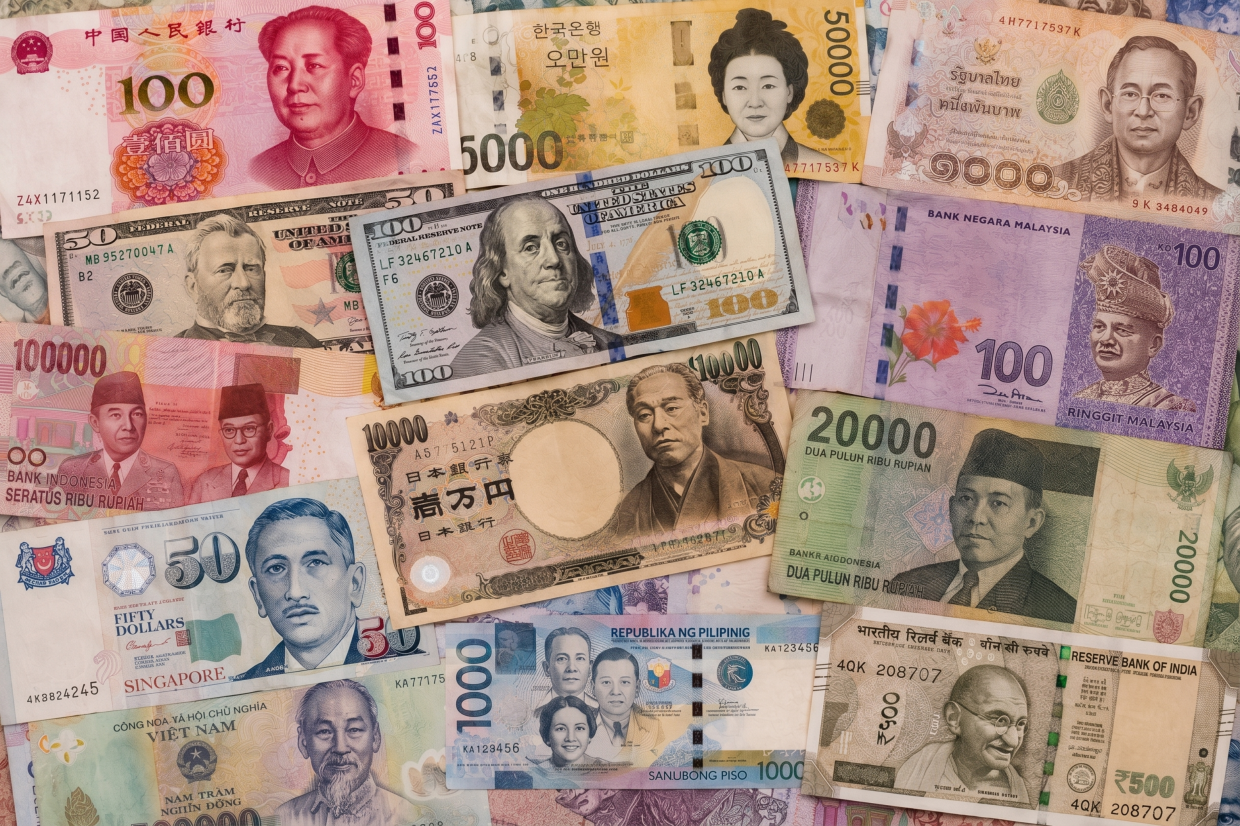
The U.S. dollar index strengthened its position against major trading partners as emerging-market currencies bore the brunt of the sell-off. In Southeast Asia, Malaysia's ringgit depreciated to 4.0780 per dollar, reflecting both the broader regional currency weakness and mounting domestic political uncertainty. Indonesia's rupiah fared worse, sliding to as much as 18,140 per dollar—a level not seen in more than thirty days—illustrating the vulnerability of the region's currencies when global risk appetite diminishes. The South Korean won similarly weakened to 1,507.9 against the greenback, though Seoul's equity market experienced far more dramatic losses than neighbouring bourses, suggesting sector-specific dynamics were equally important as macroeconomic headwinds.
South Korea's principal stock index, the KOSPI, suffered a particularly severe blow, plummeting 7.96% to touch a ten-week nadir and triggering automatic trading halts designed to prevent panic-driven liquidations. The decline was concentrated heavily in the technology sector, with SK Hynix—a heavyweight in the artificial intelligence memory chip space and a bellwether for global semiconductor demand—collapsing 13% as investors locked in gains following a strong debut on the U.S. market the previous Friday. This profit-taking appears to have unleashed a broader reassessment of valuations in the semiconductor complex, where extraordinary earnings growth tied to AI-driven demand for high-bandwidth memory has created both enthusiasm and scepticism about sustainability.
The latest weakness in chip stocks reflects deepening anxiety about whether the AI boom's financial benefits can be maintained at current levels. Concerns have intensified around two interconnected issues: the durability of record profitability when demand for premium memory chips is concentrated among a handful of hyperscaler technology companies, and whether those same hyperscalers will continue spending at the breakneck pace of recent quarters as they cautiously monitor returns on their massive capital expenditure programmes. Additionally, the proliferation of highly leveraged single-stock exchange-traded funds linked to major chipmakers has created artificial demand fluctuations that amplify normal market swings into violent price movements, deterring longer-term investors.
Despite the dramatic Monday decline, the KOSPI remains substantially higher on a year-to-date basis, having climbed roughly 63% since January and occupying a position among the world's strongest-performing equity indices. However, the index has surrendered approximately 25% of its value since hitting an all-time record close on June 22, underscoring how quickly momentum can reverse in technology-heavy markets when confidence falters. This sharp retracement highlights the risks inherent in concentrated exposure to cyclical sectors during periods of macroeconomic transition, particularly when monetary policy is potentially approaching an inflection point.
Malaysia's financial markets displayed a more mixed character than Seoul's one-directional sell-off. Although the ringgit weakened alongside regional peers, the local equity benchmark unexpectedly advanced to a three-week high, suggesting that some investors viewed Monday's turmoil as a buying opportunity. However, beneath the surface lurks a more troubling narrative centred on domestic political fragmentation. Prime Minister Anwar Ibrahim's coalition absorbed a crushing defeat in a key Johor state election on Saturday, losing ground to what was previously regarded as an allied partner—a result that has precipitated discussion about potential snap general elections and the stability of the federal government's tenure.
Analysts at Goldman Sachs have flagged this political dimension as a material risk factor for Malaysian asset prices. The firm noted that a sustained erosion of coalition cohesion or uncertainty surrounding the government's continuity could begin eroding the policy-stability premium that has been a source of relative strength for Malaysian equities and the ringgit throughout this economic cycle. Malaysia's macroeconomic fundamentals—encompassing inflation control, external balances, and growth potential—remain broadly supportive, and Goldman Sachs highlighted that the central bank's June measures to stimulate foreign exchange inflows should provide some cushion against excessive currency depreciation even if political risk premia linger. The implication is clear: Malaysia's assets have benefited from a dual premium reflecting both sound economic management and perceived political stability, and any serious erosion of either pillar could trigger material repricing.
Elsewhere across the broader Southeast Asian region, resilience was more evident. Philippine equities edged modestly higher, while Indonesian shares gained 0.5% despite the rupiah's weakness, suggesting that domestic demand factors and expectations of continued central bank support may be offsetting external headwinds. Taiwan's stock market inched lower in sympathy with Seoul, reflecting the region's integrated technology supply chains and shared exposure to semiconductor market dynamics. Singapore's benchmark index declined fractionally, snapping a streak of seven consecutive record closes and suggesting that even the region's most mature and diversified financial hub was not immune to the shift in risk sentiment.
Looking ahead, the financial calendar presents several pivotal data points that could clarify whether Monday's turbulence represents a meaningful shift in trajectory or merely a temporary bout of volatility. Singapore's advance second-quarter economic growth figures will offer insight into whether the city-state's economy is accelerating sufficiently to offset external headwinds. The United States' inflation print will be scrutinised by Asian central banks still calibrating their policy stance, while South Korea's Bank of Korea interest rate decision will signal whether Seoul remains confident in its current policy setting despite recent market weakness. Malaysia's forthcoming inflation and economic output readings will help investors assess whether the political uncertainty surrounding Prime Minister Anwar Ibrahim's coalition has begun translating into measurable economic deterioration or remains a longer-term governance concern.
The convergence of external shocks—represented by Middle East conflict and potential inflation resurgence—with idiosyncratic domestic challenges, particularly Malaysia's political fracturing, serves as a reminder that emerging Asian markets remain vulnerable to both global economic cycles and the strength of domestic institutional arrangements. The region's trajectory this cycle has depended substantially on the perception that policymakers possess both the competence and the political mandate to implement coherent economic programmes. Monday's moves suggest that investors are beginning to test that assumption more critically, particularly in markets where political consensus appears to be fragmenting.

