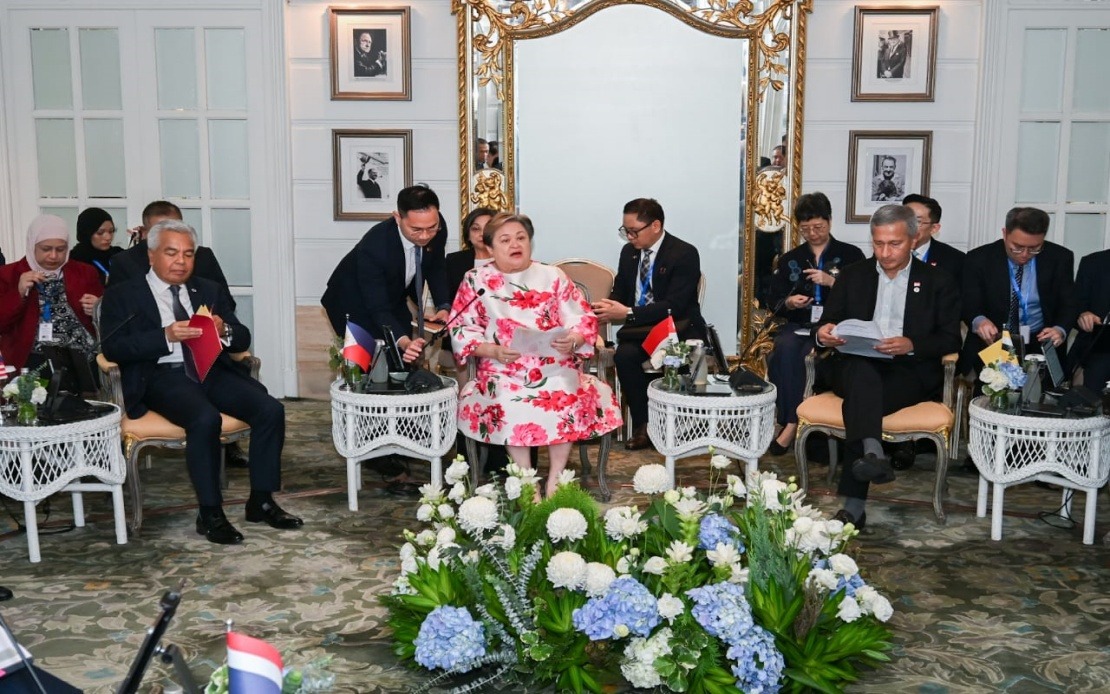
ASEAN has resolved to maintain its commitment to the Five-Point Consensus in tackling Myanmar's protracted political and humanitarian crisis, demonstrating unified resolve even as the military-backed government continues to resist the regional bloc's peace efforts. The affirmation came during high-level meetings in Bangkok on July 12, marking the first in-person engagement between ASEAN foreign ministers and their Myanmar counterpart since the country descended into turmoil following the military coup in February 2021. The stance underscores the regional grouping's determination to pursue what it terms "calibrated engagement"—a delicate balancing act designed to maintain dialogue with Naypyidaw while addressing mounting criticism over the crisis's humanitarian toll.
Philippine Secretary for Foreign Affairs Maria Theresa Lazaro, serving simultaneously as the ASEAN Chair's Special Envoy on Myanmar, reiterated during bilateral discussions with Thailand's Foreign Minister Sihasak Phuangketkeow that the Five-Point Consensus remains the foundational reference point for all ASEAN interactions with Myanmar's government and other stakeholders. Her firm assertion that "ASEAN stands behind the Five-Point Consensus" came mere days after Myanmar's parliament passed a motion explicitly rejecting the peace framework, a calculated rebuke that many observers viewed as further hardening the junta's position. Nevertheless, Lazaro indicated that ASEAN would neither abandon the initiative nor reflexively penalise Naypyidaw for its public repudiation, instead continuing to engage through established diplomatic channels.
The Five-Point Consensus, formally adopted in April 2021, represents ASEAN's most comprehensive attempt to address the Myanmar crisis through regional mechanisms rather than Western-led international pressure. The framework's five pillars encompass an immediate cessation of violence, establishment of an inclusive political dialogue process involving all parties, provision of humanitarian assistance to affected populations, appointment of an ASEAN Special Envoy to facilitate negotiations, and direct engagement between ASEAN and all stakeholders. Nearly three-and-a-half years into its implementation, however, progress remains glacially slow. The military regime has shown little inclination to move substantively on any dimension, whilst armed resistance groups and civil society organisations increasingly question whether ASEAN's patient diplomacy serves primarily to legitimise the junta rather than constrain its actions.
During the multilateral consultations, ASEAN conveyed three interconnected expectations to Myanmar's delegation. The bloc seeks expansion of humanitarian assistance mechanisms, including through a planned humanitarian mission led by the ASEAN Chair to identify pathways for increasing aid access to vulnerable populations. This initiative carries particular weight given widespread reports of deteriorating conditions across Myanmar, where conflict-driven displacement and economic collapse have left millions in need of food, medicine, and shelter. The second imperative centres on reducing violence, especially civilian casualties, a benchmark that remains woefully unmet as pitched battles between junta forces and armed opposition groups continue across multiple regions.
Third, ASEAN implored Myanmar's government to pursue genuinely inclusive political dialogue aimed at national reconciliation. This pillar acknowledges that lasting stability requires addressing the grievances and aspirations of Myanmar's diverse ethnic, religious, and political constituencies—a challenge the uniformly military-dominated regime has shown virtually no capacity or willingness to undertake. Implicit in this call lies concern over the fate of thousands of political prisoners detained since the coup, including democratically elected leaders and civil society activists. ASEAN's diplomatic language masks fundamental incompatibility: the junta seeks perpetual military dominance within a nominally civilian framework, whilst mainstream opposition forces demand genuine democratic restoration and accountability.
Thailand's Foreign Minister, Sihasak Phuangketkeow, offered revealing commentary on ASEAN's strategic dilemma when characterising calibrated engagement as "a two-way street." His statement that Myanmar "has to reach out as well and address the concerns of ASEAN and the international community" implicitly acknowledges that Naypyidaw has largely failed to reciprocate the regional organisation's patience and flexibility. Thailand, as the meeting's host and a state that shares a lengthy land border with Myanmar, occupies a peculiarly complex position, balancing commercial interests, refugee flows, and domestic political considerations against multilateral diplomatic protocol. Sihasak's emphasis on implementation strategy over mere rhetorical commitment suggests growing frustration within ASEAN capitals over the glacial pace of practical progress.
When pressed on whether ASEAN had imposed concrete timelines or consequences for Myanmar's continued intransigence, Sihasak deferred accountability to the broader ASEAN Summit scheduled later in 2024. This response reveals the structural limitations constraining the regional bloc's leverage. ASEAN's consensus-based decision-making architecture and commitment to non-interference in member states' internal affairs inherently restrict options for material pressure. Unlike Western governments or the United Nations, ASEAN cannot threaten sanctions, suspension, or forced regime change without fracturing the organisation itself—a consideration that Naypyidaw undoubtedly factors into its calculations.
The Bangkok meeting's composition itself merits examination. Malaysia's participation through Foreign Ministry Secretary-General Tan Sri Amran Mohamed Zin, rather than a cabinet-level minister, carried subtle diplomatic significance. Malaysia has historically positioned itself as moderately sympathetic to Myanmar's interests whilst maintaining rhetorical support for ASEAN positions. Cambodia's absence from the proceedings likewise carries weight, particularly given that country's historical alignment with China and relative indifference to Western-led pressure on Myanmar. These absences and modifications in representation underscore deeper fractures within ASEAN regarding how forcefully to press Myanmar on governance and humanitarian issues.
For Malaysia and other Southeast Asian nations, the Myanmar crisis presents an unwelcome dilemma. The conflict generates refugee pressures, disrupts regional stability, creates opportunities for transnational criminal networks, and undermines the economic integration agenda that ASEAN theoretically champions. Conversely, aggressive condemnation or enforcement of consequences could precipitate Myanmar's estrangement from regional structures, potentially pushing it further toward alternative alignments—particularly with China and Russia, who offer unconditional diplomatic support and material assistance without intrusive demands regarding internal governance. This consideration fundamentally constrains ASEAN's room for manoeuvre.
The philosophical tension underlying ASEAN's Myanmar approach centres on whether sustained engagement without meaningful pressure constitutes realism or simply diplomatic theatre. Proponents argue that maintaining channels of communication, even with an unresponsive regime, preserves possibilities for future movement and prevents regional fragmentation. Critics contend that ASEAN's forbearance has effectively enabled the junta's consolidation of power, providing international legitimacy to a military government with an appalling human rights record whilst delivering negligible dividends for Myanmar's civilians or ASEAN's collective interests. The Five-Point Consensus remains, in this assessment, a framework in search of genuine implementation.
Looking ahead, ASEAN faces mounting pressure from civil society, democracy advocates, and international partners to move beyond rhetorical commitment. The promised humanitarian mission offers one opportunity to demonstrate tangible engagement, yet such initiatives ring hollow if not paired with explicit mechanisms for protecting and expanding access. Similarly, ASEAN's calls for political dialogue lack credibility absent clear articulation of what inclusive reconciliation actually entails and what transitional mechanisms might facilitate genuine power-sharing rather than superficial cosmetic adjustments to military-dominated governance.
The regional bloc's strategy ultimately rests on the assumption that Myanmar's military leadership will eventually recognise costs associated with isolation and instability, thereby incentivising return to the political dialogue track outlined in the Five-Point Consensus. Whether this assumption holds remains profoundly uncertain. The junta has shown remarkable imperviousness to international pressure, sanctions, and diplomatic isolation across multiple dimensions. Myanmar's 2023 elections, which the regime conducted outside the purview of international observers, demonstrated intent to pursue its own timeline and governance model regardless of ASEAN preferences. ASEAN's patient diplomacy may eventually yield results, but the coming months will likely reveal whether this strategy represents enlightened persistence or institutionalised failure to enforce the regional norms the bloc theoretically champions.

