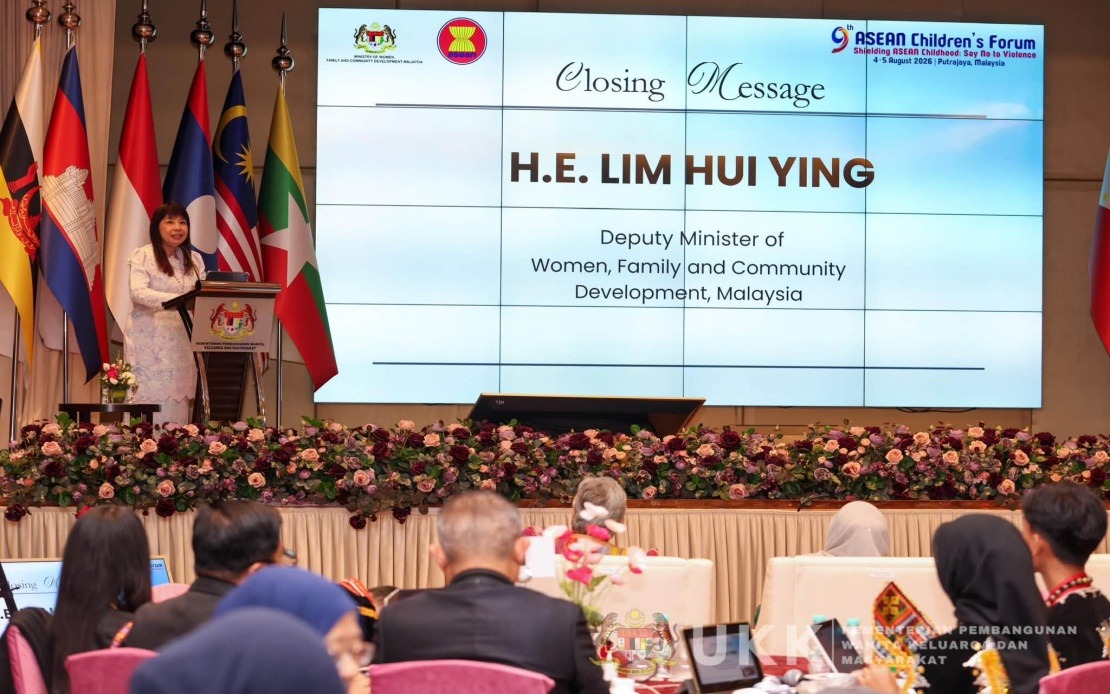
PUTRAJAYA — Regional policymakers face mounting pressure to act on child safety after the 9th ASEAN Children's Forum concluded with a comprehensive set of recommendations aimed at creating a more protective environment for young people across Southeast Asia. The hybrid gathering brought together child representatives from all ASEAN member states to address the pervasive problem of violence against children in its various forms, from physical abuse to psychological harm and sexual exploitation. The participants' collective voice carries particular weight because it emerges directly from children's own lived experiences rather than adult assumptions about what protections they need.
Deputy Women, Family and Community Development Minister Lim Hui Ying emphasised that the recommendations deserve serious consideration from governments and ASEAN institutions alike. She stressed that the observations and proposals put forward by the child participants reflect genuine aspirations grounded in reality, making them especially valuable for shaping effective policy responses. The minister's comments signal that Malaysia, as the host nation, views this forum not as a symbolic gesture but as a meaningful input mechanism for regional governance. The expectation now is that ASEAN sectoral bodies and member governments will systematically review these recommendations with an eye towards implementation.
The forum identified violence against children across four distinct contexts: within the home, in educational settings, in the digital realm, and within broader community environments. This categorical breakdown is important because it acknowledges that threats to child safety vary significantly depending on the setting, and therefore require tailored interventions rather than one-size-fits-all solutions. Each environment presents unique vulnerabilities and requires specific stakeholder engagement. Home-based violence often involves trusted adults and family members, while school settings involve institutional actors and peer dynamics. Online spaces present novel challenges around anonymity and scale, and community contexts involve neighbourhood networks and local institutions.
Among the substantive recommendations emerging from the forum, strengthening child protection laws stands out as fundamental. Several ASEAN nations currently operate under legislation that fails to adequately define or penalise certain forms of child abuse, particularly psychological and emotional violence. Participants urged comprehensive legislative reviews to close gaps and ensure consistent standards across the region. This push for legal harmonisation carries implications for cross-border cases and child trafficking networks that exploit differences in legal frameworks across Southeast Asia. Additionally, the forum highlighted the need to establish and expand child-friendly reporting channels — systems designed with children's actual capabilities and comfort levels in mind, rather than mechanisms that inadvertently discourage reporting through intimidating procedures or language barriers.
Enforcement of anti-bullying policies emerged as another critical priority. While many ASEAN schools have adopted such policies on paper, implementation remains inconsistent, and bullying — including cyberbullying — continues to cause documented harm to child mental health and educational outcomes. The forum's emphasis here suggests that child participants recognise the gap between policy existence and practical reality, and are demanding greater accountability in implementation. This resonates with broader Southeast Asian concerns about rising adolescent mental health challenges and school-related violence.
The recommendations also stress the importance of expanding psychosocial support services for vulnerable children. Trauma from violence requires professional intervention, yet many ASEAN nations face severe shortages of trained counsellors and mental health professionals equipped to work with children. The forum's call for broader support acknowledges that protecting children means not only preventing harm but also helping them heal from experienced trauma. This dimension of the recommendations reflects an understanding that effective child protection is a long-term commitment extending well beyond immediate intervention.
Crucially, the forum recognised that creating safe spaces for children requires engagement from multiple stakeholders beyond government. Parents, teachers, the private sector, civil society organisations, media outlets, and peers all play roles in either enabling or preventing violence. This ecosystemic understanding is important because it distributes responsibility appropriately and acknowledges that government action alone cannot solve the problem. Companies operating online platforms, for instance, bear responsibility for the safety of child users. Media outlets influence public attitudes toward child violence through their coverage. Peers play a protective role when they intervene against bullying or provide support to traumatised friends.
The child participants themselves pledged to support one another and cultivate a culture grounded in care and mutual respect. This commitment from young people represents an important shift from viewing children purely as passive recipients of protection to recognising them as active agents in building safer communities. Peer-to-peer support networks and youth-led initiatives have proven effective in various contexts, and this pledge suggests ASEAN children are prepared to contribute meaningfully to violence prevention.
For Malaysia and other Southeast Asian nations, the forum's output carries immediate relevance. Rising awareness of child protection issues through social media and international advocacy means public expectations around government action are increasing. The recommendations provide a roadmap for policymakers seeking to demonstrate commitment to child welfare. Additionally, ASEAN's regional character means that strengthening child protection in one nation creates positive pressure on others to follow suit, gradually elevating standards across the bloc. The forum thus represents not merely a discussion exercise but a mechanism for collective standard-setting that member states will find increasingly difficult to ignore without reputational consequences.

