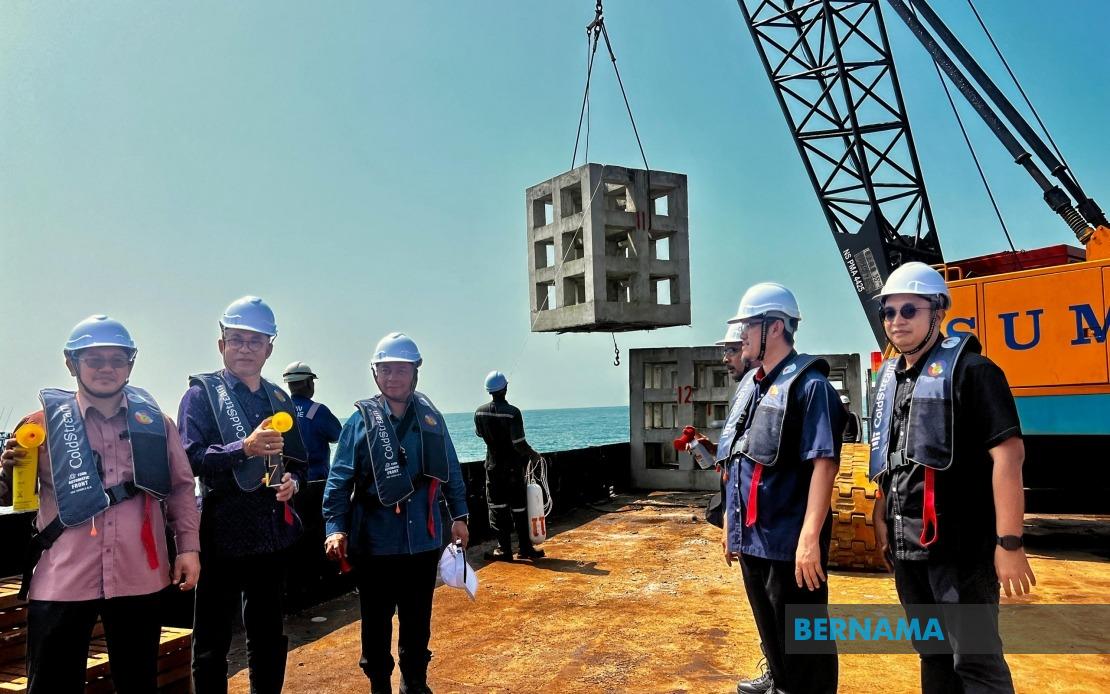
Malaysia's maritime provinces are increasingly turning to artificial reef technology as a multifaceted solution to one of Southeast Asia's most persistent fisheries challenges: the encroachment of industrial-scale fishing vessels into waters traditionally reserved for artisanal coastal operators. Kelantan's latest initiative, involving 30 new reef structures deployed approximately 4.6 nautical miles from the Tok Bali Jetty, exemplifies this approach by combining marine conservation goals with socioeconomic protection for small-scale fishing communities that form the backbone of the state's seafood supply chains.
The Kelantan Fisheries Department, under director Ismail Ibrahim, has engineered these underwater structures to serve as both ecological assets and physical deterrents. By their very design, the reefs obstruct the passage and operation of large commercial trawlers, whose nets and heavy equipment become entangled in the complex geometry of the installations. This mechanical barrier effect proves particularly valuable in Kelantan, where the pressure from larger fishing operations to exploit nearshore grounds has historically displaced smaller operators who lack the capital to compete for distant fishing zones.
Beyond their role as gatekeepers protecting artisanal fishers, these artificial reefs function as underwater sanctuaries where commercially valuable fish species congregate to spawn and reach juvenile maturity. The ecological logic is straightforward: by concentrating breeding populations within designated conservation zones, the structures amplify natural reproduction rates and ensure that juvenile fish survive to adulthood before dispersing into broader fishing grounds. This spillover effect creates measurable increases in fish landings across the broader region, fundamentally improving food security outcomes for the predominantly fishing-dependent communities dotting Kelantan's coastline.
The financial backing for this deployment carries particular significance within Malaysian governance circles. Sultan Muhammad V's contribution to fund this reef installation marks a rare instance of royal patronage directed specifically toward fisheries infrastructure, reflecting growing awareness among state leadership that marine resource management directly impacts economic resilience and livelihoods. This royal commitment signals that fisheries conservation is being elevated beyond routine departmental functions to become a matter of strategic state interest.
Kelantan's artificial reef programme has accumulated considerable operational experience since its inception in 2007. The cumulative deployment of approximately 400 reef units across four distinct maritime locations represents one of Malaysia's more ambitious marine conservation undertakings. The department's plan to add another 72 units throughout the current year indicates sustained commitment to expanding this protective infrastructure, despite the logistical and financial demands involved in submerged construction and ongoing maintenance operations.
The temporal dimension of reef effectiveness cannot be overlooked by policymakers elsewhere in the region. Ismail Ibrahim's assertion that measurable ecological impacts require a minimum six-month observation period reflects the complex timescales governing marine ecosystem adaptation. During this window, fish populations gradually discover these new structures, establish residency patterns, and initiate reproductive cycles. Longer-term data collection becomes essential for validating the real-world performance of expensive conservation investments, particularly when competing funding priorities demand fiscal accountability.
Operational maintenance distinguishes successful artificial reef programmes from abandoned installations that deteriorate into marine debris. The Kelantan Fisheries Department's commitment to regular monitoring and systematic cleaning—particularly the removal of discarded fishing ropes and gear—demonstrates institutional discipline rarely observed across Southeast Asian fisheries agencies. This attention to detail prevents the reefs from becoming hazardous obstacles rather than productive habitats, ensuring that the structures continue delivering ecological and socioeconomic returns year after year.
For Malaysian policymakers examining sustainable fisheries management, Kelantan's experience offers instructive lessons. The artificial reef model addresses simultaneously the ecological imperative to rebuild fish stocks depleted by decades of overfishing, the economic necessity to protect artisanal fishing communities from displacement by industrial competitors, and the food security requirement to maintain reliable domestic seafood supplies. Few policy interventions achieve such multifaceted objectives with a single infrastructure investment.
The broader Southeast Asian context amplifies the relevance of Kelantan's approach. Throughout the region, industrial fishing fleets—many flagged under distant water fishing agreements—systematically penetrate coastal zones designated for small-scale operators, eroding the livelihoods of millions of fisher families. Malaysia's deployment of physical barriers through artificial reefs represents a pragmatic alternative to enforcement mechanisms that coastal states often lack the capacity to implement consistently. By engineering the seabed itself as a protective boundary, Kelantan shifts enforcement from labour-intensive patrols to passive infrastructure, potentially offering a replicable model for resource-constrained maritime nations throughout Southeast Asia.
Looking forward, the scalability of this approach depends on resolving practical implementation challenges. The financial cost of manufacturing, transporting, and precisely positioning hundreds of concrete or composite structures requires sustained budgetary allocation. Technical expertise in marine surveying, habitat assessment, and construction logistics must be developed or contracted at competitive rates. Regional cooperation frameworks could potentially distribute these costs and share technological knowledge across multiple states, transforming Kelantan's initiative into a coordinated Southeast Asian fisheries strategy.
The fundamental paradox underlying such conservation interventions deserves recognition. Artificial reefs ultimately aim to increase fish availability and catch rates, potentially intensifying fishing pressure unless complementary management measures—including catch quotas, fishing season restrictions, and vessel registration systems—are simultaneously implemented. Kelantan's programme demonstrates institutional awareness of this dynamic, yet the published statements emphasize abundance enhancement rather than fishing restraint, suggesting that consumption growth remains the dominant policy objective alongside equity considerations.

