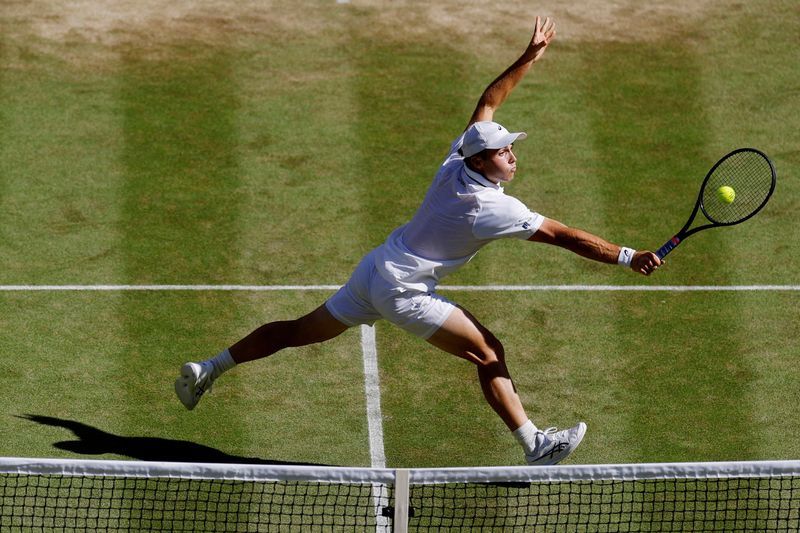
Arthur Fery's unlikely journey through the Wimbledon tournament has transformed the 23-year-old wildcard into the solitary representative of British tennis at the Championships. The France-born player, who was raised in London and educated at Stanford University, will celebrate his 24th birthday on Sunday—the day of the men's singles final—and faces the genuine possibility of contesting that very match on Centre Court, a scenario few would have predicted when the tournament began.
Fery's path to the quarterfinals has been littered with dramatic turning points that would strain credibility in fiction. Making his Centre Court debut on Monday, he faced Grigor Dimitrov, the 35-year-old former world number three, in a match that encapsulated both his raw talent and iron will. The Bulgarian held a commanding position at 4-3 in the fourth set with a break in hand, yet Fery engineered a remarkable recovery to prevail 7-5 3-6 4-6 6-4 7-6(7) in front of Roger Federer, watching from the Royal Box. The spectacle unfolded against a backdrop of extraordinary national sporting emotion—England's World Cup victory over Mexico in the early hours had left the crowd intoxicated with patriotic fervour, creating an electric atmosphere seldom witnessed at the tournament.
The magnitude of Fery's emotional experience after defeating Dimitrov was evident in his measured reflection. He spoke of cherishing memories that might never recur, acknowledging the ephemeral nature of such opportunities. His gratitude extended to witnessing British sport excelling globally, a sentiment shaped by the coincidental convergence of England's World Cup win and his own improbable victory on the same day. The roar that greeted his match point reportedly rivalled the loudest sounds heard at Wimbledon in years, a fusion of tennis appreciation and national pride.
Fery's quarterfinal opponent will be Italy's Flavio Cobolli, ranked tenth in the world, though the Briton carries the advantage of having defeated him at this year's Australian Open. This previous success provides psychological scaffolding for his assault on the latter stages, though the Italian represents a quantum leap in ranking and experience from his earlier opponents. The challenge ahead will test whether Fery's momentum and crowd support can overcome the gulf in established pedigree.
His third-round display against Zizou Bergs on Saturday established the template for his tournament success—recovery from adversity through sheer resilience. Having trailed two sets to one with a double break deficit in the fourth set, Fery rallied to secure what was at that point the longest match of the tournament. The physical toll manifested in repeated nosebleeds, yet he persisted through discomfort to claim victory. This pattern of fighting back from desperate circumstances has become his defining characteristic at the Championships.
The contrast between Fery's extraordinary performance and the broader English contingent's collapse is stark. Of the 19 British singles players competing, 15 exited in the opening round, leaving Fery as the solitary surviving home representative. This disparity underscores both his exceptional talent and the depth challenges facing British tennis at the grassroots and professional development levels. His unexpected prominence has inadvertently thrown into relief systemic questions about talent identification and nurturing within the domestic programme.
Fery's ascent within the rankings reflects his genuine competitive standard. Beginning the tournament ranked 114th globally, he has climbed inside the top 70 and continues rising with each victory. This trajectory suggests his Wimbledon performance may represent the emergence of genuine world-class potential rather than a statistical anomaly. Taylor Fritz, the American sixth seed, provided crucial insight into Fery's quality, recounting practice sessions before the World Tour Finals where the Briton proved the superior player on consecutive days. Fritz noted Fery's exceptional serving mechanics relative to his frame and his advanced baseline craft, observations that carry weight from a peer competing at the tour's elite echelon.
The narrative surrounding Fery's progress extends beyond individual achievement into broader questions about British tennis identity. His France-born background and American university education complicate straightforward patriotic narratives, yet his development within the London tennis ecosystem and deliberate choice to represent Britain establishes him as authentically British in the ways that matter most competitively. This cosmopolitan dimension mirrors the increasingly transnational character of elite professional tennis, where birthplace matters less than allegiance and development pathway.
For Malaysian and Southeast Asian observers, Fery's story resonates beyond the specific context of British tennis. His trajectory demonstrates how individual excellence can flourish through quality instruction and competitive environment—lessons relevant across the region as nations seek to develop world-class athletes. His Stanford education and subsequent professional progression illustrate the value of American university tennis as a development pathway, a model several Southeast Asian players have explored.
The intersection of personal achievement and national representation that Fery embodies carries emotional weight precisely because it remains uncertain. A potential final appearance would cement his legacy instantly; earlier elimination would position this as a remarkable but ultimately contained breakthrough. This tension between possibility and probability drives engagement with his matches, transforming sporting contests into genuine narratives whose resolutions remain genuinely undetermined. His quarterfinal encounter with Cobolli will determine whether his Wimbledon story continues its improbable upward trajectory or concludes as an impressive but temporary incursion into the tournament's elite stages.

