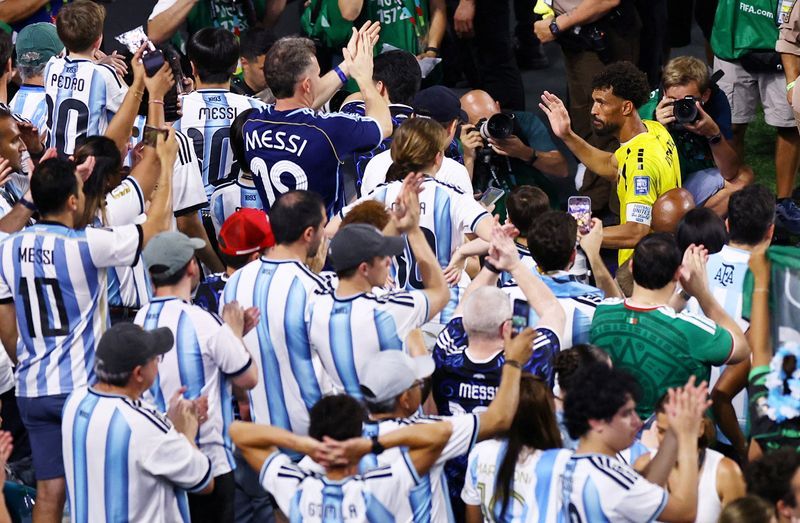
Argentina secured passage to the World Cup's knockout round with a 3-2 extra-time victory over Cape Verde in Kansas City, Missouri on July 4, yet the South American powerhouse emerged from the encounter visibly shaken by the tournament newcomers' determined resistance. The match exposed vulnerabilities that had gone largely undetected during Argentina's otherwise dominant group stage performance, forcing both the coaching staff and players to confront uncomfortable truths about their preparedness for more formidable opponents ahead.
Cape Verde's capacity to recover from behind on two separate occasions proved particularly damaging to Argentina's confidence. The Africans demonstrated tactical discipline and physical resilience that belied their status as first-time World Cup participants, repeatedly disrupting Argentina's rhythm and forcing the defending champions into reactive rather than proactive football. It took a moment of fortune—a deflected header from defender Cristian Romero that was diverted into the net by Cape Verde's Diney Borges—to finally break the deadlock and seal Argentina's progression to face Egypt in Atlanta on Tuesday.
Coach Lionel Scaloni had publicly flagged Cape Verde as a potential threat beforehand, pointing to their earlier group-stage results against Spain and Uruguay. However, the intensity of the challenge presented by the island nation clearly exceeded expectations, even among those who had warned against complacency. The nature of the victory represented a stark departure from Argentina's flawless group stage, during which they dismantled Algeria 3-0, defeated Austria 2-0, and overwhelmed Jordan 3-1 without much resistance.
The quality of opposition Argentina had navigated so far now became a focal point of legitimate concern. Analysts and former players alike questioned whether their previous victories had genuinely tested the team's mettle or merely masked deeper structural problems. The group stage opponents were relatively modest by World Cup standards, raising persistent doubts about whether the defending champions had encountered sufficiently stiff competition to hone their competitive edge. Their recent warm-up matches underscored this issue—Iceland in June marked their first European opponent since claiming the 2022 World Cup, a concerning gap in match preparation.
Marcelo Gallardo, the respected former River Plate manager who played in the 1998 and 2002 World Cups, suggested the Cape Verde match might ultimately prove beneficial as a reality check. Speaking on ESPN Argentina, Gallardo emphasised that the near-defeat would likely galvanise the squad. "It was good that this happened," he observed. "There will be a reaction, there has to be a reaction." His assessment reflected a broader sentiment that Argentina required this uncomfortable experience to sharpen their focus before confronting more dangerous adversaries.
Lionel Messi, who added another milestone to his already extraordinary World Cup legacy by scoring his record-extending 20th tournament goal in the first half, acknowledged the physical and tactical challenges the team faced. The 39-year-old captain was notably candid about Argentina's pressing ineffectiveness, a fundamental aspect of modern football that was visibly absent against Cape Verde. "They had the ball and made us run because we couldn't press," Messi explained post-match. "We couldn't press them properly, the lines were too far apart." His comments highlighted a concerning lack of compactness and coordination in Argentina's defensive organisation.
Despite the criticisms, Scaloni defended his team's mentality and capacity for self-correction. The manager reiterated his pre-match conviction that no encounter at a World Cup is genuinely straightforward, and emphasised that Argentina had demonstrated character by battling back through adversity. "There is always room for improvement, but it is important that the team stepped up during difficult moments," Scaloni stated. He remained confident that while the performance may have been imperfect, the team's underlying resilience and ability to seize control of matches remained intact—qualities essential for tournament success.
Argentina's progression was notably underpinned by contributions from two defenders whose recent injury experiences made their involvement particularly significant. Lisandro Martinez, who had endured the severe setback of an anterior cruciate ligament injury in early 2025, provided crucial attacking impetus by scoring Argentina's second goal. His return to fitness and match sharpness at such a critical juncture demonstrated the depth of character within the squad. Similarly, Cristian Romero's presence proved decisive despite earlier knee complications that had sidelined him during portions of the tournament.
Martinez expressed profound gratitude for the medical and coaching support that had enabled his remarkable recovery and participation. "Everything I went through was very hard, but thanks to my club and the national team today I'm very happy," the defender said, visibly emotional about his journey back to full availability. "I'm grateful to the doctors and coaching staff for allowing me to be here. I'm on cloud nine." His sentiments reflected not merely personal satisfaction but also symbolised Argentina's collective determination to overcome obstacles.
The psychological ramifications of Cape Verde's resistance cannot be underestimated as Argentina prepares for the Egypt encounter. The squad will reconvene for training in Miami on Saturday, providing limited time to address the tactical deficiencies exposed during the previous match. Egypt, while not regarded as a top-tier contender, represents a qualitatively different challenge—a more physically imposing African nation with World Cup experience and tactical sophistication. Argentina's narrow escape should serve as both warning and motivation, compelling the reigning champions to restore the defensive organisation and pressing efficiency that characterised their group stage dominance.
For Malaysian football enthusiasts observing Argentina's trajectory, the match offers valuable lessons about tournament football's inherent unpredictability and the dangers of underestimating opposition based on preliminary reputation or seeding. Cape Verde's performance demonstrated that determination and tactical discipline can temporarily neutralise even the world's finest players and systems. As the World Cup progresses into its knockout phase, Argentina's ability to synthesise the lessons from their Cape Verde encounter while maintaining attacking prowess will prove instrumental in determining whether they can successfully defend their 2022 championship.

