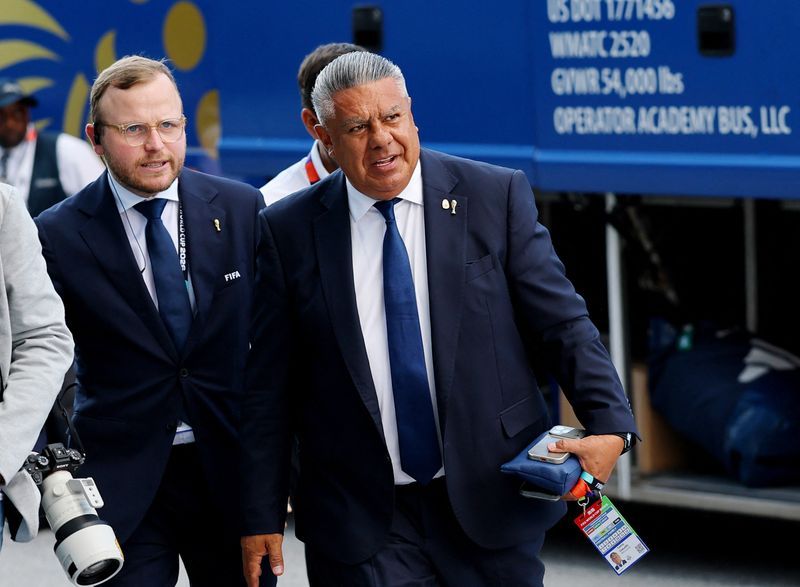
Argentina's football association issued a forceful denial on Wednesday regarding allegations that its leadership faced legal summons from United States authorities, pushing back against widespread media reports that had detailed airport detentions and device seizures involving top officials. The AFA categorically rejected claims targeting president Claudio Tapia and treasurer Pablo Toviggino, stating that neither man had been formally ordered to testify before American courts or subjected to confiscation of personal property.
However, the association's statement contained a notable caveat: it acknowledged that an unidentified third party had received a grand jury summons with instructions to potentially testify about multiple individuals connected to the organization. This admission suggested that while the AFA's top two officials may have avoided direct legal action, the investigation into the federation's operations remains active and potentially involves witnesses with knowledge of organizational practices and financial dealings.
The controversy erupted following reports that FBI agents had encountered Tapia and Toviggino at New York's JFK Airport on Monday morning as Argentina's national team prepared to depart following the World Cup final. According to eyewitness accounts, federal agents questioned both officials for approximately half an hour aboard a bus positioned on the airport tarmac, with some initial reports claiming agents had requested access to Tapia's mobile devices and other electronic equipment.
The underlying investigation appears substantially broader than any immediate focus on individual officials. Media investigations, particularly reporting by Infobae, have indicated that US authorities are examining commercial contracts exceeding $300 million in value that are connected to the AFA. This financial scrutiny represents an expansion of earlier investigations into Argentine football finances, following raids conducted in December as part of a money-laundering probe that cast a wider net across the sport's administrative structures.
The AFA's carefully worded statement sought to distinguish between what officials characterized as false allegations and the reality of their legal standing. The organization contended that the document in question—presumably a grand jury summons or related legal instrument—imposed no personal obligations on Tapia or Toviggino, did not mandate their appearance, and contained no seizure orders affecting their property. This language suggests that while US authorities may have sought to question the officials informally at the airport, they had not yet taken formal legal steps to compel their testimony or secure evidence directly from them.
The incident highlights the complex intersection of international sports administration and cross-border financial investigations. When US federal authorities become involved in probing overseas sporting organizations, questions of jurisdiction, diplomatic protocol, and the scope of investigative powers become significant. The fact that agents approached Argentine officials at an international airport, albeit without apparently executing formal legal documents at that moment, underscores how such investigations can create politically sensitive situations between nations.
For Malaysian and Southeast Asian observers, this case illustrates broader vulnerabilities within continental football federations regarding financial transparency and commercial oversight. The alleged scale of contracts under investigation—exceeding $300 million—demonstrates how substantial sums can flow through football administrative bodies with relatively limited external scrutiny. Regional football associations in Southeast Asia operate under comparable structural arrangements, making the AFA situation potentially instructive for governance discussions within ASEAN sporting bodies.
The timing of the airport encounter, occurring immediately after Argentina's World Cup victory, injected an unusual element of sporting controversy into what appears to be a serious financial investigation. The juxtaposition of national celebration with federal law enforcement intervention created a narrative tension that captured international media attention and raised questions about the coordination between sports authorities and investigative agencies in managing sensitive situations.
The AFA's insistence that neither Tapia nor Toviggino faced direct legal orders represents an important distinction from having been formally summoned. However, the organization's acknowledgment that witnesses connected to the federation have received grand jury summonses indicates that investigations are proceeding through alternative channels. This approach allows prosecutors to gather testimony and evidence without immediately confronting senior officials with formal legal demands, potentially a strategic choice to preserve investigative momentum while building a broader evidentiary foundation.
Argentine football governance has faced previous scrutiny regarding financial practices and administrative transparency. The current US investigation adds another layer of international oversight to an organization that, despite its prominence in global football, has occasionally struggled with institutional accountability. The investigation's reach into commercial contracts suggests authorities are examining not merely internal financial management but also external arrangements involving broadcasters, sponsors, and other commercial partners.
The dispute between the AFA's characterization of events and initial media reports demonstrates how investigations involving high-profile figures can generate competing narratives. Without access to the actual legal documents or formal statements from US authorities, determining the precise nature of what occurred at the airport remains challenging. However, the presence of federal agents and the questioning of senior officials clearly indicates that investigations have reached a stage where direct engagement with organizational leadership is considered necessary or strategically valuable.
Moving forward, the investigation's trajectory will likely depend on what evidence and testimony grand jury proceedings can develop through the unnamed third parties and other witnesses. The AFA's clarification, while vigorously denying certain claims, implicitly confirms that US authorities view the federation as worthy of substantial investigative attention. For football administrators globally, the case underscores how international investigations can penetrate even prominent sporting organizations, and how commercial contracts and financial flows increasingly attract regulatory scrutiny across jurisdictional boundaries.

