Prime Minister Datuk Seri Anwar Ibrahim deployed the traditional medium of Malay poetry on Wednesday to underscore themes of unity, discipline and collective purpose, posting a four-line pantun on his official Facebook account that resonated deeply with online audiences seeking reassurance about political cohesion. The measured, culturally rooted message arrived at a moment of visible strain within Malaysia's Federal Unity Government, as Anwar's Pakatan Harapan bloc prepares for vigorous electoral competition against Barisan Nasional—ostensibly a coalition partner in the federal administration—in the upcoming Negeri Sembilan state contest.
The timing and format of Anwar's intervention reveal a sophisticated political communication strategy. Rather than issuing a formal statement, the Prime Minister chose a poetic device steeped in Malay cultural tradition, lending the message moral weight and emotional resonance that transcends typical political rhetoric. The pantun format, centuries-old and beloved across Malay-speaking communities, carries particular authority when deployed by national leaders, evoking shared values and historical continuity. This choice signals Anwar's intention to speak to Malaysians not as a partisan politician but as a custodian of national harmony.
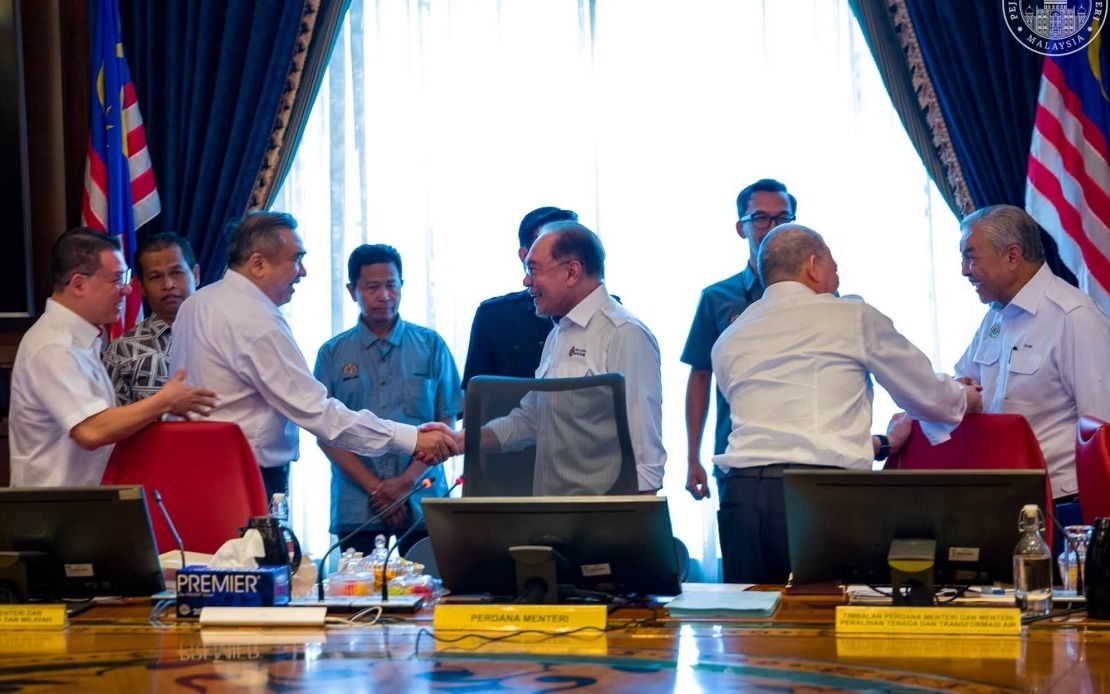
The accompanying Cabinet photograph amplified this message of internal stability. The image featured Deputy Prime Minister Datuk Seri Dr Ahmad Zahid Hamidi and Transport Minister Anthony Loke alongside other senior ministers, all displaying visible relaxation and camaraderie. The deliberate documentation of apparent ease among top government figures served as visual counternarrative to speculation about coalition fractures, reassuring both markets and the public that executive leadership remains unified despite electoral competition below.
The post generated remarkable digital traction, accumulating more than 11,500 likes within two hours—a figure suggesting either organic enthusiasm or sophisticated amplification. Beyond the metrics, however, the qualitative response proved equally telling. The comments section filled with over 1,700 remarks, with numerous users reciprocating in pantun form, transforming the Prime Minister's post into a cultural dialogue. This creative citizen response indicated that Anwar's message had successfully communicated on a register that invited participation rather than mere consumption of political messaging.
The political context sharpening these developments cannot be overlooked. Negeri Sembilan's state assembly dissolution on June 5 triggered an election cycle that has exposed underlying tensions within the Federal Unity Government arrangement. The Pakatan Harapan, chaired by Anwar, contests all 36 state seats, while Barisan Nasional under Ahmad Zahid's leadership fields candidates in 25 constituencies and has additionally negotiated electoral cooperation with Perikatan Nasional. This competitive posture among federal coalition partners reflects the inherent strain in Malaysia's consociational governing model, where rival political forces maintain both partnership and rivalry simultaneously.
The electoral mathematics in Negeri Sembilan deserve particular scrutiny. Barisan Nasional's decision to contest fewer than all available seats while simultaneously forging arrangements with Perikatan Nasional suggests calculation aimed at maximizing opposition to Pakatan Harapan without fragmenting the anti-PH vote. This tactical division of labour complicates the narrative of federal unity, implying that even at lower electoral levels, the three major coalitions maintain distinct strategic interests that cannot be entirely subordinated to federal partnership.
Malaysia's political architecture has evolved considerably since the 2022 general election introduced the Federal Unity Government framework. Initially presented as an emergency measure preventing political chaos, the arrangement has matured into a more complex negotiation between powerful interests. The Negeri Sembilan contest represents the first substantial test of whether this federal equilibrium can withstand genuine state-level competition. Anwar's pantun message, in this interpretation, functions as a preemptive stabilizer—a cultural invocation of unity designed to prevent campaign rhetoric from escalating into fundamental threats to the federal arrangement.
The Prime Minister's invocation of friendship and consensus also addresses Southeast Asian audiences concerned about Malaysian political stability. Regional investors, neighbouring governments, and international observers have invested considerable attention in Malaysia's ability to maintain coherent governance despite deep partisan divisions. A visible rupture in the Federal Unity Government could generate economic uncertainty and geopolitical consequences. By emphasizing harmony at this critical juncture, Anwar signals to external stakeholders that Malaysia's core political institutions remain functional and cooperative despite electoral competition.
The choice to pair the pantun with a 1980s popular song further demonstrated Anwar's multimedia political communication strategy, reaching audiences across generational and educational divides. While the specific song selection carried symbolic weight—drawing on shared cultural memory—the overall approach suggested recognition that political messaging in the digital age requires layered, multi-sensory engagement rather than monolithic statements. The willingness to blend traditional poetry, photographic documentation, and popular cultural reference points indicated a cosmopolitan understanding of how diverse Malaysian publics consume political information.
Observers noted that Anwar's message generated particular enthusiasm among commenters who themselves responded poetically, suggesting that the Prime Minister had succeeded in elevating political discourse above the ordinary register of partisan attack and defensive posturing. The dialogic, creative quality of citizen responses indicated that substantial portions of Malaysia's online public welcomed an invitation to engage politics through cultural and aesthetic frameworks rather than purely ideological ones. This represents a distinct shift from the grinding factional rhetoric that often dominates Malaysian political discourse.
As polling approaches on August 1, Anwar's unity message will face its practical test. The viability of the Federal Unity Government depends not merely on rhetorical commitment to solidarity but on the ability of competing coalitions to contest elections vigorously without delegitimizing the broader federal arrangement. The Negeri Sembilan election will reveal whether the pantun-powered appeal to unity can survive contact with real electoral competition and the raw stakes of state government control. The enthusiastic online response provides encouraging signs, but the ultimate measure lies in whether voters reward the message of harmony or punish the apparent contradiction between federal partnership and coalition combat.

