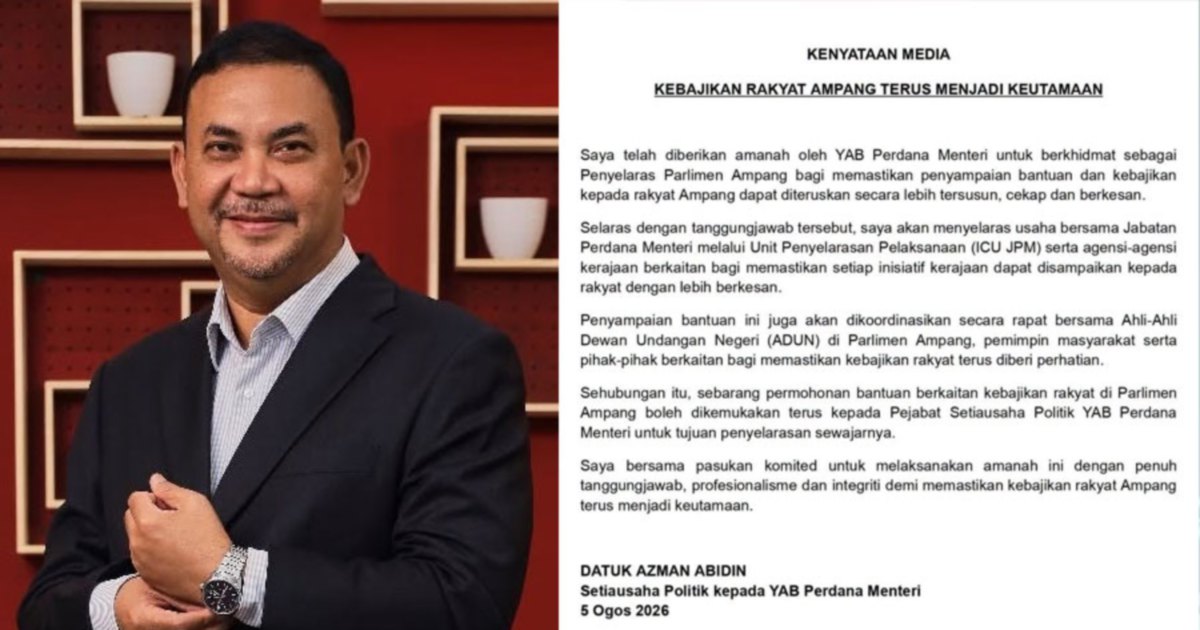
Prime Minister Datuk Seri Anwar Ibrahim's office has appointed one of his political secretaries to serve as parliamentary coordinator for Ampang, a move that coincides with the suspension of PKR lawmaker Rodziah Ismail's access to the MyKhas constituency allocation system. The development marks a significant intervention by the Prime Minister's inner circle in the administrative affairs of the parliamentary constituency, raising questions about the underlying circumstances that prompted the action.
The MyKhas system, which stands for My Kawasan Hasilan (My Constituency Development), is the digital platform through which Malaysian parliamentarians manage and distribute constituency development funds to projects and initiatives within their districts. Rodziah Ismail, the elected representative for Ampang under the People's Justice Party (PKR), has been barred from accessing this crucial tool, effectively limiting her ability to approve and monitor development spending in the constituency she represents.
The suspension of Rodziah's fund access represents an unusual step within Malaysia's parliamentary framework, as such allocation systems are typically integral to an MP's role and responsibilities. Losing access to MyKhas would substantially hamper an MP's capacity to respond to constituent needs, approve local projects, and demonstrate visible returns on development allocations—matters that are fundamental to maintaining electoral legitimacy and grassroots support. The move signals a breakdown in normal parliamentary procedures and suggests underlying tensions within PKR's political structure.
The appointment of a Prime Minister's aide to coordinate parliamentary affairs in Ampang introduces an additional layer of centralized oversight. This appointment effectively creates a parallel administrative authority within the constituency, one that reports directly to the Prime Minister's office rather than functioning under the standard chain of command that would typically run through the party and the MP herself. Such arrangements are generally reserved for extraordinary circumstances or situations involving serious misconduct or political disputes requiring executive intervention.
For Malaysian political observers, these developments occur within a broader context of internal PKR dynamics that have periodically surfaced in public discourse. The party, which forms a crucial component of the federal coalition government alongside Democratic Action Party (DAP) and Malaysian United Indigenous Party (Bersatu), has experienced periodic tensions between its leadership structures and individual members. The Ampang situation exemplifies how these internal disputes can escalate into administrative measures that affect parliamentary representation at the grassroots level.
From a governance perspective, the appointment raises important questions about the distribution of power and accountability in Malaysia's system. When a PM's political aide assumes coordination responsibilities for a constituency, it blurs the lines between party administration, executive authority, and parliamentary representation. Constituents typically expect their elected MP to be their primary point of contact for development issues, and introducing alternative channels of authority can create confusion about where responsibility ultimately lies for addressing local concerns.
For residents of Ampang, the practical implications are significant. Development projects, community grants, and local initiatives would now require coordination through multiple channels rather than flowing directly through their elected representative. This could potentially delay decision-making processes and create uncertainty about project approval timelines. Small-scale community projects that previously received relatively swift approval through the MP's discretion might now face bureaucratic complications.
The incident also reflects broader challenges within Malaysia's political landscape regarding party discipline, internal disagreements, and the resolution mechanisms available when conflicts arise between MPs and party leadership. Rather than addressing disputes through standard party protocols or democratic internal processes, the approach taken in Ampang—removing fund access and appointing a centralized coordinator—suggests that disputes may be escalating beyond negotiation and into executive action.
For opposition parties and political commentators, this situation offers material for scrutiny regarding governance standards and democratic practices. Questions will likely arise about due process, transparency in decision-making, and whether such measures represent appropriate responses to alleged misconduct or whether they constitute disproportionate exercises of executive authority against elected representatives.
The broader implications for Southeast Asia's political landscape are worth noting as well. Malaysia, as a regional democratic standard-bearer, has traditionally positioned itself as a relatively stable constitutional monarchy with functioning parliamentary institutions. Episodes involving the suspension of elected representatives' basic administrative tools can impact international perceptions of Malaysia's democratic health and institutional robustness.
Looking forward, observers will monitor whether this situation leads to clarification of the disputes underlying the action, potential resolution of tensions, or further escalation of intra-party conflicts. The handling of the Ampang situation could set precedents for how similar future disputes are managed and could influence political culture within the ruling coalition regarding power distribution and accountability mechanisms.

