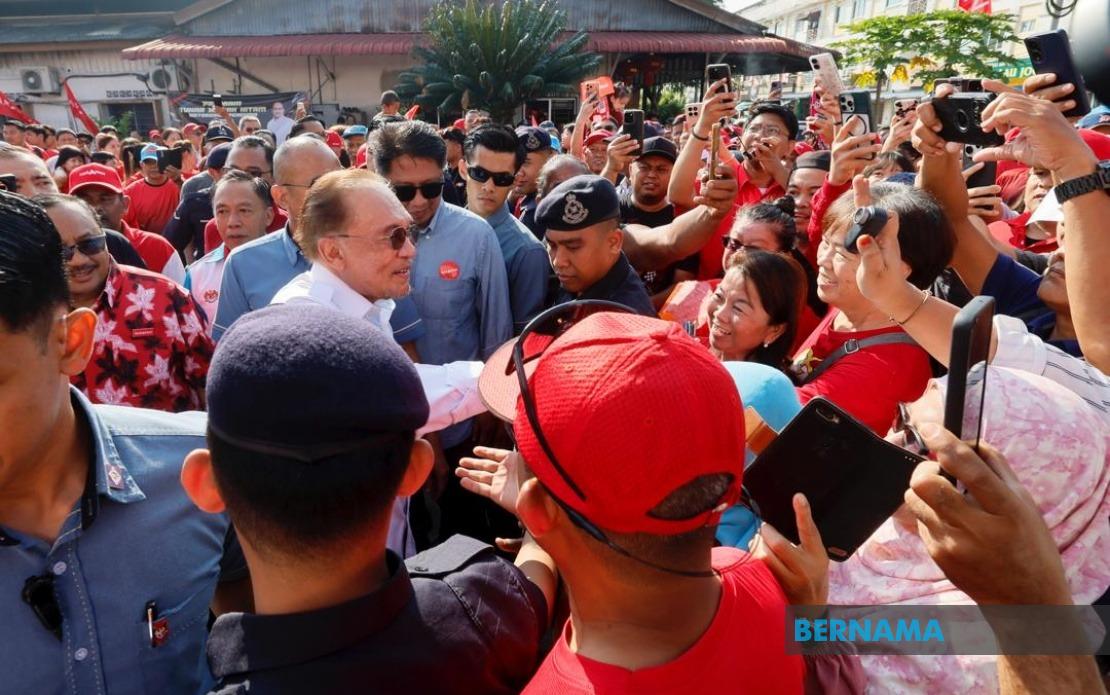
Prime Minister Datuk Seri Anwar Ibrahim's visit to Johor on the campaign trail's ninth day has delivered a significant psychological lift to Pakatan Harapan's electoral machinery, particularly in the Machap and Layang-Layang state seats, as the coalition intensifies its ground game before voters head to the polls on July 11. The appearance in Simpang Renggam parliamentary constituency underscores PH's strategy of maintaining momentum in a state where coalition fortunes have fluctuated considerably in recent electoral contests, signalling to both party operatives and the electorate that the federal leadership remains committed to securing crucial wins in one of Malaysia's most politically consequential states.
Nur Hafiz Roslan, the PH aspirant contesting the Machap seat, characterised the Prime Minister's engagement as far more than a symbolic gesture. He emphasised that Anwar's presence communicated a substantive message to candidates and campaign volunteers about the primacy of service orientation in political work. The candidate highlighted that during their interaction, the PKR president reiterated the importance of disciplined organising and ethical conduct, framing the election campaign as fundamentally about meeting community needs rather than stoking divisiveness or pursuing narrow partisan advantage. This messaging strategy attempts to distinguish PH's approach from critics who contend the coalition has become overly focused on consolidating incumbent power.
Anwar's remarks to the candidates extended beyond motivational rhetoric to establishing concrete expectations for performance. He conveyed to both Nur Hafiz and his running mate that winning electoral mandates carries the obligation to demonstrate tangible improvements in constituency development and welfare provision. This emphasis on deliverables reflects PH's broader effort to rebut opposition narratives suggesting the coalition has failed to translate legislative control into meaningful improvements for ordinary Malaysians. For candidates seeking to retain or capture seats, the implicit message is that campaign commitments made during the election season will be subject to rigorous public scrutiny once elected.
The gathering in Simpang Renggam drew more than 1,000 residents to what organisers branded as the 'PMX Santai Sarapan Bersama Masyarakat' programme, a deliberately informal affair designed to project accessibility and approachability rather than formality and distance. This stylistic choice reflects contemporary electoral dynamics in Malaysia, where sophisticated voter blocs increasingly expect politicians to demonstrate genuine engagement rather than ceremonial appearances. The substantial turnout suggests that PH's ground mobilisation efforts remain effective, at least in mobilising supporters for staged public events where sympathetic crowds can be expected.
Guna Balakrishnan, the PH candidate for Layang-Layang, credited the Prime Minister's engagement with enhancing his capacity to connect more authentically with constituents. Yet his remarks also revealed the underlying anxiety within the campaign machinery—the acknowledgement that while local enthusiasm appears robust, intensifying outreach work remains essential for converting goodwill into actual votes. This candid assessment reflects the reality that campaign visits from high-profile national figures, while psychologically valuable, must translate into sustained grassroots organising if electoral objectives are to be achieved. The implicit warning embedded in Guna's comments is that early optimism could be squandered through complacency or inadequate field operations.
Resident responses to Anwar's visit provided anecdotal evidence of how leadership presence affects voter confidence and decision-making calculus. Chuan Chee Mei, a 48-year-old Simpang Renggam resident, characterised the Prime Minister's visible backing for the local candidates as decisive in confirming her intention to support PH contenders. Her assessment highlights how voter decisions, even among politically engaged citizens, can be shaped by perceptions of viability and elite endorsement. The implication is that high-profile campaign appearances serve as signals to persuadable voters about which candidates possess institutional backing and realistic prospects of election victory, a consideration that weighs particularly heavily in close contests.
Noor Takiyudin Salleh, aged 38, similarly expressed appreciation for what he perceived as Anwar's unpretentious and genuine demeanour during the community engagement. His observations about the Prime Minister's relaxed approach and the impressive turnout suggest that the carefully choreographed informality of the event achieved its intended effect—generating impressions of authenticity and mass participation that reinforce perceptions of PH momentum. The 1,000-plus attendance figure, repeatedly mentioned by participants, functions as a visible indicator of campaign strength and public enthusiasm that extends beyond the actual attendees to shape broader narratives about which coalition is capturing electoral energy.
The Johor state contest involves 172 candidates competing for 56 state assembly seats, a configuration that fragments voting patterns across multiple constituencies and complicates efforts to predict overall outcomes. The distribution of contests across this expanded field means that individual constituency dynamics, local candidate quality, and targeted campaign intensity can produce significant variations in results even as broader state-level trends suggest particular coalition advantages or disadvantages. PH's strategy of deploying Anwar to constituencies like Machap and Layang-Layang reflects careful calculation about which seats represent genuine pickup opportunities versus safe holds that require only routine support.
The electoral calendar compresses decision-making timelines for persuadable voters and demands efficient deployment of campaign resources. Early voting on July 7 will enable supporters with transportation or flexibility constraints to participate before the main polling day, potentially shifting the composition of the electorate in unpredictable ways. Strategic candidates and party organisers must account for this bifurcation of the voting process when calibrating their campaign intensity and targeting across the remaining campaign days. PH's decision to concentrate Prime Ministerial attention in these constituencies suggests internal polling or campaign assessments indicating competitive contests where high-profile intervention could meaningfully affect outcomes.
From a broader Malaysian political perspective, the Johor contest represents a critical test of PH's capacity to maintain electoral competitiveness in a state where its governance record remains subject to intense scrutiny and contestation. Voter evaluations of the coalition's performance in office—whether on economic management, service delivery, or political stability—will ultimately determine electoral outcomes far more than campaign atmospherics or leadership visibility. The Prime Minister's engagement thus serves partly as an attempt to shape how voters contextualise their assessments of PH's record, emphasising continuity, commitment to service, and forward-looking development rather than inviting retrospective judgement on contested governance questions.
The deployment of Anwar Ibrahim in the final phase of the campaign also carries implications for national political dynamics extending beyond Johor's borders. A strong PH performance would provide momentum heading into subsequent electoral contests and reinforce narratives about the coalition's political resilience, whereas disappointing results would invite questions about voter sentiment toward the federal government and whether discontent is broadening geographically. This heightened stakes environment explains the visible intensity of campaign activity and the concentration of senior leadership attention on key constituencies where relatively modest shifts in voter preferences could produce significant swings in seat allocations.

