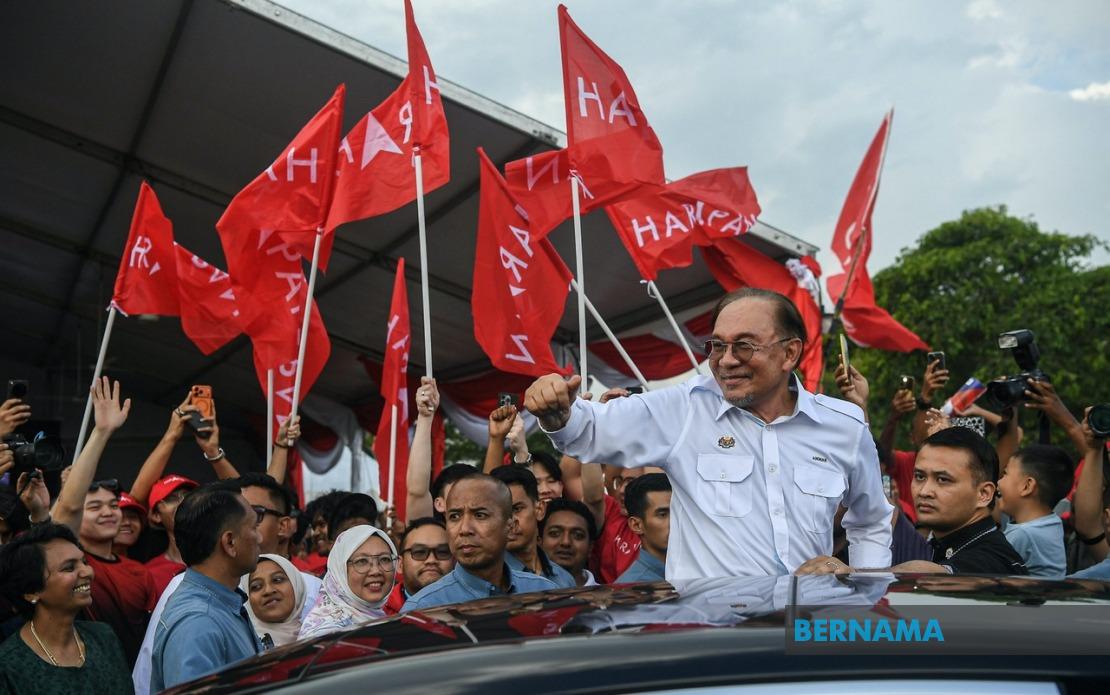
Prime Minister Datuk Seri Anwar Ibrahim's active involvement in Pakatan Harapan's campaign machinery for the 16th Johor State Election has catalysed an unexpectedly positive response from voters across the state, according to party officials monitoring the electoral landscape. Communications Minister Datuk Fahmi Fadzil highlighted the tangible enthusiasm witnessed during recent campaign stops, suggesting the coalition's messaging strategy is resonating with the electorate in ways that extend beyond traditional party machinery.
Fahmi's observations stem from his direct participation in campaign events held in the Batu Pahat district, where he accompanied the Prime Minister to rallies in Senggarang and Semerah. The minister articulated specific instances of grassroots engagement that underscore the appeal Anwar's presence generates on the ground. He recounted an anecdotal but telling example: an elderly man who transported his wife by trishaw specifically to meet the Prime Minister at a campaign event, a gesture Fahmi framed as emblematic of broader community interest.
The Communications Minister, simultaneously serving as PH's communications director, contextualised these encounters within the framework of electoral messaging and voter reception. Fahmi suggested that the spontaneous and enthusiastic responses observed during campaign stops indicate more than mere curiosity about the Prime Minister's presence; rather, they reflect genuine voter receptivity to the policy narratives and political platform the coalition has articulated throughout the election period. This distinction matters considerably for campaign strategists, as it suggests the message itself, not merely personality-driven politics, is driving engagement.
Anwar's commitment to the Johor campaign was notably intensive. Over the weekend of July 4 and 5, the Prime Minister undertook 15 separate campaign engagements across the state, a schedule reflecting PH's strategic determination to maximise leadership presence in a crucial state election. These appearances served dual purposes: reinforcing the coalition's campaign narrative to voters while simultaneously providing morale-boosting support to party candidates and grassroots workers who form the backbone of electoral machinery. Such high-level participation signals to party members that leadership takes the Johor contest seriously.
Pakatan Harapan has committed fully to the electoral contest by fielding candidates across all 56 State Legislative Assembly seats, demonstrating comprehensive territorial ambition. This blanket candidacy strategy, while resource-intensive, positions the coalition to contest every constituency and maximises opportunities to govern if voters deliver a decisive mandate. The decision reflects confidence within PH leadership that the party possesses sufficient organisational capacity and candidate quality to sustain campaigns statewide.
The electoral competition itself involves substantial numbers. Across the 56 available seats, a total of 172 candidates filed their nominations, meaning an average of approximately three contenders per constituency. This fragmentation typical of Malaysian state elections creates complex voting dynamics where plurality results can determine seat allocation, making ground-level engagement and voter mobilisation critical to outcome determination. Anwar's visible presence theoretically strengthens PH's mobilisation efforts by providing focal points for media coverage and grassroots motivation.
Election timing placed immediate consequences on campaign activities. Early voting occurred on July 7, the day Fahmi made his comments, with main polling scheduled for Saturday, July 11. This compressed timeline meant campaign momentum required rapid activation, and Anwar's concentrated schedule reflected urgency in the final week before voters cast ballots. The intensity of his engagement suggested PH leadership assessment that Johor represents winnable territory where additional effort could determine marginal seat outcomes.
For Malaysian political observers, Anwar's active campaigning in Johor warrants analysis beyond surface-level enthusiasm metrics. Johor traditionally constitutes a significant electoral battleground, with its 56 seats representing substantial parliamentary delegation potential if the state returns to federal coalition control. The state has historically swung between ruling coalitions, making voter sentiment volatile and reversible. PH's aggressive resource allocation, evidenced through prime ministerial presence, indicates strategic calculation that the state remains competitive and potentially pivotal to broader federal political dynamics.
The grassroots reception Fahmi documented also provides indirect commentary on voter sentiment regarding the current federal administration. While anecdotal evidence requires cautious interpretation, repeated spontaneous engagement suggests constituencies have not decisively rejected PH's political project, even if enthusiasm remains measured. This contrasts with scenarios where ruling coalitions face pronounced voter alienation or apathy, conditions typically preceding significant electoral losses.
Fahmi's emphasis on community interest translating into electoral support represents hopeful interpretation rather than confirmed outcome prediction. The minister acknowledged that witnessing large crowds and positive reactions indicates voter engagement, but whether that engagement crystallises into actual ballot support versus mere curiosity remains empirically uncertain. Campaign officials routinely interpret enthusiastic crowds as harbingers of electoral success, though history demonstrates such correlations prove imperfect and contingent on numerous variables including opposition campaign effectiveness, voter turnout patterns, and last-minute preference shifts.
The Johor state election ultimately tests voter acceptance of Anwar's federal administration through a regional lens. State elections frequently function as midterm referenda on federal government performance, allowing voters to register satisfaction or dissatisfaction while theoretically maintaining lower stakes than federal contests. Whether the community enthusiasm Fahmi observed translates into an electoral mandate supporting PH governance in Johor would provide significant indicators regarding the coalition's trajectory heading toward subsequent electoral cycles and its capacity to sustain voter confidence beyond initial post-election periods.

