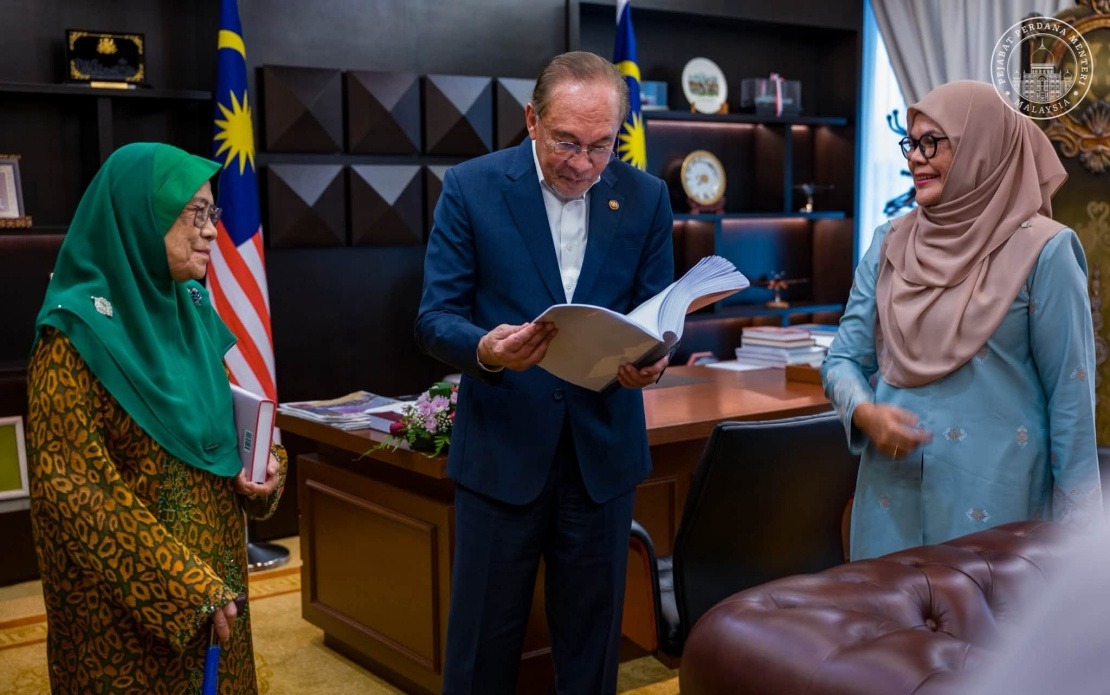
Prime Minister Datuk Seri Anwar Ibrahim has thrown his weight behind a forthcoming book that compiles his political ideas and personal philosophy, expressing optimism that the work will become an enduring guide for Malaysia's future leaders and citizens. In remarks posted on his Facebook account on July 1, Anwar indicated his active involvement in shaping the manuscript, having reviewed and offered feedback throughout its development to ensure accuracy in capturing his intellectual framework.
The book, which remains untitled in the original announcement, represents an unusual venture into the documented record of a serving head of government. It was authored by Professor Dr Salinah Ja'afar, a linguist and lecturer at the Academy of Malay Studies at Universiti Malaya, whose expertise in language and communication proves particularly relevant given the conceptual and rhetorical complexity often associated with Anwar's public discourse. The choice of an academic researcher from Malaysia's premier university underscores an apparent commitment to scholarly rigour in the project.
Guiding the book's intellectual development was Professor Emeritus Datuk Dr Nik Safiah Abdul Karim, a highly respected figure in Malaysian language scholarship and academia. Her role as academic adviser lends additional credibility to the enterprise, positioning the work within an academic context rather than mere political hagiography. Nik Safiah's involvement signals an effort to elevate the manuscript beyond standard political memoir into a more analytical examination of political thought.
Anwar participated in exclusive interviews with both scholars, providing opportunities for extended exploration of his thinking and allowing the authors to probe deeper into the intellectual foundations of his policy positions. These sessions appear designed to move beyond surface-level political statements, delving instead into the philosophical underpinnings and personal experiences that have shaped his worldview over decades of public service spanning multiple political movements and parties.
The Prime Minister characterised the forthcoming publication as a documentation of ideas shaped by his extensive life experiences and voracious reading habits. This framing is significant, as it positions the book not as a straightforward political manifesto but as an intellectual biography anchored in personal development and continuous learning. Anwar's emphasis on how his ideas have been "shaped" through experience acknowledges the evolutionary nature of his thinking, a particularly relevant point given his career transitions across different political platforms.
In his statement, Anwar expressed particular gratitude to Professor Ja'afar for undertaking what he described as the challenging task of articulating complex ideas into accessible form. This gratitude hints at the difficulty involved in translating abstract political philosophy into clear written prose—a recognition that political thinking, particularly Anwar's, often resists simple categorisation or linear presentation. The effort to make these ideas comprehensible reflects a broader concern about legacy and knowledge transfer.
The stated purpose of preserving these ideas for future generations carries particular weight in Malaysia's political context. Given the nation's experience with generational political transitions and the ongoing debates about continuity versus change in governance, a documented intellectual framework could potentially influence policy discussions long after Anwar's tenure as Prime Minister concludes. This reflects broader anxieties about institutional memory and the continuity of political philosophy across administrations.
Anwar's specific hope that the book will serve as a reference guide for nation-building positions intellectual legacy as intertwined with the practical work of governance. By framing the publication through this lens, he suggests that abstract political philosophy has direct applications to the concrete challenges of state administration and policy formulation. This approach resonates with Malaysian approaches to governance that often emphasise the interconnection between values, leadership, and institutional performance.
The emphasis on "personal values" development within the book's scope speaks to a particular vision of political leadership that prioritises character and ethical grounding alongside policy expertise. In Malaysia's contemporary political environment, marked by recent governance scandals and questions about institutional integrity, a public statement about the moral foundations of leadership carries layered significance. It suggests an understanding that sustainable governance requires alignment between personal integrity and public policy.
For Malaysian readers and regional observers, the book represents a significant cultural and political moment. Few serving Southeast Asian prime ministers have undertaken such formalised documentation of their intellectual foundations during their tenure, making this an unusual case study in how political leaders seek to shape their historical narrative. The involvement of university-affiliated scholars adds a dimension of academic legitimacy that distinguishes it from typical political memoirs.
The project also illuminates the Malaysian academic tradition of engaging with contemporary politics through rigorous scholarly methodology. Professor Ja'afar and Nik Safiah's participation demonstrates how Malaysia's universities maintain intellectual engagement with active political leaders, a relationship that varies considerably across the region. This collaboration models a particular approach to the relationship between academia and political power—neither entirely detached criticism nor uncritical endorsement, but rather engaged scholarly analysis.
Looking forward, the publication will likely become a reference point for scholars examining Anwar Ibrahim's political trajectory and policy framework. For policy analysts and political scientists studying contemporary Malaysia, the book promises insights into the intellectual scaffolding underlying recent governance initiatives. Whether future generations indeed adopt it as a foundational reference, as Anwar hopes, will ultimately depend on the work's intellectual substance and its resonance with emerging political challenges.

