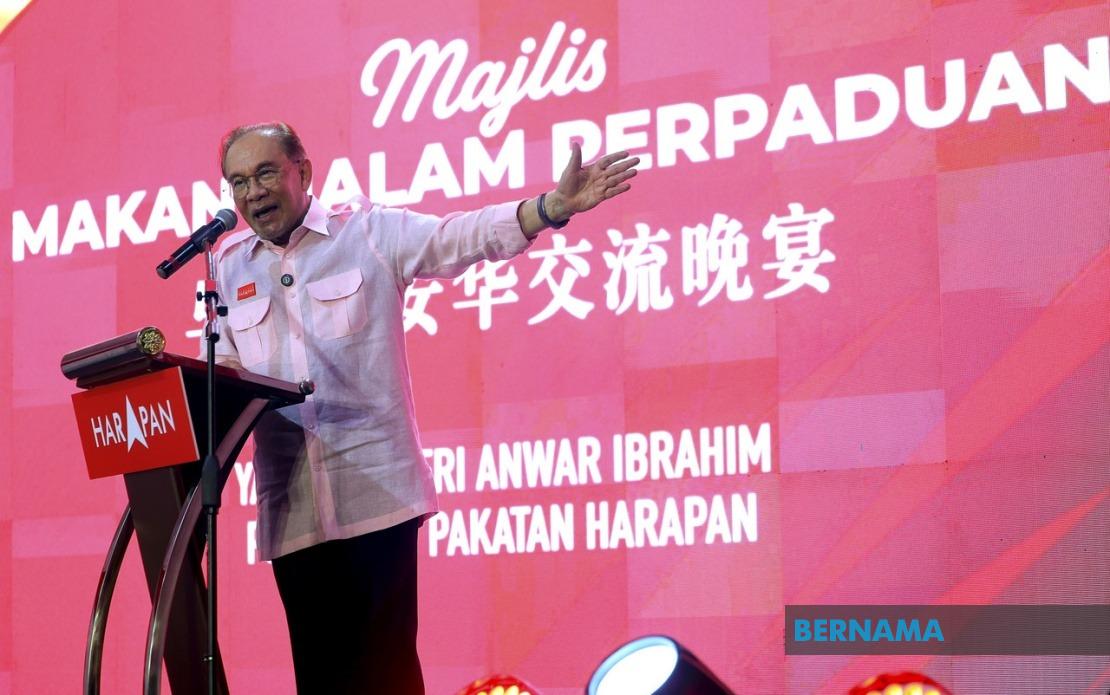
Prime Minister Datuk Seri Anwar Ibrahim has levelled a pointed critique at opposition parties contesting the Negeri Sembilan state election, suggesting their visible appetite for the menteri besar position undermines their credibility as a unified force. Speaking at the Perpaduan Dinner in Taman Sri Penaga, Sikamat, the Pakatan Harapan chairman drew explicit attention to what he characterised as internal jostling for the top executive role, contrasting this with his coalition's focus on serving public interests. The observation forms part of a broader campaign strategy emphasising institutional stability and effective governance as the core issues voters should prioritise in deciding which coalition deserves their mandate.
Anwar's comments reflect a calculated campaign tactic aimed at highlighting fractures within the opposition before voting takes place on August 1. By publicly noting the extent to which rival parties are already competing for the menteri besar position before a single vote has been cast, the prime minister seeks to frame the opposition as self-interested and faction-ridden rather than united behind a coherent vision. This line of attack resonates particularly in state elections where personal leadership and local track records often weigh heavily in voters' decisions. The implicit message—that internecine squabbling will continue after the election regardless of who wins—aims to push voters towards a coalition perceived as more cohesive and administratively competent.
In his remarks, Anwar emphasised that electoral contests should fundamentally be about identifying capable administrators able to serve all constituents effectively and protect citizens' welfare. This framing elevates competence and integrity as the deciding factors, territory on which Pakatan Harapan appears confident given its control of the state since 2018. By shifting discourse away from partisan identity towards administrative performance, the prime minister attempts to neutralise potential opposition messaging rooted in communal appeals or ideological positioning. For Malaysian voters accustomed to seeing state elections turn partly on racial and religious narratives, this pivot towards governance metrics represents a deliberate effort to reshape the campaign's central debate.
The gathering featured sitting Negeri Sembilan Menteri Besar Datuk Seri Aminuddin Harun, whose track record became the focal point of Anwar's endorsement. As the Pakatan Harapan candidate for the Linggi constituency, Aminuddin embodies the coalition's continuity narrative. Anwar specifically praised his administration's integrity and freedom from corruption or abuse of power, arguments designed to appeal to voters concerned about institutional probity. The visible presence of state-level candidates—including Nor Azman Mohamad for Sikamat and Datuk Muhammad Nazri Kassim for Ampangan—underscored the coalition's integrated campaign structure linking the prime minister's national platform directly to local electoral contests.
Anwar's remarks also targeted what he described as divisive racial narratives employed by certain quarters during the campaign. The prime minister characterised such appeals as deliberately inflammatory and counterproductive to the inclusive governance model the Unity Government claims to champion. This criticism suggests opposition parties may be relying on communal messaging strategies, though Anwar stopped short of naming specific organisations or individuals. For a state like Negeri Sembilan with significant Malay-Muslim and Indian populations, the terrain of identity-based politics remains potent, making the prime minister's defence of multi-ethnic governance both tactically significant and ideologically resonant with Unity Government branding.
In contrast to what he portrayed as divisive opposition tactics, Anwar underscored the Unity Government's commitment to fair and inclusive administration benefiting all social segments irrespective of ethnicity. He cited tangible policy initiatives—enhanced socio-economic allocations, housing programmes, and civil service salary adjustments—as evidence of this approach's concrete manifestation. These examples ground the inclusive governance narrative in material deliverables voters can evaluate, moving beyond abstract principles towards demonstrable state action. For Negeri Sembilan residents, such specificity matters considerably when assessing whether parties' campaign promises translate into actual improvements in living standards and public services.
Pakatan Harapan's electoral strategy for Negeri Sembilan involves contesting all 36 state assembly seats, a comprehensive approach reflecting confidence in its organisational machinery and candidate quality. The coalition's distribution across its constituent parties—Parti Keadilan Rakyat fielding 16 candidates, Democratic Action Party 11, and Amanah nine—demonstrates internal load-sharing designed to maintain component party balance while maximising electoral coverage. This configuration suggests negotiations among coalition partners proceeded relatively smoothly, indicating organisational cohesion Anwar implicitly contrasted with opposition divisions. The breadth of candidate deployment signals determination to sweep the state rather than focus narrowly on winnable seats, a confidence-projecting posture in campaign messaging.
The timing of Anwar's intervention carries significance given the condensed campaign calendar. With early voting scheduled for July 28 and polling day on August 1, the prime minister's remarks arrived during the final stretch when undecided voters remain persuadable and campaign messaging reaches maximum saturation. Anwar's choice to personally campaign in Negeri Sembilan underlines this state election's perceived importance within the broader political landscape. For a Pakatan Harapan-controlled state with a sitting menteri besar, the party's calculus presumably views retention as essential to maintaining momentum heading towards eventual federal elections while demonstrating Unity Government stability.
The opposition's apparent internal competition for the menteri besar post, assuming Anwar's characterisation proves accurate, reflects deeper structural questions about opposition unity and coherence. If multiple opposition parties fielding candidates harbour distinct claims to the top executive position, this fragmentation becomes electorally consequential precisely because voters must either select a coalition whose internal leadership hierarchy remains unsettled or choose the established Pakatan Harapan team with clear succession arrangements. Negeri Sembilan's experience may foreshadow dynamics playing out across Malaysia's political landscape as opposition coalitions struggle to maintain unified fronts when individual party ambitions diverge. The state election thus becomes a microcosm for broader challenges confronting anti-government coalitions seeking to rebuild credibility after years of internal recrimination.

