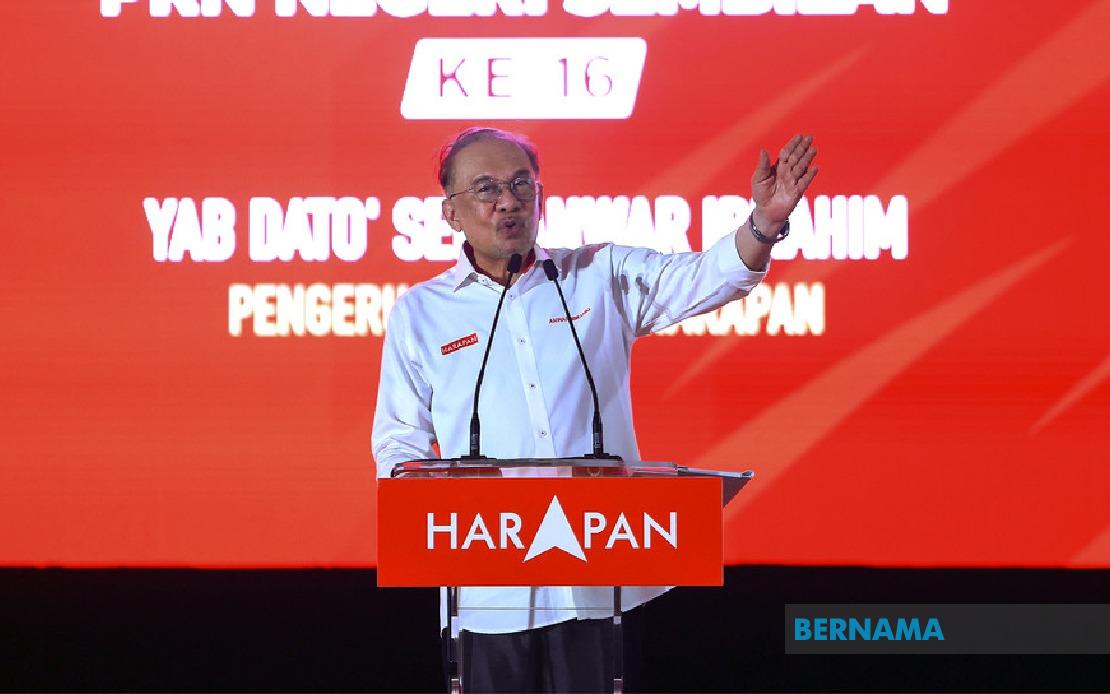
Prime Minister Datuk Seri Anwar Ibrahim has made a direct pitch to Negeri Sembilan voters to return Pakatan Harapan to power in the 16th state election, framing the ballot as a choice between consolidating recent development gains or risking momentum. Writing on Facebook, the PH chairman emphasized that sustaining the coalition's mandate is essential for the state to continue benefiting from coordinated federal-state initiatives that have already transformed key sectors.
Anwar's appeal comes just weeks before Negeri Sembilan heads to the polls on August 1, with nomination day set for July 22 and early voting on July 28. The timing of his intervention reflects the national leadership's confidence in the state contest, even as PH faces broader electoral pressures across Malaysia. By personally endorsing Menteri Besar Datuk Seri Aminuddin Harun—whom he referred to affectionately as Tok Min—Anwar sought to personalize the narrative around administrative stability and clean governance, two qualities that have become central to PH's rebranding after its 2018 election victory.
The partnership between Aminuddin's state administration and the Federal Government has produced a series of infrastructure and social development projects that Anwar believes justify continued voter confidence. However, his phrasing—"more remained to be done"—suggests awareness that satisfaction with PH's performance in Negeri Sembilan may not be universal. This measured tone reflects a broader trend in Malaysian politics where even governing coalitions must actively contest their own legacies rather than assume automatic re-election.
For Malaysian observers, Anwar's emphasis on continuity versus disruption reveals strategic thinking about how federal leaders can influence state-level outcomes. By framing the election as a question of whether to "let progress come to a halt halfway," he implicitly warns against fragmentation or coalition-switching at the state level. This argument carries particular weight in Negeri Sembilan, where the state assembly is relatively small, making each seat proportionally more significant and allowing swings in voter sentiment to produce dramatic shifts in control.
Aminuddin's six-year tenure as Menteri Besar since 2018 positions him as an incumbent with a track record to defend, though his performance has remained largely uncontroversial—a quality that can work both for and against him depending on voter appetite for change. Anwar's decision to highlight Aminuddin's "integrity, humility and strong sense of responsibility" suggests the party is banking on a character-based appeal rather than delivering headline-grabbing announcements in the final campaign weeks.
The broader context of Negeri Sembilan's electoral cycle matters for regional politics beyond the state itself. As a relatively compact state with manageable voter rolls, it often serves as a bellwether for sentiment in central Malaysia. A convincing PH victory would reinforce the coalition's narrative of stable, federal-level governance, while any significant erosion of the PH vote share could embolden opposition parties contesting other state elections planned for later in the year.
Anwar's invocation of Islamic language—"Alhamdulillah" and "Insya-Allah"—also reflects his consistent strategy of grounding political messaging in moral and religious framings that resonate with Malaysia's Muslim-majority electorate. This rhetorical choice signals to voters that PH governance is not merely technically competent but ethically grounded, a positioning that carries particular resonance given the coalition's anti-corruption credentials.
The synchronization between federal and state development planning that Anwar highlighted underscores how modern Malaysian politics operates as an integrated system. Funds, projects, and policy initiatives flow more readily when state and federal governments share the same political complexion. For Negeri Sembilan residents, this means that electing PH state representatives potentially unlocks access to federal resources and coordination that might be more fraught under opposition administration.
Yet Anwar's campaign language also reveals potential vulnerabilities. His appeal to "not let progress come to a halt" presupposes that voters view current progress as satisfactory and worry about reversal—a presumption that may not hold uniformly across all demographic and geographic segments of the state. Rural constituencies, urban centres, and industrial zones may have markedly different assessments of what PH governance has delivered to their specific communities.
The electoral mechanics—with nominations on July 22, early voting on July 28, and polling on August 1—compress the campaign season into a brief window during which PH must activate its ground machinery while simultaneously managing the party chairman's competing obligations at the national level. Anwar's Facebook statement serves partly as a substitute for physical campaigning, allowing him to lend national weight to the state contest without requiring his constant presence on the ground.
For Southeast Asian observers watching Malaysian electoral politics, Anwar's intervention demonstrates how coalition governments operate in a system where control of individual states remains contested terrain. Unlike federalizations where state and federal power are neatly separated, Malaysia's system creates mutual dependencies and pressures that make state elections matters of genuine national consequence. A swing in Negeri Sembilan reverberate through calculations about PH's broader stability and viability as the governing coalition nationally.

