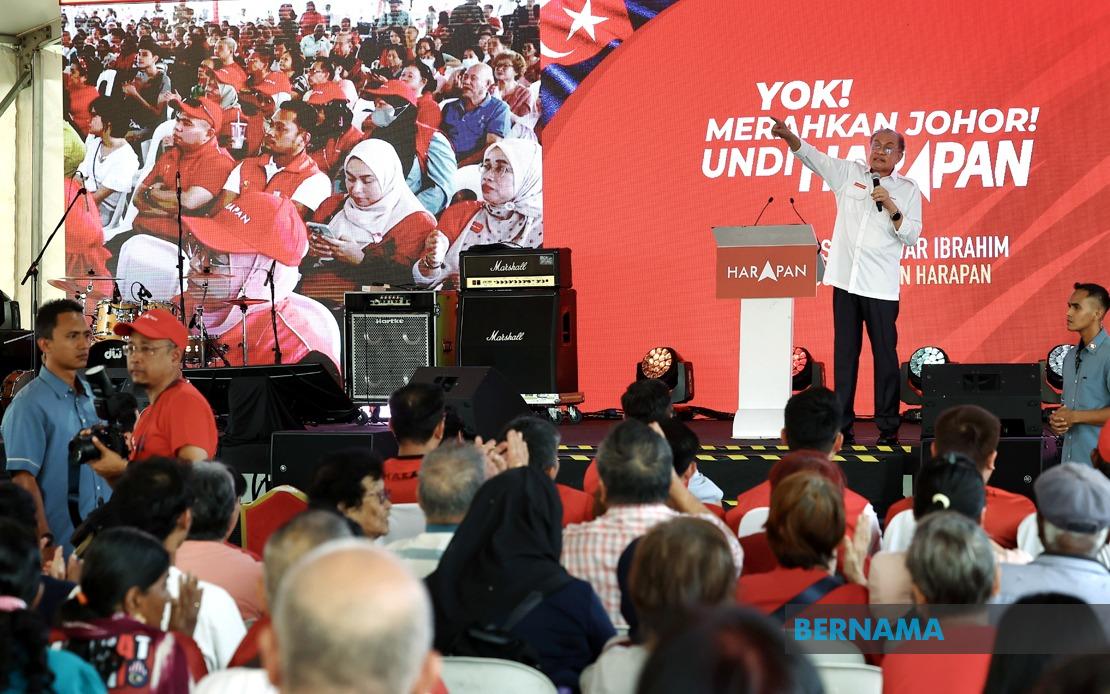
Prime Minister Datuk Seri Anwar Ibrahim has appealed to all political contestants in the upcoming Johor state election to refrain from weaponizing the situation surrounding Datuk Seri Najib Razak's imprisonment for electoral gain, signalling that prolonged engagement with the issue detracts from substantive governance priorities. Speaking at the Yok! Merahkan Johor! Undi Harapan programme in Kulai on July 10, Anwar sought to redirect public discourse away from the former prime minister's custodial status and toward matters of immediate concern to ordinary Malaysians, namely economic stewardship and the safeguarding of living standards across the nation.
The intervention underscores a deliberate attempt by the current administration to establish new parameters for acceptable campaign discourse in state-level politics. Anwar's remarks suggest an implicit acknowledgement that Najib's continued detention remains emotionally resonant among sections of the electorate, particularly within Barisan Nasional's traditional support base. By explicitly calling for cessation of such rhetoric, Anwar appears to be signalling confidence that substantive policy performance rather than revisiting past controversies represents the stronger electoral pitch, a calculation that implicitly reflects internal polling data and campaign strategy assessments.
The timing of Anwar's intervention carries particular weight given Johor's historical significance as a BN stronghold and its continuing importance within Malaysia's federal political balance. Johor has traditionally served as a training ground for national political movements and its electoral outcomes often presage broader national trends. By attempting to establish boundaries around campaign conduct before Johor voting commences, Anwar appears intent on preventing the state contest from becoming a referendum on Najib's legacy or the legitimacy of his prosecution for 1MDB-related offences. This preemptive framing suggests acknowledgement of potential vulnerabilities in the government's electoral positioning, even as it projects confidence in alternative messaging platforms.
A central component of Anwar's counter-narrative revolves around the material consequences of the 1MDB scandal for public finances. The Prime Minister explicitly highlighted the RM51 billion debt burden stemming from the financial mismanagement affair, positioning this figure as emblematic of squandered public resources that might otherwise have served productive purposes. By quantifying the opportunity cost in concrete terms—schools, hospitals, roads, and welfare provisions—Anwar sought to translate abstract notions of financial malfeasance into comprehensible impacts on voters' daily circumstances. This rhetorical strategy aims to redirect emotional energy from sympathy toward a imprisoned former leader toward frustration with the fiscal constraints his administration inherited.
The framing of the 1MDB debt as an ongoing burden carries particular resonance for Malaysian voters who have experienced constrained public spending and service reductions since 2018. Anwar's invocation of this issue serves multiple strategic purposes simultaneously: it legitimizes his government's relatively cautious fiscal posture by attributing budgetary constraints to past wrongdoing rather than present incompetence; it subtly reinforces the narrative that accountability for the previous administration remains incomplete despite Najib's conviction and imprisonment; and it positions economic recovery and debt reduction as shared national imperatives transcending partisan divisions. This rhetorical manoeuvre seeks to elevate the conversation beyond personalities toward systemic considerations.
The delegation accompanying Anwar to the Kulai event—including Youth and Sports Minister Mohammed Taufiq Johari, Deputy Investment, Trade and Industry Minister Sim Tze Tzin, PKR Youth chief Muhammad Kamil Abdul Munim, and Pakatan Harapan candidate for Bukit Batu Arthur Chiong Sen Sern—represented a carefully curated mix of organizational representation and electoral validation. The presence of both ministerial figures and grassroots party leadership conveyed organizational cohesion around the campaign messaging, while the inclusion of specific electoral candidates grounded the event within the concrete mechanics of candidate selection and voter mobilization. This staging choice reinforced the notion that Pakatan Harapan had moved beyond historical grievances toward forward-looking governance propositions.
Anwar's characterization of the Najib situation as settled—"Datuk Seri Najib is now in prison, so leave him alone. If you ask me, enough is enough"—represented a calculated assertion of finality designed to foreclose continued political contestation around the issue. The rhetorical move functioned on multiple registers: it demonstrated magnanimity and confidence from the government's perspective; it signalled to potential Najib sympathizers that the matter had concluded; and it attempted to establish a social norm wherein continued emphasis on the former premier's circumstances would be characterized as poor sportsmanship or obstinate refusal to accept electoral accountability. Whether such rhetorical positioning reflects genuine belief or tactical calculation remains secondary to its communicative intent.
For Malaysian voters, and particularly those in Johor, Anwar's intervention crystallized a tension between competing orientations toward the country's recent past and near future. The question of how justice for financial crimes, institutional accountability, and personal redemption ought to be balanced against forward momentum represents a substantive political question unlikely to be resolved by prime ministerial appeals for rhetorical restraint. Opposition parties and Najib sympathizers retain obvious incentives to revisit these issues regardless of Anwar's preferences, potentially interpreting his intervention as evidence of government anxiety rather than settled confidence. The electoral consequences of this communicative contest will likely manifest most clearly in voting patterns among swing constituencies.
The broader context of Malaysian politics since 2018 has been characterized by oscillating attention to questions of institutional accountability and political renewal on one hand, and material economic performance on the other. Anwar's appeal to deprioritize the Najib question implicitly acknowledges that his government's electoral fortunes depend increasingly on demonstrating tangible economic improvements and social policy benefits rather than continuing to extract political dividends from the previous administration's malfeasance. This represents a significant psychological and strategic transition from the 2018 campaign, when anti-corruption messaging and institutional cleansing occupied the emotional and rhetorical center of Pakatan Harapan's electoral platform. The Johor contest therefore assumes significance as a test of whether Malaysian voters have shifted decisively toward evaluating performance-based criteria.
The ongoing negotiation of how recent Malaysian history should be addressed in contemporary electoral discourse extends beyond immediate partisan calculations to questions about national reconciliation and social cohesion. Communities divided by the 1MDB scandal and its aftermath may reasonably debate whether prolonged emphasis on these issues perpetuates damaging divisions or whether strategic amnesia represents an evasion of accountability principles. Anwar's intervention attempts to assert a particular answer to this question, though implementation depends less on prime ministerial rhetoric than on broader shifts in public consciousness and political competition. The Johor state election will provide preliminary evidence regarding whether his framing strategy resonates with voters or faces continued resistance from those invested in alternative interpretations of the recent past.

