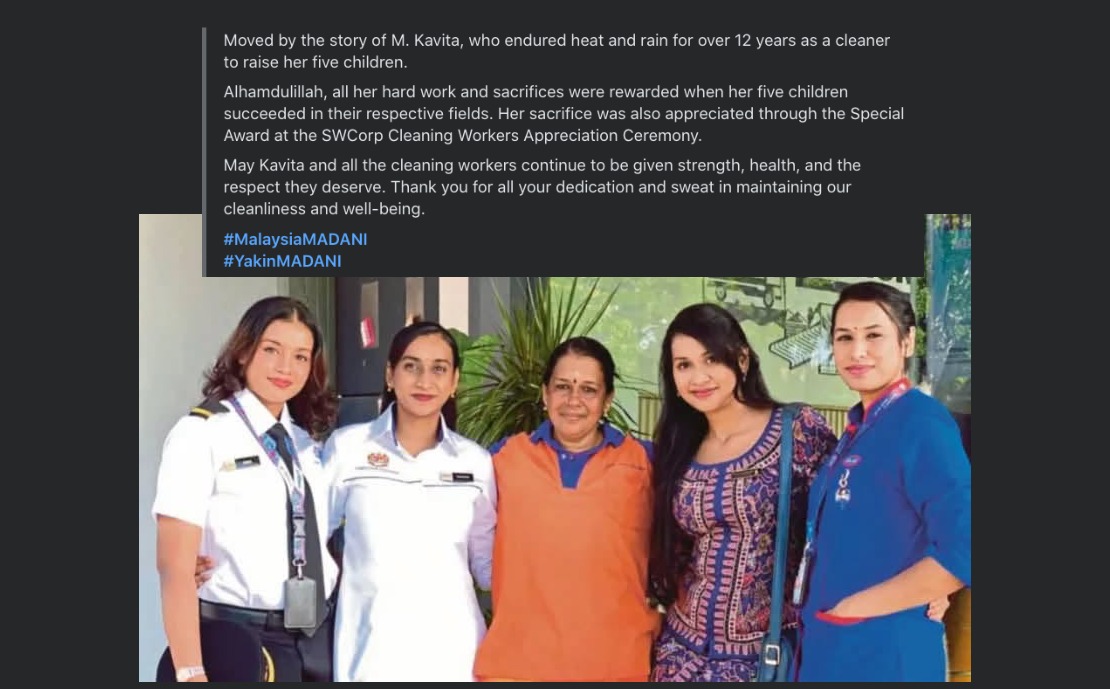
Prime Minister Datuk Seri Anwar Ibrahim has commended the remarkable resilience and sacrifice of street sweeper M. Kavita, whose unwavering commitment to her family while maintaining a demanding job has become an inspirational example within Malaysian society. Through a Facebook post released on August 19, Anwar highlighted how Kavita's more than 12 years of labor in various weather conditions—a defining feature of sanitation work in Malaysia's tropical climate—enabled her to successfully guide all five of her children toward prosperous careers, each establishing themselves in their chosen professional fields.
Kavita's story resonates particularly within the Malaysian context, where sanitation workers form an essential yet often underappreciated segment of the workforce responsible for maintaining public health and urban cleanliness. The Prime Minister's public acknowledgment serves to elevate the status of these workers, drawing attention to the physical and emotional toll their roles demand while simultaneously raising awareness about the dignity inherent in such labor. In his tribute, Anwar extended his appreciation beyond Kavita individually, addressing the broader community of street sweepers and cleaning workers across the country, emphasizing their indispensable contribution to societal wellbeing.
The depth of Anwar's message lay in recognizing not merely Kavita's personal success, but the systemic challenges she overcame during her tenure with SWM Environment in Seremban. Working in Malaysia's humid subtropical conditions requires remarkable physical endurance, and doing so while simultaneously fulfilling parental responsibilities demonstrates exceptional commitment to family welfare. The Prime Minister wished continued blessings upon Kavita and her colleagues, invoking strength, good health, and the social respect that these workers fundamentally deserve but frequently fail to receive in broader societal discourse.
Kavita's achievements gained nationwide attention through a touching incident last month when her four daughters surprised her at work to celebrate her 50th birthday, generating significant viral attention across Malaysian social media platforms. The gesture transcended ordinary birthday celebrations; the daughters arrived dressed in their professional uniforms representing their respective careers as a pilot, cabin crew member, and a staff nurse. This visual representation of upward mobility and professional accomplishment served as a powerful testament to the outcomes of Kavita's sacrifices, moving her to tears during the surprise gathering at her workplace.
The narrative of parental sacrifice translating into children's professional success carries profound significance across Southeast Asian contexts, where family-centered values remain culturally dominant. Kavita's story illustrates how dedication to education and child development can transcend socioeconomic barriers, enabling children born into humble circumstances to achieve positions of responsibility within Malaysia's growing aviation and healthcare sectors. This trajectory—from a sanitation worker's household to professionals in skilled industries—reflects broader patterns of social mobility within Malaysia, though such stories remain insufficiently celebrated in public discourse.
Recognizing this exemplary commitment, SWCorp presented Kavita with a Special Award during its Cleaning Workers' Day Appreciation ceremony, formally institutionalizing recognition of her contributions both to her family and to public service. This official acknowledgment, coupled with the Prime Minister's public tribute, represents a deliberate effort to shift perception regarding sanitation work within Malaysian society. Rather than treating such employment as merely transitory or undesirable, the recognition framework positions these roles as dignified occupations worthy of social esteem and adequate compensation.
The timing of Anwar's statement holds particular relevance given ongoing discussions about wage equity, working conditions, and social welfare provisions for Malaysia's service sector workers. By highlighting Kavita's personal narrative, the Prime Minister indirectly underscores the need for sustainable employment practices and fair remuneration that enable workers to invest meaningfully in their children's futures. The story demonstrates that systemic support for lower-wage workers directly correlates with broader societal benefits, as educated children from sanitation worker families contribute their skills to Malaysia's professional workforce.
For Malaysian readers, Kavita's journey offers both inspiration and reflection on class mobility within the country. Her ability to raise five accomplished children while maintaining a demanding manual job illustrates the transformative power of parental determination and educational investment. Furthermore, the national attention garnered by her story suggests growing recognition that Malaysia's development depends upon valorizing all forms of honest work and supporting workers across socioeconomic strata.
The broader implications extend to policy considerations regarding worker benefits, childcare support, and educational access for children of lower-income families. By publicly celebrating Kavita's accomplishments, the government signals potential openness to examining whether existing support structures adequately facilitate similar success stories among Malaysia's broader sanitation workforce. The story serves as both celebration and subtle call for systemic examination regarding how Malaysia can better support working families across all sectors.

