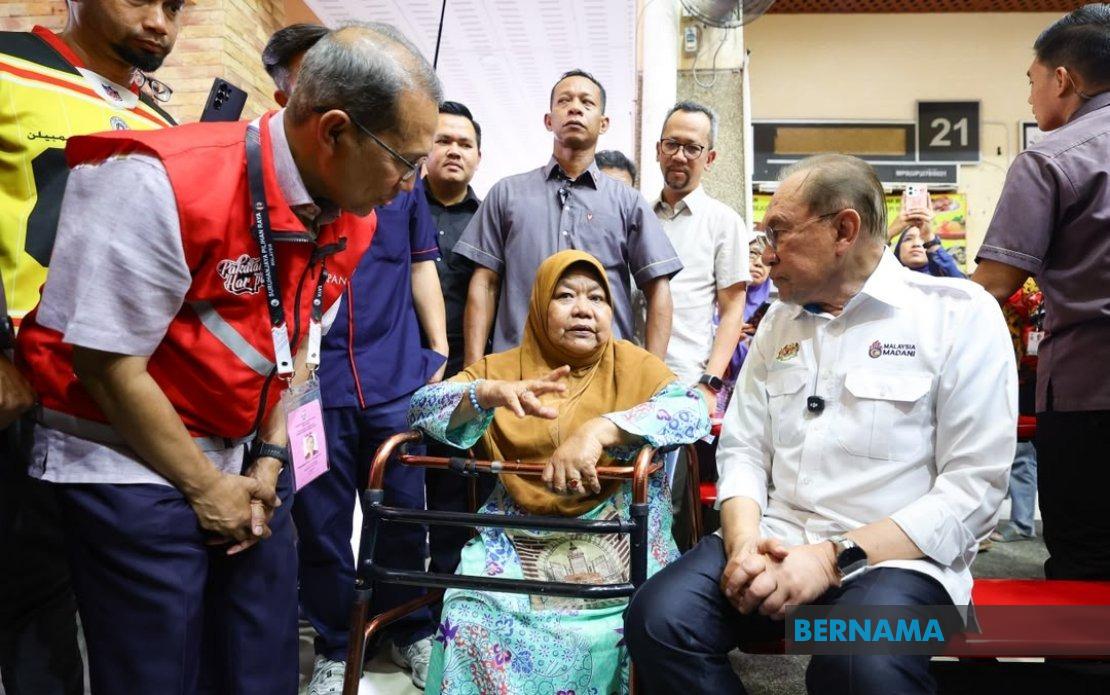
Prime Minister Datuk Seri Anwar Ibrahim has lauded the Pakatan Harapan administration in Negeri Sembilan for proving its capacity to channel development benefits directly to residents, citing the implementation of reciprocal river widening and deepening projects across multiple localities. Speaking at a community engagement event in Ampangan here on July 22, Anwar highlighted how such infrastructure initiatives represent a departure from conventional governance models, instead prioritising transparent resource management that serves the broader public interest.
The river enhancement work undertaken in Ampangan exemplifies this philosophy, Anwar explained, delivering dual benefits by tackling chronic flooding while simultaneously ensuring that proceeds from resource extraction serve community needs. The approach embodies what he termed as integrity-based governance, a principle he emphasised must form the cornerstone of development both within Negeri Sembilan and throughout Malaysia. By framing infrastructure projects as vehicles for both immediate problem-solving and long-term resource stewardship, Anwar sought to position the PH government as fundamentally different from previous administrations.
Under the reciprocal model that Anwar described, sand extracted during river widening operations becomes a revenue source, with proceeds channelled back into maintaining and upgrading the river infrastructure itself. This circular approach reduces waste, minimises external expenditure, and creates a self-sustaining system where environmental management generates resources for continued improvement. For Malaysian readers accustomed to infrastructure projects that often appear disconnected from tangible community outcomes, such specificity about resource recycling represents a notable governance narrative that attempts to bridge the gap between state investment and visible returns.
Anwar drew parallels to his involvement in Port Dickson development negotiations, where he emphasised that project planning had incorporated the welfare of local fishing communities alongside broader economic objectives. He specifically mentioned provisions for education improvements and housing upgrades, framing these as integral to development rather than ancillary considerations. This anecdote served to reinforce his broader assertion that PH-led governance integrates social welfare into infrastructure planning from the outset, rather than treating community support as an afterthought.
The timing of these remarks held particular significance, as Anwar was in Negeri Sembilan attending multiple campaign events ahead of the 16th Negeri Sembilan State Election scheduled for August 1. Early voting has been set for July 28. By highlighting tangible achievements like the Ampangan river project, the PH leadership sought to provide voters with concrete examples of governance philosophy translated into action, moving beyond rhetorical commitments to demonstrated outcomes. This strategy reflects broader challenges facing ruling coalitions across Southeast Asia in translating governance pledges into voter confidence.
The Pakatan Harapan coalition is contesting all 36 state seats with a carefully balanced distribution of candidates: PKR fielded 16 nominees, while DAP contributed 11 and Amanah nine. This allocation reflects the coalition's effort to maintain internal party equilibrium while projecting a united front. For observers tracking Malaysian coalition politics, such internal balance mechanisms often prove as significant as electoral platforms in determining long-term stability. The distribution suggests that PH remains attentive to maintaining inter-party harmony, a crucial consideration given previous tensions within multiparty coalitions in Malaysia.
Anwar's exhortation to voters emphasised the importance of selecting candidates based on trustworthiness and personal integrity rather than ethnicity or religious affiliation. He specifically acknowledged the presence of capable individuals across Malaysia's diverse communities—describing many good Malays, Indians, and Chinese who possess dignity and competence. This framing attempted to reorient electoral choice around governance quality and ethical standards rather than identity-based considerations, a positioning that carries particular resonance in Malaysian politics where communal divisions have historically shaped voting patterns.
The Prime Minister's visit to Ampangan and engagement with the local community represented a direct attempt to build grassroots momentum ahead of the state election. Such community-focused campaigning contrasts with purely top-down political messaging, instead creating opportunities for direct dialogue between leadership and constituents. For Malaysian voters, particularly in smaller towns and rural areas, such personal engagements often carry disproportionate influence compared to media campaigns or national speeches. The event format—framed as an informal afternoon conversation rather than a formal rally—aimed to foster accessibility and approachability.
In the context of Negeri Sembilan's political landscape, the 16th state election represents a critical test of PH's ability to maintain governance control and potentially strengthen its mandate. The state has been under PH administration, and the upcoming election will determine whether the coalition can consolidate its position or faces erosion of support. For Malaysian politics more broadly, the Negeri Sembilan result will provide meaningful indicators about voter sentiment regarding the PH government's performance across its first term, particularly regarding its anti-corruption messaging and claims about transparent governance.
The emphasis on river management and resource recycling, while seemingly technical, carries deeper political implications. Environmental governance and infrastructure transparency have increasingly become touchstones for evaluating government competence in Malaysia and across Southeast Asia, where climate-related challenges and flooding incidents have heightened public awareness of such issues. By highlighting specific mechanisms through which extracted resources return to communities, PH attempted to address growing voter concerns about whether development genuinely benefits ordinary residents or primarily enriches well-connected contractors and officials.
Looking forward to the August 1 polling day, Anwar's messaging sought to frame the choice as fundamentally about governance philosophy and ethical standards rather than partisan affiliation alone. His invocation of integrity-based governance and transparent resource management represents a conscious effort to reconnect PH's governance narrative with the anti-corruption platform that propelled the coalition to power federally in 2018. For voters evaluating PH's track record and future direction, such specific project examples provide mechanisms to assess whether the party's foundational principles remain operational or have eroded during implementation.

