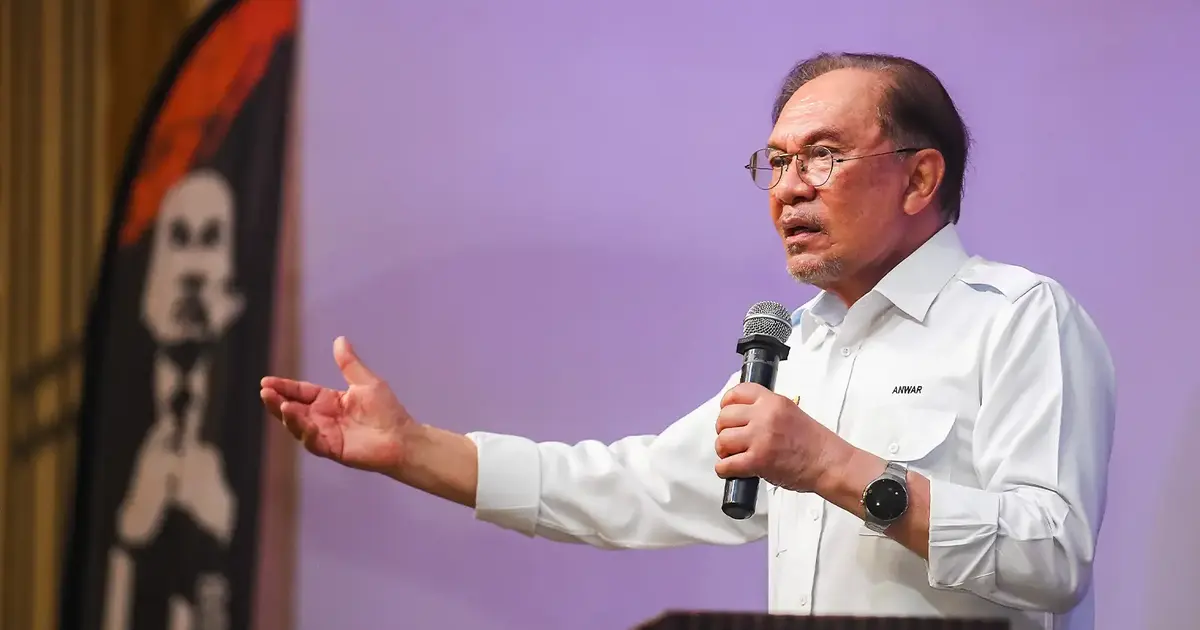
Prime Minister Anwar Ibrahim has levelled accusations at opposition movements aligned with the former premier, asserting that they orchestrated conditions forcing Pakatan Harapan into an early Johor state election that lacked justification. Speaking in his capacity as chairman of the ruling coalition, Anwar suggested that advocacy surrounding Najib Razak's legal circumstances formed part of a broader political strategy to destabilise the state government and force a premature electoral contest.
The timing of Johor's election represents a significant flashpoint in Malaysia's contemporary political landscape. Constitutional provisions ordinarily permit state legislatures to serve full five-year terms, and triggering a dissolution before that period concludes requires either extraordinary circumstances or strategic political calculation by the governing party. Anwar's remarks implicate external pressure as the catalyst, rather than circumstances arising organically from the state administration's needs or electoral readiness.
The 'Free Najib' movement encompasses various civil society actors, political operatives, and sympathisers advocating for clemency, legal review, or release of the former Perikatan Nasional leader currently serving a prison sentence. This campaign has maintained considerable visibility across social media, grassroots networks, and certain political circles, particularly among constituencies where Najib retains substantial support. Anwar's characterisation suggests that these activities transcended ordinary political discourse, instead functioning as instruments to apply pressure on the state's governance machinery.
Johor holds particular strategic importance within Malaysia's federal structure. As the nation's second-largest state by population and economically significant through its proximity to Singapore and position as a manufacturing and logistics hub, control of its state government carries consequences extending beyond provincial administration. Electoral outcomes in Johor historically influence broader national political calculations, given the state's capacity to shift parliamentary mathematics and the symbolic weight of electoral success or failure in such a substantial territory.
The mechanics by which opposition movements prompted the election warrant examination. If advocacy campaigns demonstrably influenced the timing decision, this raises questions about institutional independence and the degree to which extra-governmental pressure can reshape electoral calendars. Anwar's assertion suggests that rather than operating as a neutral administrative matter, the election's timing became entangled with contemporary debates about justice, clemency, and the appropriate consequences for alleged financial misconduct by previous administrations.
Pakatan Harapan's positioning in Johor reflects the coalition's broader electoral challenge. Following the 2022 general election that delivered Anwar's premiership, Pakatan Harapan has contended with sustaining momentum whilst managing expectations across diverse constituencies. A premature state election, irrespective of outcome, imposes organisational and financial burdens on the coalition, demanding resource reallocation from other strategic initiatives and testing internal unity across component parties whose interests do not always align.
Najib's legal situation continues generating political reverberations despite his removal from immediate executive authority. His conviction on corruption-related charges, subsequent imprisonment, and ongoing appeals preserve his status as a polarising figure capable of mobilising both supporters and opponents. The 'Free Najib' constituency represents not merely nostalgia for his administration but reflects deeper voter sentiments regarding governance legitimacy, judicial processes, and the degree to which Malaysia should pursue transitional justice mechanisms targeting previous regimes.
Anwar's criticism operates on multiple levels simultaneously. Rhetorically, it frames opposition movements as exploitative of legitimate public concerns about a former leader's predicament, instrumentalising such concerns for narrow electoral advantage. Substantively, it contests the justification for disrupting Johor's electoral calendar during a period when the state government presumably could continue functioning within its lawful mandate. Politically, it positions the ruling coalition as victim of coordinated opposition manoeuvres rather than architect of the election's timing.
The Opposition's perspective differs materially. Parties within the Perikatan Nasional coalition and their allies maintain that sufficient grounds existed for reconstituting Johor's legislature, citing either governance failings or changed political circumstances warranting fresh electoral certification. Whether such justifications carry persuasive force among voters necessarily depends on individual assessment of the state government's performance and broader political preferences regarding which coalition should govern.
Beyond Johor specifically, Anwar's remarks illuminate ongoing tensions within Malaysia's political system regarding the boundary between legitimate political advocacy and illegitimate pressure on governmental institutions. Civil society campaigns surrounding legal matters inevitably intersect with electoral politics, yet determining where justified public discourse ends and improper institutional pressure begins remains contested and context-dependent. Anwar's framing attempts to establish that the 'Free Najib' movement crossed this boundary by effectively coercing an election.
The international dimension merits consideration as well. Malaysia's democratic institutions and electoral processes remain subjects of external observation, particularly regarding whether political actors respect constitutional norms and refrain from manipulating electoral calendars for partisan advantage. Foreign observers assess Malaysian governance partly through such episodes, which either reinforce or undermine confidence in the stability and impartiality of the country's institutional arrangements.
Moving forward, Anwar's intervention establishes the ruling coalition's public narrative regarding the election's origins and legitimacy. Whether voters credit this explanation or instead prioritise other considerations will become apparent through electoral behaviour. Regardless of outcome, the episode demonstrates how campaigns ostensibly focused on individual legal cases can become entangled with broader questions about political power, institutional autonomy, and the appropriate mechanisms through which Malaysians should resolve fundamental disagreements about governance and justice.

