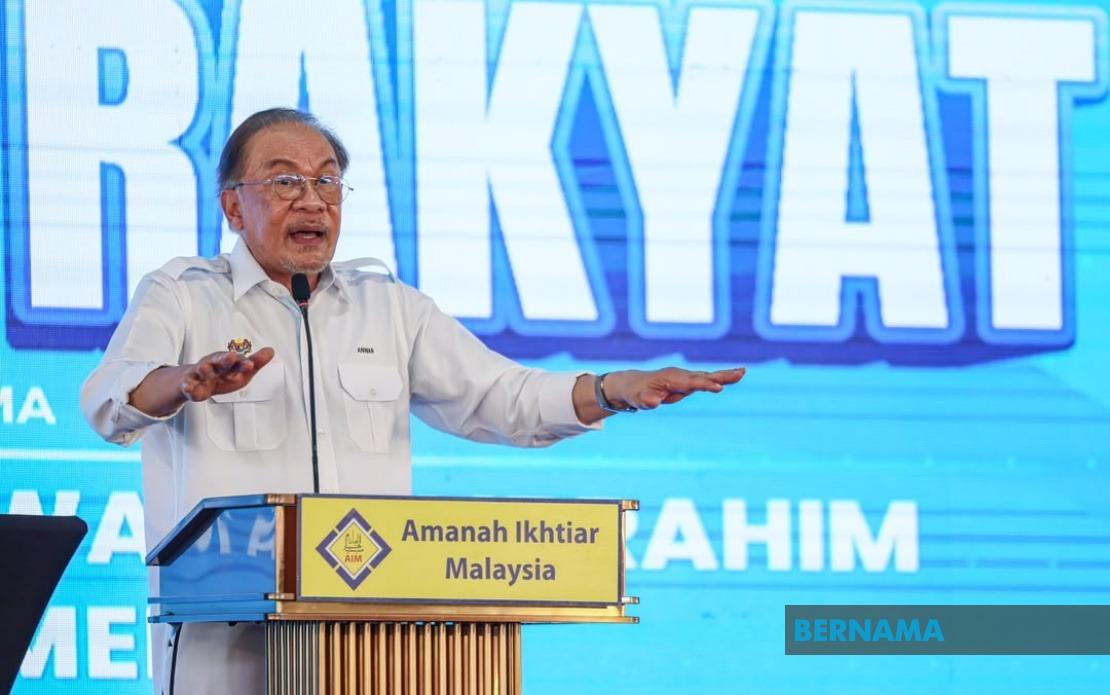
Prime Minister Datuk Seri Anwar Ibrahim has attributed political opposition to his administration's firm anti-corruption measures, claiming that rival parties are coordinating efforts to weaken his government precisely because of its refusal to tolerate graft and misuse of authority. Addressing supporters at a campaign gathering in Batu Pahat on July 5 ahead of the Johor state election, the Pakatan Harapan chairman characterised the mounting political pressure as a symptom of success rather than failure, suggesting that those uncomfortable with stringent governance standards are driving the campaign against him.
Anwar's remarks reflect a strategic framing of contemporary Malaysian politics around the theme of institutional accountability. By positioning anti-corruption as the flashpoint dividing his government from opponents, the Prime Minister implicitly argues that resistance to his administration flows from vested interests threatened by transparency and discipline. This messaging strategy attempts to shift the narrative away from specific governance challenges toward a broader moral contest between those committed to clean administration and those allegedly protecting corrupt networks.
The Prime Minister articulated a specific governing philosophy centred on preventing leaders from leveraging public office for private enrichment. He outlined four prohibited categories of misconduct: acquiring land through political connections, securing government contracts improperly, obtaining equity stakes in companies, and accumulating personal wealth through state authority. Anwar used his own record as evidence, noting that despite numerous visits to Johor as Prime Minister, he had neither acquired property, secured projects, nor obtained shareholdings in the state. This personal testimony serves as a performative demonstration of the standards he claims to enforce across his administration.
The Prime Minister's invocation of personal integrity carries particular weight in Malaysian political discourse, where questions of financial propriety have historically damaged political careers and shaped electoral outcomes. By explicitly denying any material benefit from his position in a wealthy state, Anwar attempts to establish credibility on the corruption issue, a domain where public scepticism toward political leaders remains substantial. His challenge to opponents to verify his claims against available records further reinforces this positioning, though such transparency claims require independent verification to carry genuine persuasive force.
Regarding Pakatan Harapan's controversial coalition with the Democratic Action Party, Anwar defended the partnership by asserting that DAP ministers in his Cabinet have consistently supported programmes benefiting Malays and Islam. This defence addresses persistent concerns among Malay-Muslim voters about whether non-Malay coalition partners might dilute support for communal interests. By citing three-and-a-half years of ministerial cooperation without opposition to such initiatives, Anwar seeks to neutralise accusations that the multiethnic coalition compromises Malay-Muslim priorities, a perennial friction point in Malaysian coalition politics.
Anwar's campaign message also concentrated on Johor's development trajectory, acknowledging billions of ringgit in infrastructure projects while simultaneously arguing these investments have not adequately addressed grassroots welfare concerns. He identified gaps in affordable housing, road quality, and religious facility provision as persistent issues despite substantial capital allocation to the state. This framing suggests that development spending alone, without equitable distribution mechanisms, fails to translate into meaningful improvement in living standards for ordinary Johoreans, implying that Pakatan Harapan governance would rebalance investment toward mass welfare rather than concentrated projects.
The affordability crisis specifically emerged as central to Anwar's Johor pitch. He contrasted massive development expenditure against persistently unaffordable housing, using this contradiction to argue that current state governance has captured development benefits for a narrow stratum while excluding broader populations from prosperity. This resonates with widespread frustration across Malaysia regarding housing accessibility, an issue transcending state and federal boundaries but particularly acute in economically dynamic regions like Johor. By claiming alignment between federal and state governments could unlock more effective welfare distribution, Anwar implicitly suggests that opposition-controlled state governments have underutilised available federal resources for grassroots assistance.
Anwar's campaign strategy in Johor during this election cycle emphasises institutional legitimacy and administrative competence rather than partisan mobilisation alone. By anchoring his narrative to anti-corruption commitment and integrity-based governance, the Prime Minister attempts to establish a principled distinction between his administration and rivals, grounding political competition in questions of institutional quality rather than merely factional competition. This approach potentially appeals to voters concerned with governance effectiveness beyond communal or partisan loyalties, though its persuasive power depends on whether voters perceive actual performance improvements matching rhetorical commitments.
The Johor state election represents a significant test of Anwar's political standing and Pakatan Harapan's broader coalition viability. With 172 candidates contesting 56 state seats, the July 11 polling date would demonstrate whether anti-corruption messaging and administrative performance claims translate into electoral support, particularly in a state with substantial Malay-Muslim demographics where coalition politics remain contested. Early voting scheduled for July 7 would provide preliminary indicators of voter sentiment before primary polling, offering insight into whether the Prime Minister's campaign themes resonate with state electorates.
Anwar's account of enthusiastic crowd responses at the Senggarang gathering, where supporters waited through intense heat, provided anecdotal evidence of mobilisation strength, though the relationship between rally attendance and electoral outcomes remains variable across Malaysian political contexts. The Prime Minister's characterisation of turnout as exceptional compared to previous ceramah events suggests confidence about ground-level enthusiasm, yet translation of campaign energy into actual votes depends on numerous factors beyond event participation, including voter registration patterns, campaign effectiveness in marginal constituencies, and local candidate quality.
The substantive differences Anwar emphasised between Pakatan Harapan and opposition governance centre on welfare distribution mechanisms and accountability standards rather than fundamental ideological transformation. By arguing for alignment between federal and state administrations to maximise development impact, he frames the election as practical governance optimisation rather than existential political choice. This pragmatic positioning, combined with anti-corruption emphasis, constructs an appeal to electoral self-interest alongside principled governance concerns, potentially broadening the coalition's appeal beyond its traditional base.
Anwar's campaign narrative must navigate complex terrain where multiethnic coalition politics meet rising expectations for welfare delivery and integrity standards. The Johor election outcome would signal whether Malaysian voters prioritise anti-corruption commitments and welfare-focused governance over traditional factional or communal divisions, or whether established political identities continue dominating electoral behaviour despite Prime Ministerial claims of administrative superiority. The result would provide meaningful evidence about the durability of Anwar's political coalition and the salience of integrity-based governance messaging in contemporary Malaysian politics.

