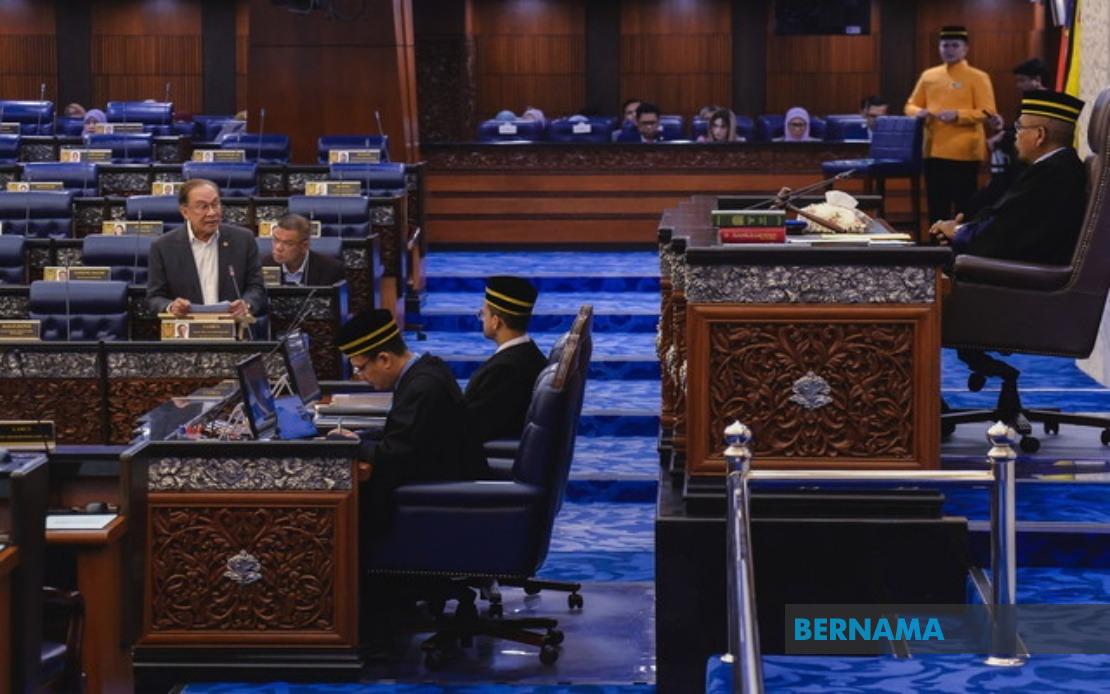
Prime Minister Datuk Seri Anwar Ibrahim has made clear that Malaysia's election laws strictly forbid the announcement of new projects or policies once nomination day has been declared, reinforcing a legal framework designed to ensure fair electoral competition. Speaking during Minister's Question Time in the Dewan Rakyat today, Anwar emphasised that this position remains unchanged and will be upheld across all ongoing state elections, particularly the forthcoming polls in Johor, Melaka and Negeri Sembilan.
The legal basis for this restriction lies in Section 24B of the Election Offences Act 1954, legislation that has formed the cornerstone of Malaysia's electoral integrity safeguards for decades. This provision represents a fundamental principle in the country's election management system: preventing the ruling government from leveraging state resources and announcements to gain electoral advantage during the campaign period. By prohibiting such announcements once nomination day arrives, the law aims to level the playing field for all contesting parties.
Anwar's clarification came in response to a parliamentary query from Datuk Seri Dr Shahidan Kassim of PN-Arau, who sought confirmation that the prohibition remains in effect and raised questions about enforcement mechanisms. The Prime Minister's response underscores the government's commitment to upholding electoral standards, even as the nation prepares for multiple state elections that will test Malaysia's democratic processes and institutional adherence to these rules.
Crucially, the Prime Minister drew a distinction between new project announcements and the implementation of previously approved initiatives. Anwar explained that announcing projects which had already been approved or received funding allocations in earlier federal budgets does not constitute a breach of election regulations. This clarification is significant for state governments and federal agencies, as it allows them to proceed with previously planned developments without running afoul of election laws. The distinction acknowledges the practical reality that governments must continue basic operations while respecting electoral fairness principles.
The restriction applies comprehensively across all levels of government administration. Anwar stressed that government machinery cannot be deployed to announce new projects during campaign periods, regardless of whether such announcements emanate from city councils, state governments, or the Federal Government itself. This blanket approach reflects the view that electoral integrity requires restraint across the entire bureaucratic apparatus, preventing any segment of the state machinery from becoming an instrument for campaign advantage.
For Malaysian voters and observers, this reiteration serves as an important reminder of the rules governing electoral conduct in the country. The prohibition acknowledges a fundamental democratic principle: that elections should be decided by voters' freely formed political preferences rather than by promises of government benefits timed to campaign periods. By restricting new project announcements, the law attempts to create conditions where policy platforms and long-term visions matter more than short-term electoral bribes.
The timing of Anwar's statement is particularly relevant given the anticipated state elections in three prominent states. Johor, Melaka and Negeri Sembilan will provide significant tests of whether all political actors respect these electoral boundaries. As campaign periods approach, the clarity provided by the Prime Minister's parliamentary statement may serve to preempt potential violations and set expectations for all participants in these electoral exercises.
Enforcement of election laws remains a perennial challenge in Malaysia's democratic system. While Anwar did not provide extensive details on how compliance would be monitored ahead of the state elections, his emphasis on the prohibition's continued force signals that authorities will be vigilant. The Election Commission plays a central role in monitoring campaign conduct, and the Prime Minister's public reaffirmation of these rules strengthens the institution's hand in investigating potential breaches.
The distinction between new and previously approved projects carries practical implications for state administrations currently in office. While constrained in announcing fresh initiatives, these governments can still claim credit for implementing long-planned developments. This balance attempts to recognise that governance cannot entirely cease during elections, while still maintaining the principle that voters should not be swayed by last-minute announcements of government spending designed purely for electoral impact.
For opposition parties, the rule provides a framework for holding the government accountable during campaigns. If ruling coalitions attempt to circumvent the prohibition by creative rebranding of new initiatives as previously approved, opposition parties can raise formal complaints with the Election Commission. The legal clarity Anwar provided today potentially arms critics with clearer standards by which to evaluate government conduct.
The Prime Minister's parliamentary response also reflects broader governance principles embraced by Malaysia's electoral framework. Section 24B of the 1954 Act predates modern concerns about election spending and state resources, yet remains remarkably relevant. It embodies the view that a functioning democracy requires some measure of constraint on incumbent advantage, particularly when state machinery can be marshalled to favour ruling parties.
Looking ahead to the Johor, Melaka and Negeri Sembilan elections, all political parties will need to navigate these restrictions carefully. The clarity provided by Anwar's statement leaves little room for ambiguity about what constitutes permissible conduct. Whether this translates into actual compliance during campaigns will be a measure of Malaysia's electoral maturity and the effectiveness of the institutions tasked with overseeing fair competition.
Anwar's restatement of these long-standing rules underscores that Malaysia's electoral system, despite periodic controversies, rests on enduring legal foundations designed to protect democratic fairness. As the nation moves into this electoral cycle, the enforceability of these principles will test whether the country's institutions can meaningfully constrain the advantages typically enjoyed by incumbents.

