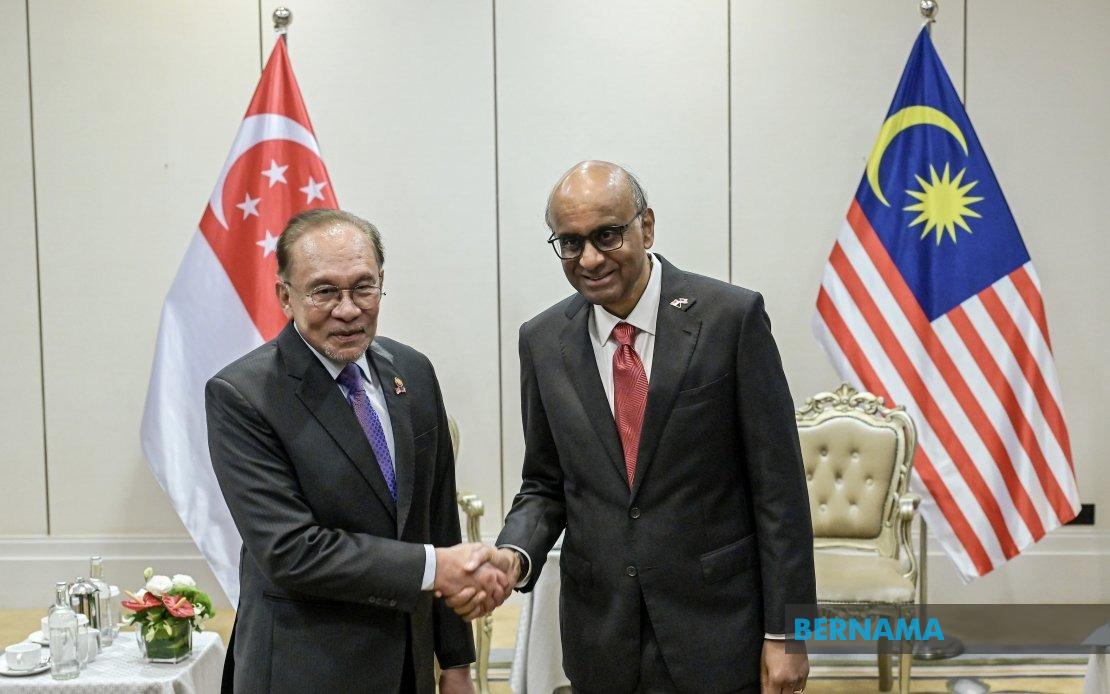
Prime Minister Datuk Seri Anwar Ibrahim welcomed Singapore President Tharman Shanmugaratnam on Monday during a formal courtesy call, marking a significant moment in the diplomatic calendar as the Lion City's leader undertakes a three-day state visit to Malaysia. The meeting, held in Kuala Lumpur and lasting 40 minutes, reflected the depth of bilateral engagement between Southeast Asia's two most economically developed nations and their commitment to nurturing a robust partnership.
The engagement was not a bilateral affair confined to the two leaders. Foreign Minister Datuk Seri Mohamad Hasan, Investment, Trade and Industry Minister Datuk Seri Johari Abdul Ghani, and Entrepreneur and Cooperatives Development Minister Steven Sim Chee Keong were among those present, signalling the breadth of cooperation spanning diplomatic, trade, and economic portfolios. Senior officials representing both governments also attended, underscoring the institutional nature of the discussions and the wide-ranging nature of issues likely placed on the table.
President Tharman's arrival in Malaysia followed a ceremonial welcome at Istana Negara, where Yang di-Pertuan Agong Sultan Ibrahim accorded him a state reception befitting his status as the elected head of a neighbouring nation. Such protocols underscore the formal importance both countries attach to the visit and serve as a public affirmation of their strategic partnership in an increasingly complex regional environment.
The three-day visit, spanning July 13 to 15, operates as a reciprocal gesture following His Majesty's own state visit to Singapore in May 2024. This pattern of exchange visits between the highest political offices demonstrates the institutionalised nature of Malaysia-Singapore relations and the importance placed on maintaining regular high-level dialogue. Such exchanges serve multiple purposes: they allow leaders to discuss matters of bilateral importance, signal commitment to the relationship to domestic constituencies, and enable substantive discussions on regional issues affecting both nations.
Economically, the relationship remains extraordinarily significant for Malaysia. Singapore ranks as the country's second-largest trading partner globally, a position that reflects decades of integrated supply chains, financial flows, and commercial interdependence. Within Southeast Asia specifically, Singapore holds an even more prominent position as Malaysia's largest trading partner among ASEAN member states, a testament to the depth of intra-regional commerce between the two nations.
The scale of this economic engagement becomes apparent when examining recent trade figures. In 2025, bilateral trade between Malaysia and Singapore reached RM402.35 billion, equivalent to approximately US$93.97 billion. Though this represented a modest increase of 1.5 per cent compared to the previous year, the absolute volume underscores the critical importance of the relationship to both economies. For Malaysian exporters, manufacturers, and service providers, access to Singapore's markets and supply chains remains essential to competitiveness and growth.
More encouraging signs emerged in the early months of 2025. From January to May, bilateral trade rose substantially by 14.5 per cent, reaching RM189.90 billion (US$47.87 billion) compared to RM165.93 billion (US$37.65 billion) in the corresponding period of 2024. This acceleration suggests that the relationship is moving into a more dynamic phase, with both nations finding fresh areas of cooperation and mutual benefit. For Malaysian policymakers, such momentum justifies continued investment in strengthening ties with Singapore and capitalising on opportunities in growth sectors.
The timing of President Tharman's visit carries additional significance given regional geopolitical currents. Southeast Asia faces multiple pressures: from great power competition in the Indo-Pacific, from concerns about maritime security and trade routes, and from the need to maintain ASEAN centrality in addressing regional challenges. Malaysia and Singapore, as significant economies and influential voices within ASEAN, have particular responsibility to ensure that their partnership remains solid and exemplary, demonstrating how neighbouring nations can manage differences while pursuing mutual prosperity.
Trade and investment discussions likely dominated the substantive agenda. Both nations have declared ambitions to deepen cooperation in emerging areas such as green energy, digital transformation, and financial services. Malaysia increasingly seeks Singapore's expertise and capital in developing its renewable energy sector, while Singapore views Malaysia as a source of skilled talent, manufacturing capabilities, and access to regional markets. These complementarities create genuine scope for expanding cooperation beyond traditional sectors.
The presence of Malaysia's Investment, Trade and Industry Minister alongside the Foreign Minister indicates that this visit transcends ceremonial courtesy. Rather, it represents an opportunity to review progress on bilateral economic initiatives, address any impediments to trade and investment flows, and chart new directions for collaboration. Such high-level discussions typically result in commitments to pursue specific projects or expand partnerships in identified sectors.
For Malaysia's broader foreign policy strategy, maintaining a warm and productive relationship with Singapore remains non-negotiable. Singapore's centrality to regional finance, its influence within ASEAN, and its strategic geographic position make it an indispensable partner. Conversely, Singapore benefits significantly from regional stability and Malaysia's economic development, making the relationship mutually dependent rather than one-directional.
As Malaysia navigates its development trajectory and seeks to strengthen its position as a middle-income economy transitioning towards higher-value activities, the partnership with Singapore offers both benchmarking opportunities and practical collaboration possibilities. Whether in port operations, financial services, technology, or manufacturing, the two nations find regular avenues to learn from each other and create synergies that benefit their respective populations.

