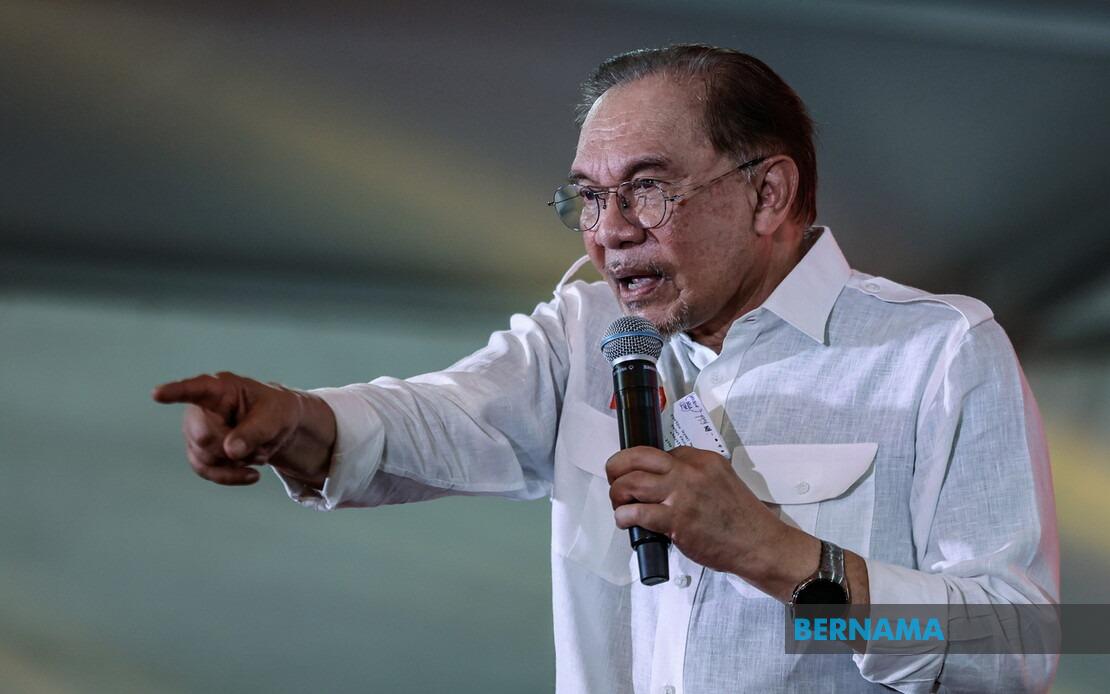
Prime Minister Datuk Seri Anwar Ibrahim has publicly rebuked Kedah Menteri Besar Datuk Seri Muhammad Sanusi Md Nor for what he characterised as unjustified political attacks, insisting that his government remains dedicated to advancing development across all states, including those governed by the opposition. Speaking at a Pakatan Harapan rally in Simpang Renggam during campaigning for the Johor state election, Anwar expressed dismay at Sanusi's continued criticism despite the federal government's substantial investments in the northern state.
The friction between the two leaders reflects broader tensions within Malaysia's federal system, where partisan politics frequently complicates resource allocation and infrastructure development. Anwar's remarks underscore the principal minister's determination to position his government as non-partisan in its development approach, a crucial messaging point as PH seeks to consolidate voter support ahead of state elections and build confidence among constituencies governed by different political coalitions.
Anwar specifically referenced an incident where Sanusi publicly criticised him while campaigning in Johor, yet declined to participate in federal government events held in Kedah. The Prime Minister highlighted his recent visit to the state with Thailand's Prime Minister Anutin Charnvirakul to officially open a newly constructed road alignment connecting the Bukit Kayu Hitam Immigration, Customs, Quarantine and Security (ICQS) Complex with Thailand's corresponding Sadao facility. This infrastructure project, deliberately chosen to be inaugurated in the border region rather than at federal headquarters in Kuala Lumpur, exemplifies the type of targeted development investment Anwar argues demonstrates genuine commitment to Kedah's economic advancement.
The road alignment project carries significant strategic importance for the northern corridor's economic trajectory. By streamlining cross-border logistics and facilitating smoother trade flows between Malaysia and Thailand, the infrastructure upgrade targets enhanced commercial activity in one of Southeast Asia's important trading corridors. For Kedah and neighbouring Perlis, such improvements carry potential to generate employment, attract investment, and stimulate tourism and business opportunities centred on border commerce. The decision to emphasise this achievement during the Thai Prime Minister's visit amplifies the development narrative Anwar wishes to project.
Anwar's insistence that his government does not discriminate against opposition-controlled states addresses a persistent criticism levelled against PH administrations since the 2018 general election. He articulated a philosophical position grounded in democratic principle rather than partisan calculation, arguing that his responsibility encompasses all Malaysians regardless of their state's political complexion. This stance matters considerably for Kedah, where the PAS-led state government has frequently clashed with federal authorities over policy and resource matters, creating friction that threatens to undermine effective governance and development coordination.
The Prime Minister's emphasis on financial prudence and leak prevention provides context for his capacity to expand welfare assistance if political conditions remain favourable. Anwar referenced plans to increase the Sumbangan Asas Rahmah (SARA) assistance programme contingent on sustained economic management and continued electoral support for PH. This conditional commitment suggests the government views welfare expansion as dependent on both fiscal discipline and political stability, a calculus that may influence voter behaviour in upcoming electoral contests.
Anwar's tour of Johor encompassed five separate campaign events supporting PH candidates and mobilising party machinery, illustrating the intensity of PH's electoral focus as the state election approached. This intensive campaigning pattern reflects the strategic importance Malaysia's political establishment attaches to state-level contests, which function as significant barometers of national political sentiment and influence factional dynamics within coalition governments.
Sanusi's earlier comments, which portrayed Anwar as excessively centralising governance and rendering states dependent on federal structures, touch on substantive constitutional questions about federalism and inter-governmental relations. The critique resonates within opposition circles and among those skeptical of increased federal authority, even as Anwar counters that federal resources represent legitimate tools for addressing national development inequities and advancing cross-state economic projects.
The public nature of this disagreement, conducted through media channels and campaign speeches, signals that tensions between the federal and Kedah governments remain unresolved beneath surface-level cooperation. While Anwar frames his approach as inclusive and development-focused, the Menteri Besar's attacks suggest fundamental political mistrust persists, potentially complicating future collaborative efforts on joint projects requiring coordinated state-federal action.
For Malaysian observers and particularly for constituencies in northern states, this dispute highlights the continuing salience of partisan considerations in infrastructure allocation and development planning. Although both leaders articulate commitments to non-partisan governance, the underlying political competition for electoral advantage and policy influence remains evident. The outcomes of state elections and subsequent patterns of resource distribution will ultimately determine whether Anwar's assertions about equitable federal support ring credible to electorates across Malaysia's politically diverse landscape.

