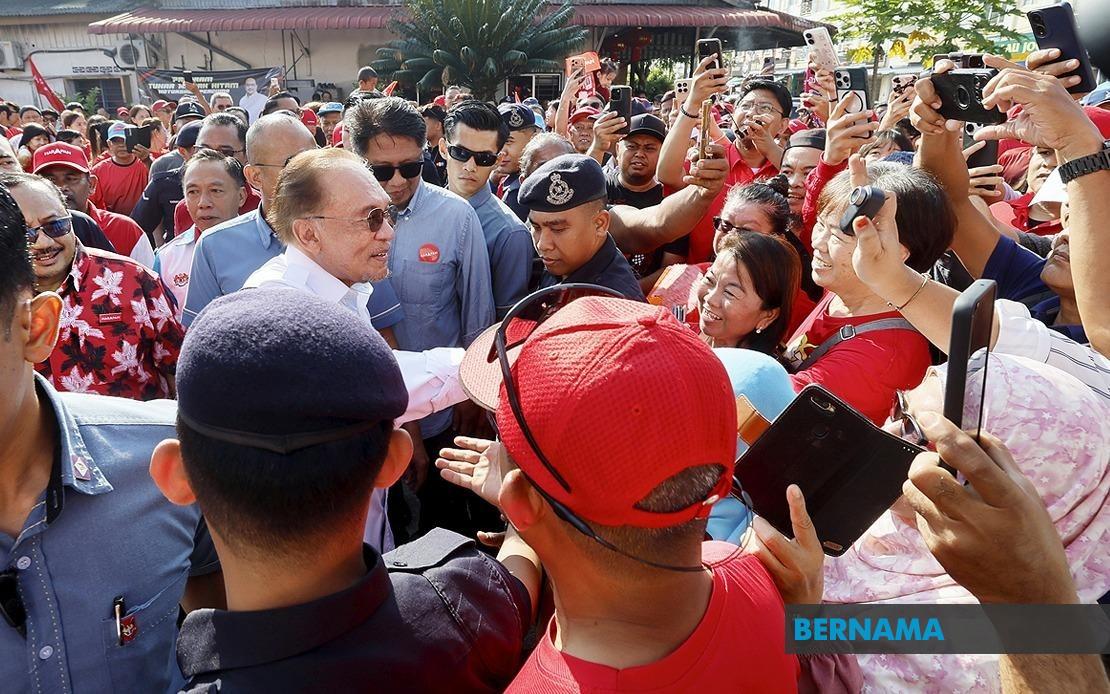
Prime Minister Datuk Seri Anwar Ibrahim has moved to counter perceptions of partisan governance by declaring that his Federal Government extends development assistance and welfare initiatives across the country regardless of whether states are governed by ruling coalition allies or opposition parties. Speaking during a Johor state election campaign event in Senggarang on July 9, Anwar sought to differentiate his administration's approach from past practices where development funds were sometimes seen as conditional on political alignment.
The statement carries particular weight in the context of Malaysia's competitive multi-party landscape, where concerns about resource allocation along political lines have periodically surfaced during election cycles. By explicitly addressing the fairness question at a campaign gathering, Anwar appeared to be signalling to voters in contested states that support from the Federal Government would not depend on electoral outcomes. This messaging holds relevance for Malaysian readers given the country's history of centre-state tensions and the ongoing negotiation of power distribution across federal and state administrations.
Anwar, who also chairs the Pakatan Harapan coalition, grounded his assertion in concrete examples of nationwide projects. He highlighted the development of the Johor-Singapore Special Economic Zone, a major cross-border initiative designed to stimulate economic activity and investment in the southern region. This project represents the type of significant infrastructure commitment that shapes perceptions of Federal Government support, particularly in economically strategic areas where development announcements carry both practical and symbolic weight.
Beyond the Singapore-linked development corridor, the Prime Minister emphasised that his government had approved and allocated billions of ringgit specifically for flood mitigation infrastructure in Segamat and Muar, both Johor constituencies. These allocations underscore a broader commitment to addressing recurring natural disasters that disproportionately affect certain regions. Flooding remains a persistent challenge across Malaysia, and the willingness to direct substantial federal resources toward preventative infrastructure in particular states suggests an approach unconstrained by political considerations.
The inclusion of Kelantan and Kedah in Anwar's list of beneficiary states is strategically significant. Both states have periods of opposition or non-ruling coalition governance, making their mention particularly relevant to his assertion of non-partisan funding. By naming states outside the Peninsula's economic heartland and highlighting their inclusion in development programmes, the Prime Minister attempted to demonstrate that peripheral regions receive comparable attention and resources. This resonates with longstanding regional equity concerns within Malaysian federalism.
Anwar's characterisation of his government as one that does not merely make electoral promises reflects awareness of voter scepticism toward campaign rhetoric. He distinguished between genuine developmental commitment, demonstrated through implementation across electoral cycles, and the transactional approach where assistance materialises only during election season before receding once votes are counted. This framing implicitly critiques predecessors while attempting to establish his administration's credibility on the matter.
The campaign event itself featured several Pakatan Harapan candidates standing for state seats, including Onn Abu Bakar for Senggarang, Mohd Khuzzan Abu Bakar for Semerah, and Felicia Poh Rui Ling for Penggaram. Communications Minister Datuk Fahmi Fadzil, serving dual roles as Communications Minister and PH communications director, was also present, indicating the coalition's coordinated messaging strategy around themes of inclusive governance and equitable resource distribution.
The timing of these remarks during Johor's 16th state election campaign suggests that concerns about fairness in resource allocation remain electorally significant. Johor, as Malaysia's second-most populous state and an economically important region, represents crucial ground where perceptions about Federal Government support can influence voter behaviour. By proactively addressing the neutrality question in this context, Anwar sought to pre-empt opposition narratives that might characterise his administration as partial to certain states or parties.
For Malaysian readers, the broader implication concerns the functioning of federalism under a coalition government. The Prime Minister's emphasis on non-partisan development reflects an attempt to navigate the complexity of managing a diverse, multi-party federation where some state governments may be controlled by opposition parties. This arrangement creates inherent tensions around fund allocation and development priorities that require careful political management to maintain public confidence in institutional fairness.
The specific projects mentioned—special economic zones, flood mitigation infrastructure, and broad development initiatives—represent the tangible mechanisms through which Federal-state relationships are mediated in Malaysia. These are not merely symbolic gestures but investments that shape regional economic prospects and quality of life. The claim that such projects proceed without political filtering carries substantial implications for how federal resources are deployed across the country's diverse geography and political landscape.
Anwar's statement also reflects evolving expectations around political conduct in Malaysia. Increasingly, voters across the political spectrum appear to expect that fundamental services and development projects should transcend partisan considerations. The Prime Minister's explicit articulation of this principle, even while campaigning for coalition candidates, suggests recognition that governance legitimacy now depends partly on demonstrable commitment to impartial resource distribution.
Looking forward, maintaining consistency between these declared principles and actual implementation will be crucial for Anwar's government. Opposition parties will scrutinise development allocations to verify whether the commitment to non-partisan support holds under budgetary pressures and competing priorities. For Malaysian voters, the gap between campaign assurances and post-election reality often determines long-term trust in political leadership, making the Prime Minister's pledge on fairness a benchmark against which his administration will be measured.

