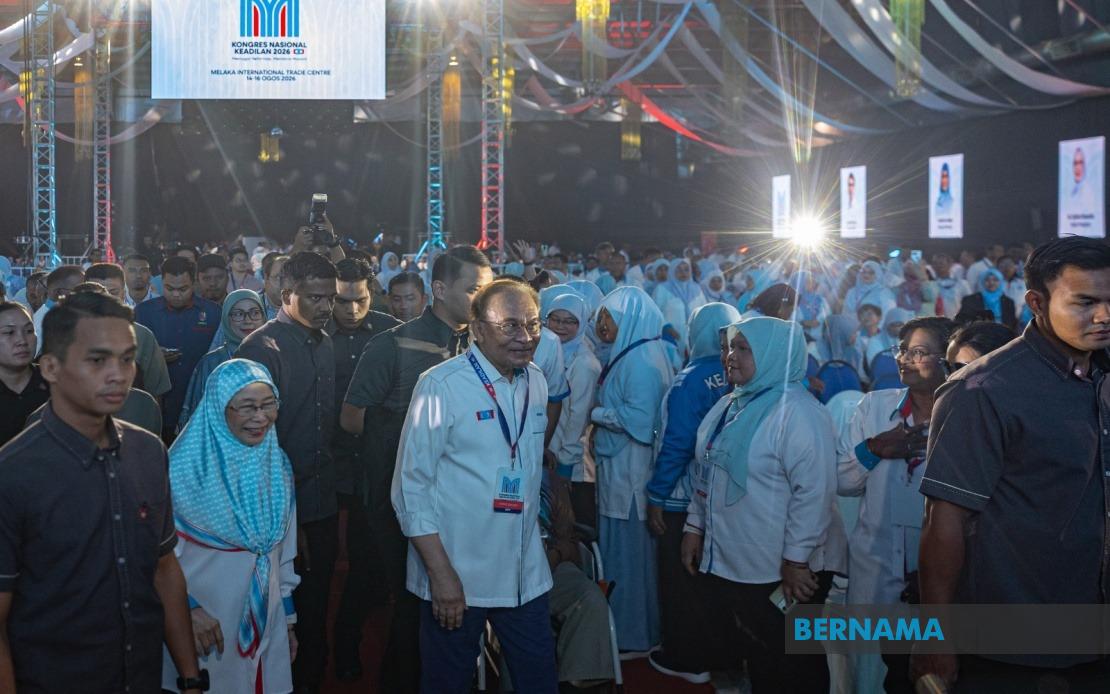
Prime Minister Datuk Seri Anwar Ibrahim has publicly reaffirmed his commitment to sustaining the federal-level alliance between the Unity Government and UMNO-Barisan Nasional (BN), signalling that pragmatic governance and broad-based cooperation remain central to his political philosophy. Speaking at the Parti Keadilan Rakyat (PKR) National Congress 2026 in Melaka on August 16, Anwar underscored that recent political developments have prompted questions about the stability of the coalition, but he chose to address those concerns by doubling down on the merits of continued partnership.
The Prime Minister's remarks come at a moment when Malaysia's political landscape has been marked by periodic tensions and speculation about the durability of the Unity Government framework. By explicitly stating his preference for cooperation with UMNO-BN, Anwar has sought to dampen speculation about potential fractures or realignments that might destabilise the federal administration. His emphasis on wisdom and careful deliberation suggests an effort to present himself as a statesman prioritising national interests over short-term political advantage, a posture that distinguishes his approach from more confrontational alternatives that periodically surface within coalition politics.
Central to Anwar's argument is the proposition that political decision-making must be divorced from personal ambition, factional loyalties, and emotional responses to setbacks. This framing addresses what has become a recurrent challenge in Malaysian politics: the tendency for coalitions to fracture when individual leaders feel sidelined or when party rivalries intensify. By elevating principles of collective prosperity and economic stability, Anwar attempts to establish a higher moral ground that transcends the zero-sum calculations that often characterise Malaysian political maneuvering. Such rhetoric, while not uncommon in public addresses, carries particular weight given his historical role as an opposition figure and his more recent pivot toward pragmatic coalition management.
The economic dimension of Anwar's message warrants careful examination, particularly for Malaysian observers concerned with the practical implications of political instability. A fractured or unstable government typically results in delayed policy implementation, investor uncertainty, and reduced capacity to execute long-term developmental projects. By anchoring his argument for coalition continuity in the promise of sustained economic growth, Anwar appeals to a cross-partisan constituency of business leaders, professionals, and ordinary citizens who prioritise material welfare over ideological purity. This approach has proven moderately effective in maintaining sufficient elite consensus to keep the Unity Government intact, even as individual parties navigate their own internal pressures.
For UMNO-BN, Anwar's public endorsement of continued cooperation carries strategic significance. The statement suggests that the Prime Minister, despite leading a coalition that includes parties historically positioned as reformist or anti-establishment, believes the benefits of working with Malaysia's traditionally dominant party outweigh the political costs of appearing to compromise PKR's ideological distinctiveness. This accommodation reflects the reality that no single coalition partner commands sufficient parliamentary strength to govern alone, making accommodation and power-sharing arrangements inevitable features of Malaysian federal politics in the current era.
The PKR National Congress provided an appropriate venue for these remarks, allowing Anwar to address his own party faithful while communicating to the broader political establishment. Party members, some of whom undoubtedly harbour reservations about cooperation with UMNO-BN given historical enmities and differing programmatic priorities, needed reassurance that their leader's coalition strategy was deliberate and principled rather than born of weakness. By framing stability and prosperity as universal goods that transcend party boundaries, Anwar sought to reconcile his party's reformist base with the necessities of coalition governance.
The timing of these remarks also reflects Malaysia's broader political calendar and the imperative to maintain stable administration in the lead-up to major policy initiatives and elections. Political uncertainty can stall government functioning at critical junctures, and Anwar's statement functions partly as a calming gesture to markets, civil service institutions, and international partners who benefit from predictable governance. This consideration becomes particularly acute in Southeast Asia, where political instability in major economies reverberates across the region's trade and investment networks.
However, Anwar's reaffirmation of coalition commitment does not entirely resolve the underlying structural tensions within the Unity Government framework. The coalition brings together parties with genuinely divergent platforms on issues ranging from religious policy to economic liberalisation to federalism. Personal rivalries between leaders remain unresolved, and competition for electoral advantage in state-level contests continues to generate friction. What Anwar's statement effectively does is establish the default position as one favouring continuity, placing the burden of proof on those advocating for coalition disruption to justify why instability would serve national interests.
For Malaysia's opposition parties and their supporters, Anwar's embrace of UMNO-BN cooperation represents a significant departure from the reform narrative that animated his earlier career. Whether this pragmatic accommodation represents political maturation or a betrayal of earlier principles depends significantly on one's ideological vantage point. What remains clear is that Anwar has determined that inclusive governance, even if imperfect and sometimes frustrating, serves his administration's capacity to maintain stability more effectively than pursuing a narrower partisan agenda.
The broader implications for Southeast Asian politics are worth noting. Malaysia's experience with diverse coalition governments under conditions of democratic competition offers lessons for neighbouring countries navigating similar challenges of managing plurality and preserving stability. Anwar's articulation of prioritising prosperity over personality-driven politics strikes a chord in a region where political drama frequently overshadows substantive policy discussion. Whether the Unity Government can sustain this cooperative framework over multiple electoral cycles remains an open question, but for the present, Anwar has clearly signalled his determination to prove that pragmatism and principle need not be mutually exclusive.

