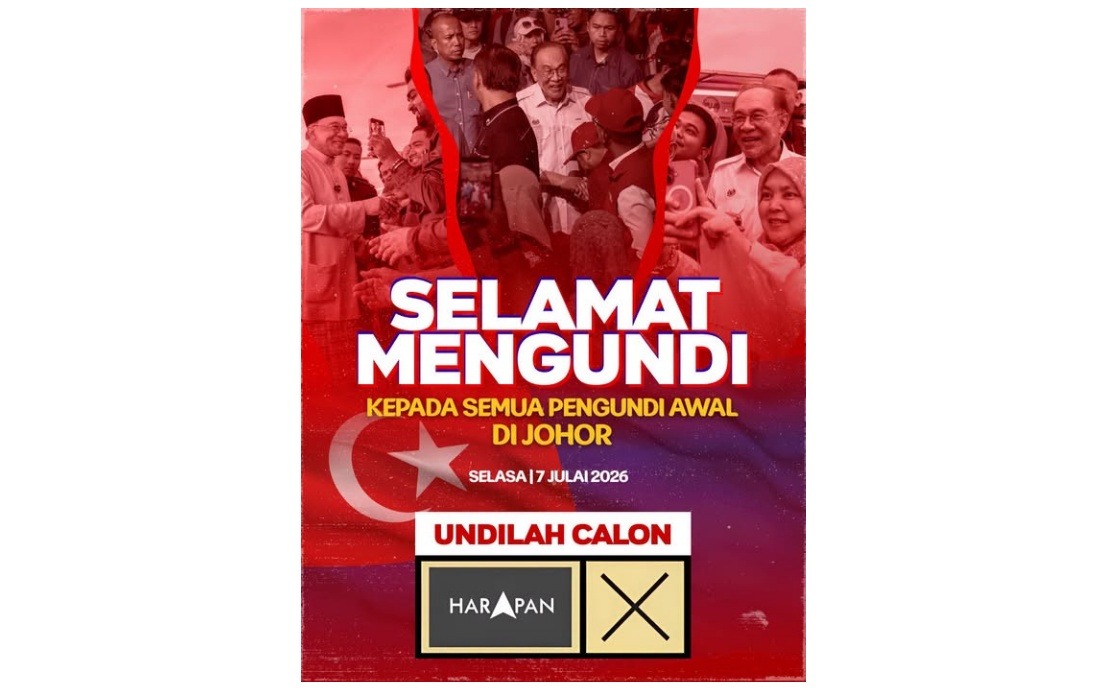
Prime Minister Datuk Seri Anwar Ibrahim has weighed in on the 16th Johor state election, using his social media platform to encourage more than 24,000 early voters who cast ballots across the state on Sunday. Speaking through Facebook, the Pakatan Harapan chairman expressed confidence that eligible voters would make decisions beneficial to Johor's trajectory, while explicitly urging supporters to back coalition candidates at the polls.
The early voting phase saw 24,751 registered voters participate through 64 designated polling centres throughout Johor, a process that commenced simultaneously across the state at 8 am on Sunday morning. These early voters comprised primarily personnel from Malaysia's security apparatus—specifically 12,041 members of the Malaysian Armed Forces and their family members, alongside 12,710 from the Royal Malaysia Police and General Operations Force together with their spouses. The staggered closing times at polling centres, ranging from noon to 6 pm depending on location and voter registration numbers, reflected the logistical complexities of accommodating military and police schedules.
The mechanics of early voting involved 53 dedicated polling centres established for police-affiliated voters, with an additional 11 facilities designated for military personnel and their families. This bifurcation underscores how Malaysia's electoral framework creates separate voting pathways for security forces, a system that both streamlines participation for these cohorts and acknowledges their operational commitments that might otherwise conflict with standard election day voting.
Pakatan Harapan's approach to this election reflects broader coalition dynamics in Malaysia's political landscape. The three-party coalition has distributed candidacies strategically across Johor's 56 contested seats, with PKR fielding 20 candidates, Amanah 19, and DAP 17 respectively. This allocation demonstrates how Malaysia's ruling coalition balances representation among its constituent parties while maintaining overall competitive strength in a crucial state election.
The broader Johor election context involves substantially higher competition intensity than the early voting phase suggests. A total of 172 candidates from various parties are competing across all constituencies, while approximately 2.7 million registered voters prepare for the main polling day scheduled for Saturday. This scale of candidate participation indicates a fragmented political environment where multiple parties across the political spectrum are contesting for influence in Johor, the nation's southernmost state and home to significant economic activity.
Anwar's public messaging to early voters carries particular significance given his role as both Prime Minister and PH chairman. His appeal directly to military and police voters—constituencies with traditionally structured voting patterns and strong institutional discipline—suggests coalition recognition of security personnel as a potentially decisive demographic bloc. The targeting of this audience through explicit campaign messaging reflects sophisticated understanding that early voters, drawn disproportionately from these disciplined organisations, may substantially influence overall electoral outcomes.
The Johor state election represents an important mid-term assessment of Pakatan Harapan's standing since assuming federal government in late 2022. State elections offer voters opportunity to register approval or disapproval of the ruling coalition's governance record without directly affecting federal leadership, creating a distinctive political environment where voters sometimes utilise state ballots to send messages about overall government performance. For Anwar's coalition, retaining strong performance in Johor—a state they currently control—remains strategically vital.
Malaysia's system of advance voting specifically for military and police personnel reflects constitutional provisions acknowledging these groups' operational requirements and the principle that their service to the nation should not compromise democratic participation rights. By enabling organised early voting, the electoral system removes practical obstacles that might otherwise suppress turnout among this critical constituency. However, the existence of separate voting processes for security forces also creates distinct voting blocs whose preferences may diverge from general population voting patterns.
The immediate significance of Sunday's early voting will only become apparent once full election day results emerge on Saturday evening. Early voting trends frequently offer exit-poll-style indicators of broader electoral sentiment, though security personnel voting patterns may not precisely mirror overall voter preferences. Observers will scrutinise whether Pakatan Harapan's early voting performance aligns with or diverges from its expected performance among general voters, with variations potentially indicating constituency-specific dynamics or demographic shifts.
For Malaysian political analysts and regional observers, this Johor election cycle demonstrates continued competition intensity within the PH coalition and broader questions about voter satisfaction with the federal government's performance. Anwar's personal appeal to early voters, rather than delegating campaign communication to subordinate coalition figures, underscores the election's perceived importance to his administration. The Prime Minister's willingness to campaign directly in Johor, even through digital channels, signals both confidence and recognition that coalition performance here carries implications beyond the state level for overall government legitimacy and mandate.

